


Just in time for the long, hot days of midsummer, botanical gardens across the United States are extending their hours and unveiling new art installations, light shows and educational displays to help city dwellers find a little shade and get a dose of nature.
Here are some of our favorite botanical gardens in six U.S. cities. Each of these gardens is largely accessible for strollers and people using wheelchairs, though steep or rocky terrain in some areas may limit access. Be sure to check ticket options carefully — many gardens offer discounts for students, seniors, locals and other categories of visitors.
Portland, Ore.
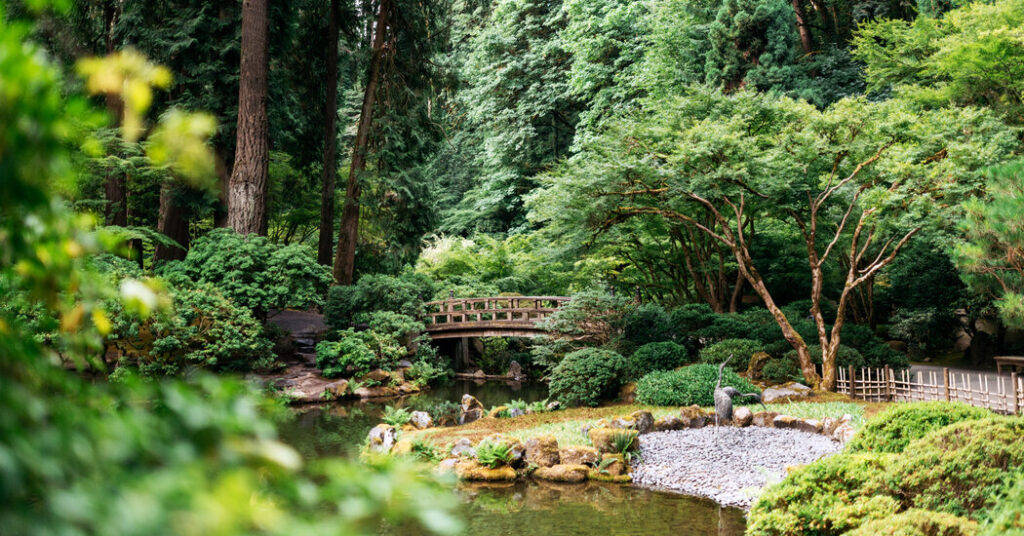
Portland Japanese Garden
Portland may be known as the City of Roses, but its lush and immaculately landscaped Japanese Garden gives that nickname a run for the money (adults, $22.50). Explore bonsai, bridges, ponds and pagodas at the 12.5-acre garden, which overlooks the city from a hillside perch west of downtown. Check out the garden’s iris tracker to see when those purple and white beauties are blooming (usually late June). The Flat Garden and Sand and Stone Garden, both examples of the karesansui — or dry landscape — style, pair neatly raked stones and pebbles with manicured shrubbery, trees and other plants.
Sip a cup of tea and have a sweet treat at the cafe. On a clear day, visitors can take in stunning views of Mount Hood, Oregon’s highest peak, 50 miles east.
And in case you find yourself still dreaming of roses, the free International Rose Test Garden, next door, is home to more than 10,000 rose bushes that bloom between May and October.
Miami
The Kampong
One of five National Tropical Botanical Gardens in the United States (the other four are in Hawaii), the Kampong ($17) brims with orchids, fruit trees and mangroves along the edge of Biscayne Bay in Miami’s Coconut Grove neighborhood. Peacocks roam through the garden, their striking plumage often on display.
This eight-acre jewel box of a garden was created by the famed botanist David Fairchild, who named it after villages he encountered in Malaysia. Dr. Fairchild is credited with introducing thousands of crops, including kale, mangoes, avocados and soybeans, to U.S. farmers in the late 19th and early 20th centuries.
The garden periodically offers group activities like all-levels yoga and embroidery classes among the trees for an additional fee.
St. Louis
Missouri Botanical Garden
The Missouri Botanical Garden brings plants and gardening traditions from places as far afield as Bavaria, Japan and the Ottoman Empire to a 79-acre oasis in St. Louis ($16 for nonresidents). But its centerpiece is the 65-year-old Climatron, a 70-foot-tall geodesic dome that houses 1,400 tropical plant species. Among them is the double coconut, the world’s largest known species of seed — specimens can weigh more than 50 pounds and be more than a foot long.
The dome is hot and humid, but you’ll quickly dry off at the nearby Shoenberg Arid House, which displays cactuses and succulents. The garden hosts free outdoor concerts on Wednesday evenings through the end of July. “Patterns in Nature: LightForm,” an illuminated exhibition showcasing naturally occurring geometries, is on view Thursday to Saturday evenings through Aug. 29.
Austin, Texas
Lady Bird Johnson Wildflower Center
As the official state botanical garden and arboretum of Texas, the 284-acre Lady Bird Johnson Wildflower Center, in Austin, features nearly 900 species of native plants ($15 Monday to Thursday, $18 Friday to Sunday). Meandering paths bring visitors through separate gardens planted with Hill Country and West Texas flora. Many of the more than 50 species of oak trees native to Texas — the most of any state — are on display in a 16-acre arboretum, too.
The Wildflower Center, part of the University of Texas at Austin College of Natural Sciences, is also a hub for research. Its Hill Country Trails area is a testing ground for prescribed burns and mowing practices that can help support native plant growth.
For those who need a break from the Texas heat, the garden is hosting “Ice Age in the Wild,” an exhibition showcasing the era’s giant mammals, including a 17,500-pound woolly mammoth, through Aug. 15.
Phoenix
Desert Botanical Garden
The sun-baked Desert Botanical Garden, in Phoenix, is home to towering saguaro cactuses and delicate wildflowers hailing from a wide array of desert habitats ($19 online). The garden’s extended summertime hours — 6 a.m. to 10 p.m. through the end of September — offer a welcome respite from the often dangerous midday heat. The garden hosts 7 a.m. yoga classes on Wednesdays ($20) and a light show nightly after 6 p.m. (included with admission).
Watch for butterflies, hummingbirds and other desert wildlife along the garden’s nature trails, which close from 1 to 5 p.m. in July and August, when temperatures regularly exceed 100 degrees.
New York City
New York Botanical Garden and Brooklyn Botanic Garden
Stroll through wetlands and gaze up at towering conifers right in the middle of the Bronx at the New York Botanical Garden ($35 weekdays, $39 on weekends), a sprawling 250-acre complex of thousands of plant species and dozens of distinct gardens showcasing greenery from around the world. “Flower Power,” a 1960s-themed exhibition exploring “the enduring symbolism of flowers as icons of peace and love,” is on view through Oct. 18 and included with admission. The garden is famous for its annual orchid show, an extravaganza that usually runs from February to April.
Just a subway ride across the city, the 52-acre Brooklyn Botanic Garden ($22 at the gate) punches above its weight, showcasing roses, lilacs and other flowers, fruit trees, and a water garden. Smelling and touching the flowers is encouraged at the Fragrance Garden, which was designed to help people with visual impairments experience the vegetation but is open to anyone. Don’t miss the Japanese Hill-and-Pond Garden, built in 1915, and its carp-filled pond.