



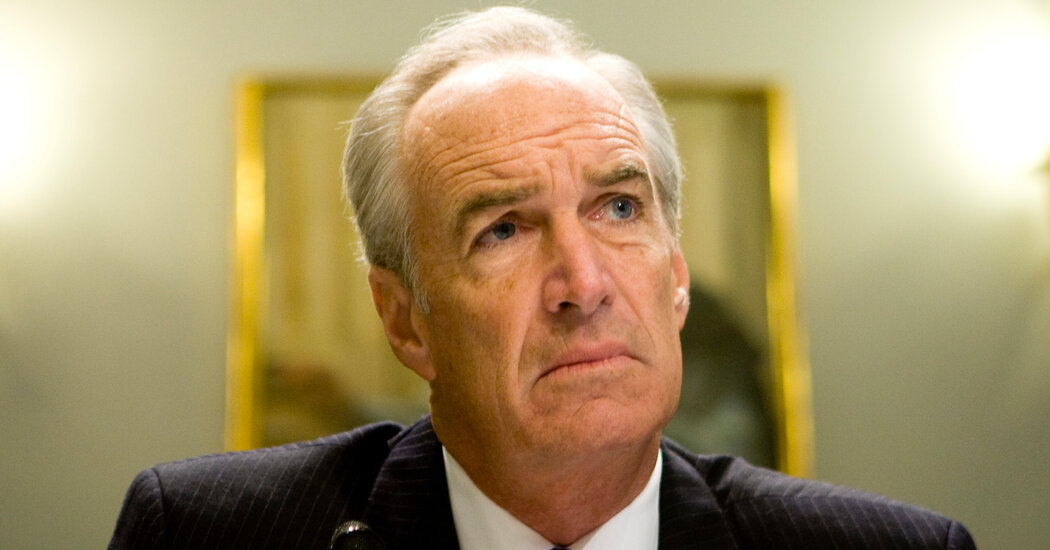
Dirk Kempthorne, the personable former governor of Idaho who later served as President George W. Bush’s second interior secretary, died on Friday in Boise. He was 74.
His family confirmed his death in a statement, but did not specify a cause. He said last year that he was undergoing chemotherapy for colon cancer.
Mr. Kempthorne, a Republican, rose to political prominence as the mayor of Boise in the late 1980s and early ’90s, backing a plan for parkland along the Boise River that later cemented the city as a haven for cyclists, runners and pedestrians.
While he frequently cruised around Idaho in a recreational vehicle or on his motorcycle, and was “an ardent user of the wide-open spaces himself,” Mr. Kempthorne was viewed as an interior secretary choice who prioritized compromise and the middle ground, The New York Times wrote in 2006. Environmentalists often criticized him as being overly friendly with the oil and gas industry.
Dirk Arthur Kempthorne was born on Oct. 29, 1951, in San Diego. He was raised in San Bernardino, Calif., and attended San Bernardino Valley College before transferring to and graduating from the University of Idaho. Before he became Boise’s mayor in 1985, he worked at the Idaho Department of Lands and the Idaho Home Builders Association.
In 1992, he was elected to the Senate, where he served for a single term. His votes often drew criticism from environmental activists, who said he frequently favored changing laws like the Endangered Species Act and the Safe Drinking Water Act to appeal more to commercial interests.
Idaho voters elected him governor in 1998, and he remained in office until 2006. His close association with Boise, the state’s largest city, sometimes put him at odds with the more rural-focused Idaho Legislature, but he became widely known as a personable leader with a strong understanding of environmental issues. He won re-election in 2002 by a 14-point margin.
He resigned in 2006 to become Mr. Bush’s interior secretary. After his nomination to lead the agency, Mr. Kempthorne told reporters that Mr. Bush had selected him because he was a consensus-builder, saying, “He wants me to find common ground.”
The Interior Department that Mr. Kempthorne inherited was entangled in several divisive issues, including Mr. Bush’s proposal to sell off large swaths of public land to increase education spending and reduce the federal deficit. Mr. Kempthorne’s predecessor in the role, Gale A. Norton, resigned after the agency became marred in a lobbying scandal over Native American gambling licenses.
Mr. Kempthorne opposed the administration’s plan to sell off public lands, but he pushed forward with efforts to open some public lands to oil and gas exploration and curtail protections for endangered species.
In 2008, he placed the polar bear under the protection of the Endangered Species Act, but said it would be “wholly inappropriate” for environmentalists to use the designation as a tool to reduce greenhouse gases, The Times reported. The State of Alaska sued Mr. Kempthorne over the decision in 2008, claiming that the classification would hinder the state’s offshore oil and gas development.
Mr. Kempthorne is survived by his wife, Patricia; two children, Jeff and Heather; and several grandchildren.

