



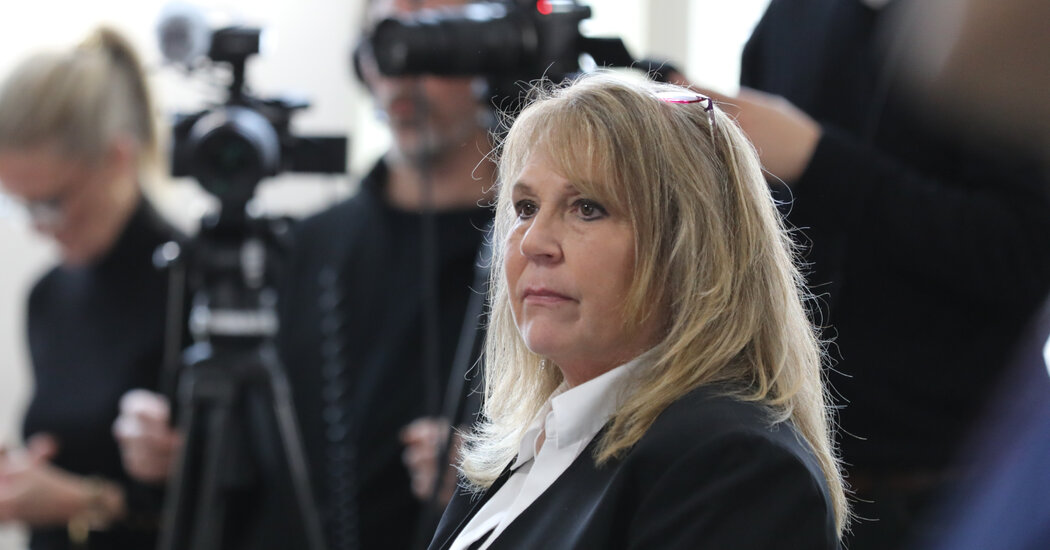
Just an hour after Alex Murdaugh was convicted of murdering his wife and one of his sons, the court clerk who had read the verdicts to the world was standing on the courthouse balcony with her dog, beaming as the South Carolina attorney general singled her out for praise.
“I call her Becky-Boo, that’s her nickname,” said Alan Wilson, the attorney general, whose office led the prosecution, calling up to her from his news conference.
Three years later, the court clerk, Becky Hill, was singled out by South Carolina’s top court as it tossed out the conviction of Mr. Murdaugh, the scion of a family of lawyers in a rural corner of the state.
Calling it “shocking jury interference,” the South Carolina Supreme Court laid out in a unanimous opinion on Wednesday how Ms. Hill had told jurors not to let Mr. Murdaugh’s arguments “convince you,” and how she had wanted a guilty verdict because she believed it would help her sell more copies of a book about the trial — maybe even enough to buy a lake house. The justices quoted a lower-court ruling that found that Ms. Hill had been “attracted by the siren call of celebrity.”
Indeed, the Murdaugh trial had drawn huge attention, riveting an international audience and putting the small towns of South Carolina’s Lowcountry region and their longstanding structures of power and clout under a spotlight. As the sudden reversal sank in on Wednesday, residents reeled at the prospect of another trial, another airing of painful events, another turn in the spotlight for the region.
The reversal of Mr. Murdaugh’s conviction was in some ways a “huge irony” that undercut the legend of the Murdaugh family’s influence, said Joe McCulloch, a lawyer in Columbia, the state capital.
“Everybody in the community, coming into this trial, believed that this jury was going to be fixed,” Mr. McCulloch said. But they thought it would be fixed in favor of Mr. Murdaugh, he said, not against him.
At Hurricanes Sports Cafe in Hampton, S.C., the town where Mr. Murdaugh’s family built its legal dynasty, the restaurant’s father-son owners said the court’s decision was surprising.
“How are they going to find a jury that’s not biased?” said Rodney Jarrel, the father, who knew Mr. Murdaugh when the two were growing up in Hampton.
The son, Austin, recalled the trial’s circuslike atmosphere, with food trucks crowding around the courthouse in Walterboro, a 40-minute drive away.
“It was crazy,” he said.
Others residents appeared to be tired of the case. Several declined to discuss it.
While Mr. Murdaugh will be tried again, he remains in prison on decades-long state and federal sentences for financial crimes. He pleaded guilty to those charges but has always maintained that he did not kill his wife or son. Attorney General Wilson, who is now running in the Republican primary for governor, said he intended to quickly retry the murder case.
At Ms. Hill’s home on Wednesday shortly after the court’s opinion was released, a man declined to open the door and said from behind it that Ms. Hill did not want to comment. A lawyer who has represented her has not responded to requests for comment.
Ms. Hill, now in her late 50s, was elected the Colleton County clerk of court in 2020. When Mr. Murdaugh went on trial in January 2023 — accused of killing his wife, Maggie, 52, and their younger son, Paul, 22 — it was Ms. Hill who managed jury logistics and responded to inquiries from reporters.
After Mr. Murdaugh was found guilty, Ms. Hill made no secret of her views. She wrote on social media that she was the chief prosecutor’s “biggest fan in Colleton County,” and wrote in her book that she had been worried Mr. Murdaugh would be wrongly acquitted.
Six months after the verdict, Mr. Murdaugh’s lawyers filed a motion for a new trial, accusing Ms. Hill of having tampered with the jury. Not long after that, her co-author discovered that Ms. Hill’s preface contained passages that were similar to those in a BBC article. Ms. Hill, through her lawyers, apologized for the plagiarism and said they would stop selling more copies.
She became the subject of multiple ethics complaints, including allegations that she had allowed a photographer special access, such as the opportunity to take a picture of Mr. Murdaugh in a holding cell; that she had misused thousands of dollars in county money; and that she had given herself bonuses from federal funds intended to improve the collection of child support, according to news reports. She resigned from office in March 2024.
In May 2025, she was arrested. She pleaded guilty to obstruction of justice and perjury, related to her allowing reporters to view sealed trial exhibits and then lying about it; and to two counts of misconduct in office, including taking bonuses and using her office to promote the book.
During Mr. Murdaugh’s appeal, a majority of jurors testified that they did not have any inappropriate communication with Ms. Hill during the trial. But several said that she had made brief comments about Mr. Murdaugh’s testimony, including a warning to “watch his body language” and not to be “fooled by” his defense.
That was enough for the South Carolina Supreme Court, which found that Ms. Hill had “placed her fingers on the scales of justice,” denying Mr. Murdaugh a right to a fair trial.
The court noted the title of Ms. Hill’s book, “Behind the Doors of Justice: The Murdaugh Murders,” and wrote that “as her book’s title suggests, it turns out Hill was quite busy behind the doors of justice, thwarting the integrity of the justice system she was sworn to protect and uphold.”
Blanca Turrubiate-Simpson, a former housekeeper for the Murdaugh family who had testified at trial, said that she respected the top court’s decision but that the possibility of a retrial also opened up painful wounds.
“People had already moved on in the community,” she said. But now, “It’s reliving everything.”
A new trial for Mr. Murdaugh would be long, costly and doubtless bring hordes of journalists back to the normally quiet Lowcountry.
“It certainly will sell papers. It will certainly sell more books. It’ll certainly have people like me giving interviews,” said Mr. McCulloch, the lawyer, who is himself at work on a screenplay based on the case. “But does it really serve the public interest?”
Caitlin Philippo and Christina Morales contributed reporting. Kirsten Noyes contributed research.

