



The Trump administration is scrapping more than three dozen firearms regulations, abandoning a crackdown on illegal sales, restoring gun rights to some people with mental illness and loosening oversight of private weapons transactions.
The drastic retrenchment at the Bureau of Alcohol, Tobacco, Firearms and Explosives, the federal agency responsible for enforcing the nation’s gun laws, was not entirely unexpected: President Trump campaigned as a champion of gun rights.
In the view of critics and even some A.T.F. veterans, the agency, in closely mirroring the demands made by gun owners and manufacturers to lighten their regulatory burden, is enacting changes at the expense of public safety. The moves, they worry, come as the bureau has already been weakened, with hundreds of its officials diverted to immigration enforcement.
Proponents of the changes point out that some of the reversals would return regulations to what they were only a few years ago, before President Joseph R. Biden took office. After a series of deadly mass shootings, Mr. Biden signed into law gun control measures, ending nearly three decades of gridlock over whether and how to regulate firearms.
The divisiveness illustrates the complicated landscape for gun policy.
“With the Biden regulations that we got and put in place, we advanced the ball,” said Kris Brown, the president of the Brady Campaign to Prevent Gun Violence, one of the country’s biggest gun control organizations.
But the Trump administration’s approach “takes us back 100 years,” she said. “It’s really decimating A.T.F.’s ability to regulate this industry.”
A White House official said the administration’s policies reflected Mr. Trump’s commitment to ensuring that Americans could exercise their Second Amendment rights, accusing the Biden administration of bypassing Congress and using the regulatory process to restrict gun rights.
Mark Oliva, a spokesman for the National Shooting Sports Foundation, the firearms industry’s trade association, said the changes were meant to clarify gun regulations.
“We want clarity to know how we’re going to be able to conduct business,” he said, “to be able to produce and to be able to sell firearms in accordance with the laws and regulations that govern our industry.”
Already, the administration has done away with major policies, including a zero-tolerance approach toward gun dealers who repeatedly broke the law. The more than three dozen rules that it has moved to eliminate would raise the legal threshold for revoking a dealer’s license; extend gun rights to buyers who had faced restrictions because of mental illness or inability to manage their own finances; and end extra scrutiny of stabilizing braces, gun accessories that have been used in mass shootings to lethal effect.
The administration is now targeting gun regulations that Democrats have passed at the state and local levels. It has challenged bans on semiautomatic rifles in Colorado, the District of Columbia and Virginia. On Wednesday, it sued California for its restrictions on the sale of Glock and Glock-style handguns, and Virginia for limits on the sale of semiautomatic rifles, hours after both laws went into effect.
Since his first run for office, Mr. Trump has positioned himself as an ardent supporter of gun rights. In the run-up to the 2024 election, he vowed to be “the best friend gun owners have ever had in the White House.” Days after being inaugurated, he signed an executive order instructing the attorney general to scrutinize what he described as “ongoing infringements of the Second Amendment rights of our citizens.”
By May 2025, the A.T.F. had overturned its “zero-tolerance” policy, which had empowered its inspectors to revoke the licenses of federal gun dealers who were known to have broken the law. Pam Bondi, then the attorney general, said it had “unfairly targeted law-abiding gun owners and created an undue burden.” The policy increased the chances that dealers who had falsified business records, skipped background checks or otherwise sold guns to people prohibited from owning them would face consequences. The agency ultimately revoked more than 600 licenses. But critics say that the new standards seriously curb the agency’s ability to do so.
It is a part of a broader bid across government to enact changes in line with the president’s directive. The Veterans Affairs Department in February removed the requirement that veterans who require a fiduciary to manage their benefits be prohibited from buying firearms, and veterans who were previously reported to the F.B.I. were being removed from its list. The Health and Human Services Department slashed funding for research into gun violence prevention. The U.S. Postal Service has proposed allowing people to ship handguns in the mail, upending a nearly century-old law.
In realigning the Justice Department’s priorities to bolster Mr. Trump’s agenda, the agency said in December that it would balance defending the right to own a gun with ensuring the public’s safety.
But when the A.T.F. announced in April nearly three dozen changes, the administration’s own analyses acknowledged the pitfalls to public safety.
The A.T.F.’s director, Rob Cekada, defended the agency’s approach. In a statement, he said that it reflected an effort to be as explicit as possible about “the full range of costs and benefits, including even remote scenarios.”
“This was an honest attempt to fully and transparently inform the public and is exactly the kind of analysis the comment period exists to test,” he said.
In unveiling more changes on Friday, including eliminating fingerprinting requirements for certain firearms applications, Mr. Cekada again asserted that the agency was committed to public safety, pointing to a news release that heralded how its shift in priorities had led to the seizure of nearly 50,000 firearms and the handling of nearly 950,000 gun trace requests. Still, the data is far from a complete picture because it does not reflect all the policies the Trump administration has rolled back and because many of its proposals have yet to go into effect.
Todd Blanche, the acting attorney general, in announcing the proposals in April, said that the moves struck a careful balance between the interests of the gun industry and gun owners, as well as public safety. “For too long, regulations were written without any real understanding of how firearms businesses operate, how lawful gun owners actually handle their firearms or what truly improves public safety,” he said.
One proposed change allowing more people with a history of mental illness to have a gun would mean that the public safety risk could range from minimal to considerably greater, “up to and including potential mass casualty events,” according to a cost analysis by the agency. For instance, people involuntarily committed to a mental health institution would still be barred from owning a gun, whereas those who voluntarily enter those facilities would not. The rule also seeks to extend the Veterans Affairs Department’s policy to ensure that all Americans unable to manage their financial affairs, not just veterans, are not automatically prohibited from buying a gun.
In the analysis of another proposal, seeking to undo a Biden-era rule intensifying scrutiny of the use of stabilizing braces, the agency acknowledged that the gun accessory to create “dangerous, easily concealed weapons would pose an increased public safety problem.”
The agency is also proposing a higher bar to revoke a federal gun dealer’s license, instead requiring evidence that the dealer knew that it was violating the law. The agency said in its analysis that it expected the number of federal firearms licenses it revoked to drop “considerably” both under the new rule and “shifting enforcement priorities.”
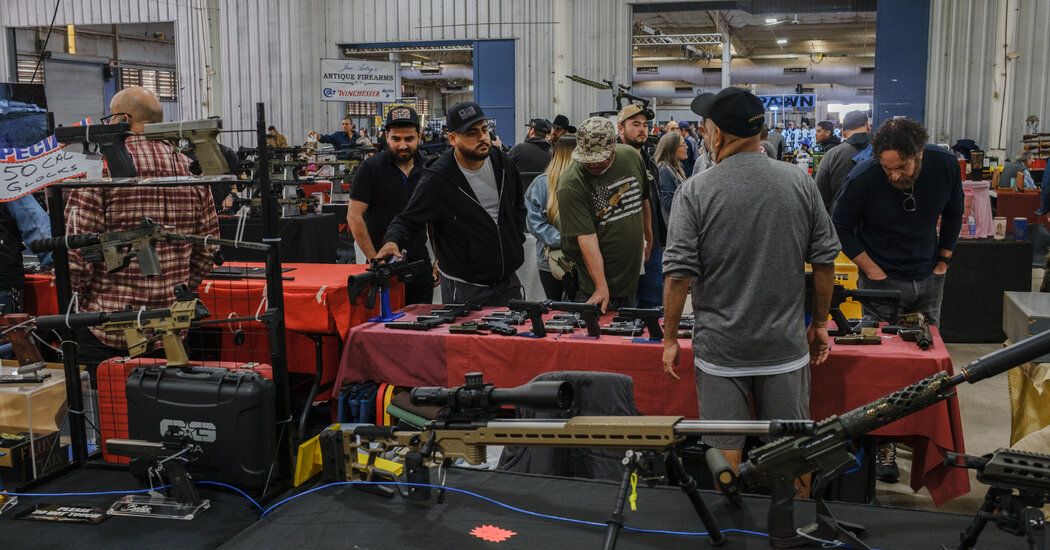
Another rule would end the so-called gun show loophole, which required background checks for gun shows and certain private sales as a way to crack down on straw purchasers, or people who illegally buy guns on behalf of another.
Critics warned of the potential consequences. The rapid changes under the Trump administration flew in the face of its vow to be tough on crime, they said, crediting the Biden-era measures for helping to bring down the murder rate after coronavirus pandemic highs, though experts have suggested that a number of factors could have contributed to the drop.
“These guns are going to start to percolate back out into the community over the next couple of years,” said Marianna Mitchem, a former A.T.F. official who now advises Everytown for Gun Safety, a nonprofit advocacy group founded by Michael R. Bloomberg, the former mayor of New York.
She added, “I sadly expect that we will see an increase in violent crime.”
Even as the proposals have yet to take effect, some supporters of gun rights are pushing for the regulations to be loosened even further.
Erich Pratt, the senior vice president of Gun Owners of America, one of the country’s largest gun advocacy groups, said it was not enough to simply revert to regulatory standards on the books before the Biden administration.
His group, for instance, opposes the Justice Department’s approach to a 2022 rule directing federal licensed gun dealers to hold on to records indefinitely, reducing the amount of time that gun dealers have to keep records of sales. It has argued that the administration should eliminate the requirement altogether.
“The A.T.F. proposals are a mixed bag,” he said, adding, “Gun owners would expect better from our Republican Justice Department.”

