



The expected announcement of a U.S. agreement with Saudi Arabia to develop a civilian nuclear program has raised Israeli concerns that it could lead to a regional arms race, and underscored how the U.S. is charting its own path in the region, independent of Israel.
The agreement, first reported on Tuesday, could enable Saudi Arabia to enrich its own fuel for nuclear reactors. It took many by surprise in Israel, which has a secretive nuclear weapons program, as well as a publicly acknowledged nuclear research reactor.
While Saudi Arabia has long lobbied for access to U.S. nuclear technology, the Biden administration had conditioned that in part on Riyadh agreeing to open diplomatic relations with Israel, one of Prime Minister Benjamin Netanyahu’s central goals.
Instead, President Trump is now forging a deal with Saudi Arabia that appears to sidestep Israel entirely. Analysts say it could also embolden other countries — like Turkey, which has been increasingly at odds with Israel — to develop their own nuclear enrichment programs.
Israeli opposition figures and former officials said it was the latest sign of how their country’s stature in Washington had eroded. Mr. Netanyahu lobbied Mr. Trump hard to launch a war together against Iran, which has been unpopular in the United States. Mr. Trump has called Mr. Netanyahu “crazy” for his aggressive pursuit of the related war in Lebanon against Iran’s ally, Hezbollah.
The president cut the Israeli leader out of talks with Iran to end the war that began in late February. He also persuaded Mr. Netanyahu to curb retaliation for a major Iranian attack last month, fearing it could derail peace talks.
The Trump administration is increasingly signaling that “they will move ahead, regardless of whether Israel’s red line clashes with their own,” said Avishay Ben Sasson-Gordis, an expert on U.S.-Israeli relations at the Institute for National Security Studies in Tel Aviv.
Mr. Netanyahu did not immediately comment on the U.S.-Saudi nuclear deal. At least one Israeli government minister sought to soothe public concern, arguing that the country could live with a Saudi nuclear program for civilian purposes.
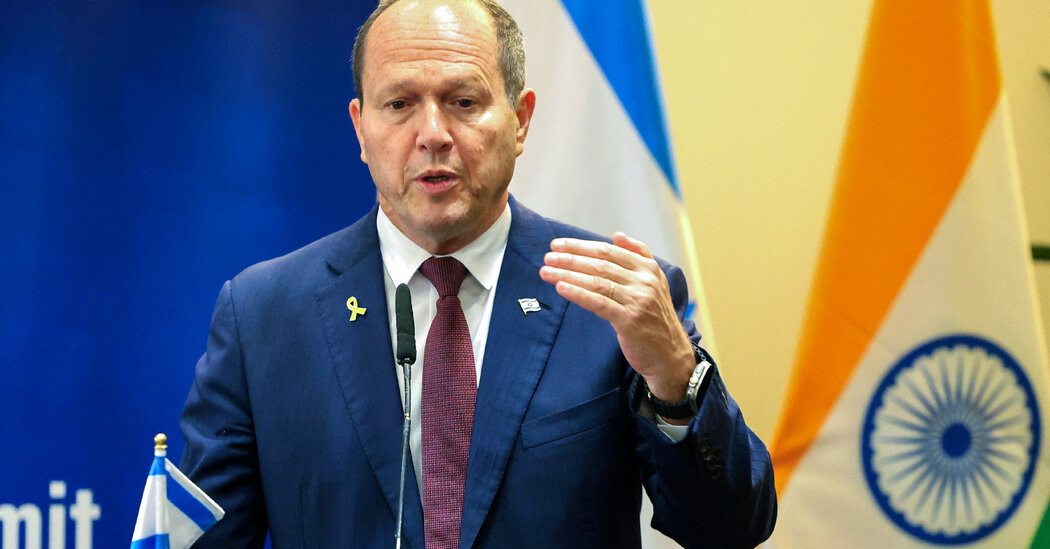
“If they want it for peaceful purposes, for energy needs, we can manage it,” said Nir Barkat, Israel’s minister of economy, the most senior government official to comment on the issue so far, in a radio interview on Wednesday.
He added that normalizing ties with Saudi Arabia was “still on the table,” and that Mr. Netanyahu and Mr. Trump would not make moves that would imperil Israel.
Israel has enjoyed a de facto monopoly on nuclear weapons in the region for years, although it has never publicly admitted owning a bomb. Iran, Israel’s archrival in the region, has a nuclear program that Israel and the U.S. have long viewed as a grave national security threat, paving the way for the ongoing war.
Israeli opposition leaders quickly denounced the expected U.S.-Saudi deal as a threat. Naftali Bennett, a former prime minister, said that “enriching nuclear material on Saudi territory could prompt a nuclear race in the region, leading to a total breakdown.”
“Every military nuclear program begins with a civilian one,” said Avigdor Liberman, a former Israeli defense minister, calling for Israel to lobby Congress to strike down the agreement .
A previous U.S. nuclear deal, with the United Arab Emirates, imposed tightened inspections and did not allow the Emiratis to enrich their own uranium, severely limiting their path to a bomb. The deal with Riyadh appears to be different, potentially allowing Saudi Arabia to enrich its own fuel, U.S. officials said.
For Israel, much depends on whether the agreement has safeguards that could prevent Saudi Arabia from using its nuclear capabilities for military purposes, said Michael Herzog, who served as Israel’s ambassador to Washington during the Biden administration.
At the time, Israeli officials discussed some restrictions on the Saudi nuclear program as part of a grand bargain on normalization, he added, without elaborating.
“The fact that it’s not tied to normalization, nor is it clear what guardrails are in place to prevent Saudi Arabia from breaking out to a military program — both of these are sources of concern in Israel,” said Mr. Herzog, now a fellow at the Washington Institute for Near East Policy.
As part of the nuclear deal envisioned by the Biden administration, the United States would have entered a formal defense treaty with Saudi Arabia. U.S. officials had also sought Israeli concessions to the Palestinians, albeit far short of an independent state, in return for normalization.
Those hopes receded after the Hamas-led attack on Israel on Oct. 7, 2023, and the subsequent war in Gaza. The political mood in Israel soured on granting any accommodations to the Palestinians, while the devastating Israeli campaign in Gaza prompted heavy criticism in Saudi Arabia.
“A nuclear deal with the U.S. was supposed to be one of the largest carrots” for Saudi Arabia to open ties with Israel, said Michael Koplow, a political analyst at the Israel Policy Forum, a research institute in New York. As Israel sees it, “now Trump has given it to them for free,” he said.
Heedo Abu Laban contributed reporting from Jerusalem.

