



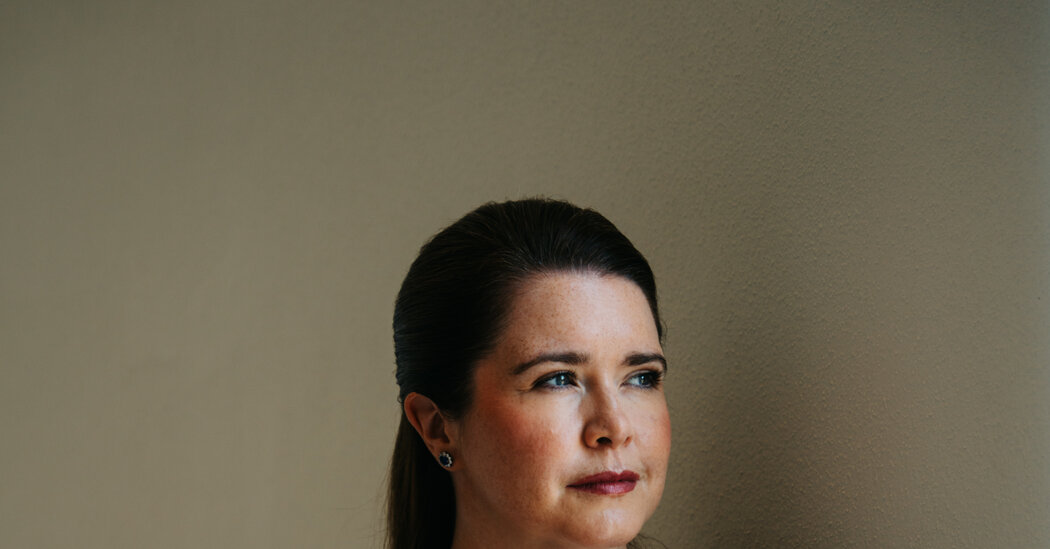
In her latest role, the soprano Tara Erraught took a cue from the hospitality industry.
As Madama Cortese in Rossini’s madcap comedy “Il viaggio a Reims,” which opened at the Salzburg Whitsun Festival in May and returned to the larger summer stage through last Sunday, she had to hold the fort as a spa owner where blue-blooded guests from all over the world found themselves trapped by a lack of horses to take them to the coronation of Charles X in Reims, France.
As it happens, the Irish native is the daughter of professional chefs. “I always thought our industries are the same,” she said in a video interview from the Grosses Festspielhaus, the Salzburg Festival’s main venue. “We work with the ingredients we have and give everything we can.”
Early in her career, she learned to stay grounded in the throes of what can be a challenging business. In 2014, critics from major British newspapers declared Erraught’s body type unsuited to the role of Octavian in Strauss’ “Der Rosenkavalier” at Glyndebourne Opera. Leading artists from Jessye Norman to Alice Coote rose to her defense, emphasizing that quality of singing, not physical appearance, should be decisive (she also received doughnuts backstage in a sign of solidarity).
Now an established figure on the international opera stage, Erraught has worked in recent years to support the next generation of singers. In 2020, she founded “Celebrating the Voice,” a professional development program that offers master classes, public lectures and performances, most recently at the National Concert Hall in Dublin. She served on the board of directors at Irish National Opera through 2025, a company that will celebrate its 10th anniversary in the 2027-28 season.
Onstage, Rossini and Mozart rank among her staple repertoire. Erraught, 40, who typically performs as a mezzo-soprano, has also ventured into less-known territory such as the songs of Alma Mahler, most known as the wife of the Austrian composer Gustav Mahler, but an artist in her own right, and an album exploring Giusto Ferdinando Tenducci, the Italian castrato, whose professional travels took him to Dublin in the 18th century.
The coming season includes the soprano part of Mahler’s Second Symphony with the National Symphony Orchestra Ireland as they commemorate 15 years after the attacks of Sept. 11. In February 2027, she will make her first appearance at Milan’s La Scala, as Donna Elvira in Mozart’s “Don Giovanni,” a role which she will return to at Paris National Opera in May. Erraught will sing her first concert without a conductor, in a program ranging from Handel to Lili Boulanger with the Irish Chamber Orchestra in March.
As she settles into her role as Madama Cortese, the singer spoke about the collaboration with director Barrie Kosky, the opera world in Ireland and more. The following interview has been lightly edited and condensed.
How is this Rossini role different than others you have sung?
As soon as I opened the score, I thought of the old TV show “Fawlty Towers.” Everything that can go wrong goes wrong! And I’m running this hotel.
It’s the first time I’ve been asked to do a pitter-patter section. That is usually left to the men. I had to spend four months every day, saying it faster every time. It became muscle memory because of the way Barrie rehearses. He’s a genius at reading the room and knowing what the artists need to do to facilitate his vision.
We ran it from the point of view of a busy lady who’s running a business. No matter how annoyed she gets, she knows that the customer’s always right. She is the only person in the show who’s expected to be empathetic to cultural differences from every end of Europe and beyond.
This is also your first time performing with Cecilia Bartoli, a veteran Rossini interpreter.
During college in Dublin, I worked as an usherette in the National Concert Hall. I saw her sing and was mesmerized.
She has been so kind and supportive my whole way up. She arrives at the first rehearsal with a ream of new ornaments and exciting things, yet when you speak to her in the corridor, she treats you like an equal, which is wild.
Barry, Cecilia and Maestro [Gianluca Capuano, the conductor] said that everybody was handpicked not just for their vocal abilities, but for how our characters would meld together. And the room was very open. You could offer anything musically or dramatically.
What advice do you give to young singers as they start their careers?
I think we have to ask them to step up and learn about the industry. Although we want the highest artistic level, the business since Covid is different.
It used to be that theaters booked three to five years in advance. Now some wait to see the results of the box office on a certain title. So we have to stay flexible repertoire-wise.
I started “Celebrating the Voice” because so many incredible singers had missed opportunities the rest of us would have had. Two summers ago, as artist in residence at the Glimmerglass Festival in upstate New York, I also decided to run talks and master classes.
My advice to most young singers was to come to Europe as quickly as possible and get a first job. At the Bavarian State Opera, I spent two years in the opera studio and 10 in the ensemble and made 49 role debuts.
It’s wonderful that you’re investing in education so early in your career.
What good is knowledge if you don’t share it? When I left Ireland, there was very little live opera. Now we have this incredible national company.
It is funny to say at the moment, but it’s an exciting time for opera in Ireland. I can’t explain how proud that makes you to bring what you’ve learned abroad home.
When you look back on the incident in 2014, how have things changed for women in the classical music industry?
It started a big conversation that I don’t think is a bad one. It was incredible in that time how other singers gathered and formed this hedge of protection.
My mom also came from Ireland and took away my phone and my laptop, which was a massive blessing.
I am so grateful to have a family that is grounded and sensible. Because it might have broken somebody else. You always try your very best, working with what you have on that given day.

