



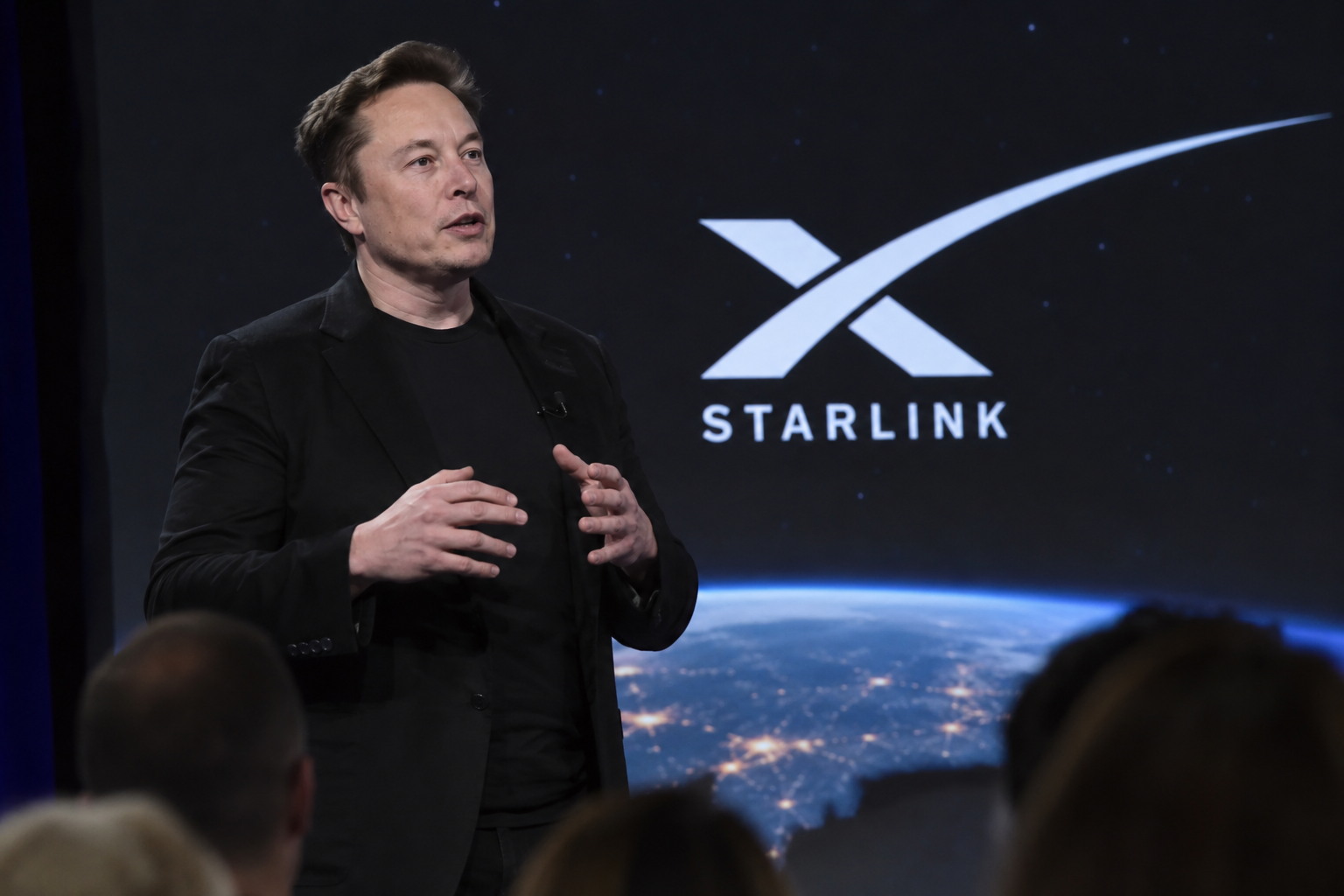
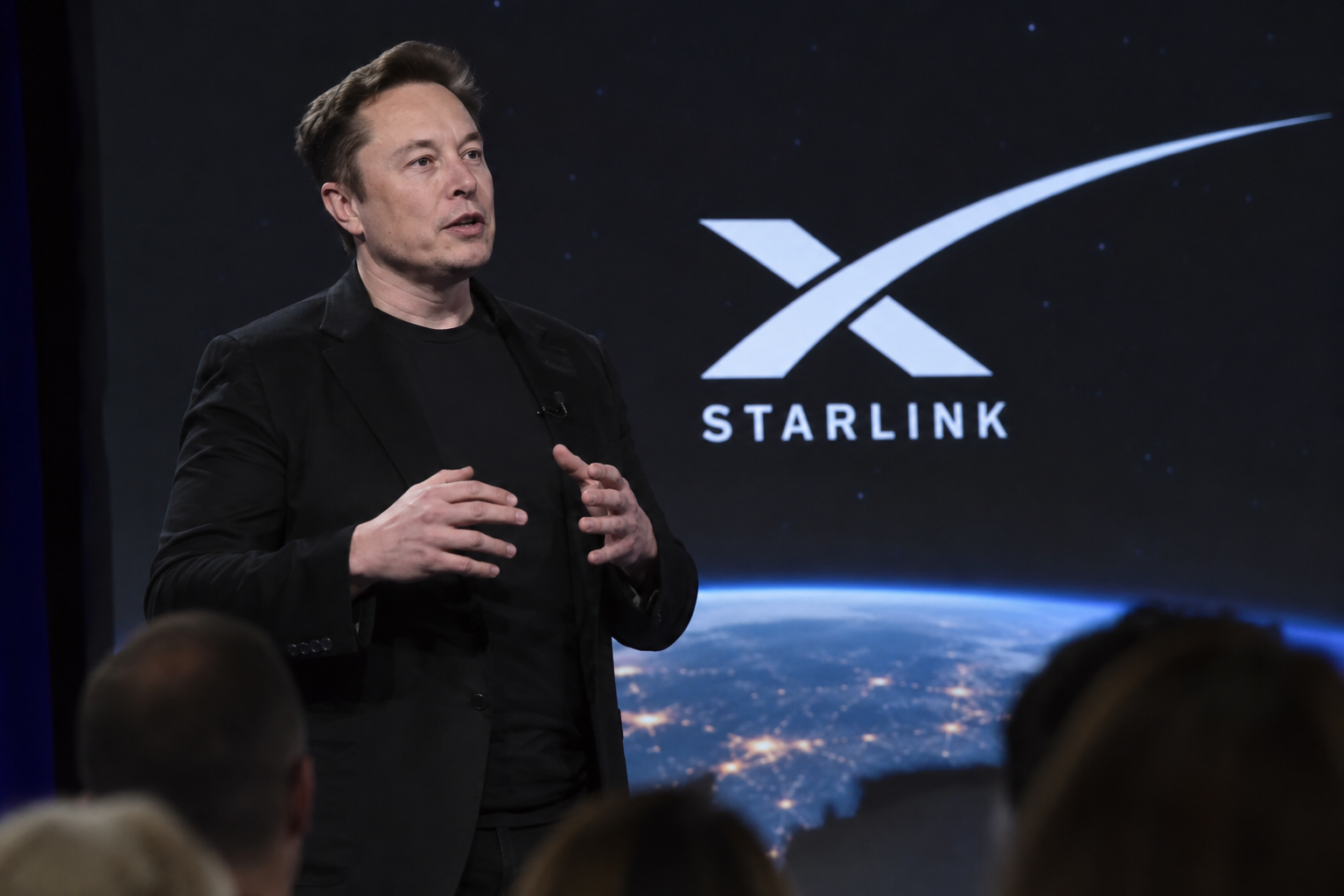
SpaceX chief Elon Musk’s years-long effort to bring its satellite internet service Starlink to India took a dramatic turn this week.
Musk, whose company competes with Ambani’s Reliance Jio and Eutelsat’s OneWeb in India’s satellite communications market, on Thursday took to X, the social media platform he owns, to challenge the delay in Starlink’s commercial launch.
„Starlink is licensed in over 165 countries and has spent five years complying with every single law and requirement of the government of India, so why still no license?
Is Ambani the real boss of India?“
The combative remarks came a day after Musk was more indirect in his attack against what he claims is obstructing his entry into the Indian market.
„Unfortunately, we are being blocked by certain oligarchs in order to maintain their monopolistic chokehold on the Indian people. You can guess who they are …
This is a crime against the people of India!“ he said on X on Wednesday.
The comments have brought the rivalry between two of the world’s wealthiest businessmen into the open again, placing renewed attention on India’s regulatory approach to satellite broadband and the commercial stakes involved in opening one of the world’s largest internet markets to Starlink.
Starlink received a licence to launch commercial operations in India last year, clearing a major regulatory hurdle for the satellite provider, which has been pursuing entry into the country since 2022.
It became the third company to receive India’s approval to provide satellite communications services, following clearances for Eutelsat’s OneWeb and Reliance Jio.
However, the licence did not automatically allow Starlink to begin commercial operations.
The company must still secure spectrum from the government, establish ground infrastructure and demonstrate through testing and trials that it complies with the security requirements it has agreed to meet.
India’s telecom ministry rejects Musk’s allegations
India’s ministry of communications was quick to respond to Musk’s criticism, rejecting suggestions that the regulatory framework was being applied unfairly or that Starlink was being treated differently from its domestic competitors.
The ministry said telecom licences had been granted to three providers of Global Mobile Personal Communication by Satellite services based on non-geosynchronous satellite orbit technology.
However, it said each licensee was required to demonstrate compliance with security conditions intended to ensure that its services met the necessary requirements for protecting users and their data.
„Security assessment as part of this process is currently under way in respect of all the three licensees. As and when this process is completed for a licensed entity, it may proceed to the next step of seeking assignment of spectrum. At present, all the three entities are at broadly the same regulatory stage. As such, the suggestion that the framework or its application is unfair or discriminatory is baseless and misconceived,“ the ministry said.
„Waiting for our own approvals“, say competitors
The dispute unfolded even as senior executives from Starlink, Reliance Jio and Bharti Airtel gathered at the India Mobile Congress in New Delhi, where the companies discussed their plans for satellite internet services.
Akash Ambani, chairman of Reliance Jio Infocomm and son of Mukesh Ambani, said the company was developing its own satellite communications technology and working towards securing regulatory approvals.
Asked by a reporter about Musk’s allegations, Akash declined to comment directly, saying only: „We want to be heads down and deliver value to our Indian consumers.“
Then, on the sidelines of the event, Sunil Mittal, chairman of Bharti Enterprises and the largest shareholder in the Eutelsat group, also said the company was waiting for the necessary approvals.
Eutelsat is the French satellite operator that merged with the UK’s OneWeb, which is backed by the Bharti group.
„We’re waiting for our own approvals,“ Mittal said, adding that the group’s satellite services would begin „hopefully soon“ in India.
Musk’s comments also came hours after Lauren Dreyer, Starlink’s vice president of business operations, appeared at the India Mobile Congress.
„We stand ready to serve India,“ Dreyer said, adding that Starlink wanted to help realise Prime Minister Narendra Modi’s goal of achieving universal connectivity across the country.
The seeds of the Musk-Ambani rivalry
The latest episode is only another chapter in the complicated relationship between Musk and Ambani, both of whom are eyeing to establish themselves as the go-to players in India’s satellite internet market.
The seeds of the rivalry were first sown when Musk sought entry into the Indian market and argued that satellite spectrum should be assigned administratively, in line with the approach followed in several other countries.
Reliance, meanwhile, argued that the spectrum should be auctioned to ensure a level playing field between satellite operators and traditional telecommunications companies.
Starlink lobbied the Indian government against an auction, arguing that satellite spectrum was a natural resource that should be shared among companies rather than allocated through a competitive bidding process.
An auction could impose geographical restrictions and increase costs, the company argued in letters made public by the Indian government, Reuters reported.
Musk said a decision by India to auction satellite broadband spectrum rather than allocate it administratively would be „unprecedented“.
In 2024, India’s government sided with Musk on the spectrum allocation question, deciding that satellite broadband spectrum would be assigned administratively rather than through an auction.
Musk welcomed the decision, saying on X: „We will do our best to serve the people of India with Starlink“.
There was also speculation among some observers that expediting Starlink’s entry could help India strengthen its trade relationship with the US administration.
Some Indian government officials were reported anonymously to have viewed faster approvals as potentially helpful in broader trade negotiations.
The timing of the current dispute also adds a diplomatic dimension, as New Delhi and Washington have struggled to finalise a trade deal after reaching a framework in February.
Then, last year, in a surprise move, Reliance Jio signed a deal with Musk’s SpaceX to bring Starlink satellite internet services to India.
Under the arrangement, India’s largest telecom operator would stock Starlink equipment in its retail stores, giving the satellite company access to thousands of outlets across the country.
Nevertheless, the latest exchange shows that disagreements over market access and regulatory treatment remain unresolved.
Why India needs satellite internet
India represents an important opportunity for Starlink because of its large internet-connected population and the persistent gaps in broadband infrastructure outside major urban centres.
The country had 1,065.88 million broadband internet subscribers at the end of March 2026, making it the world’s second-largest internet market by connected population, behind China.
Mobile wireless connections accounted for more than 94% of India’s internet subscriptions, reflecting the country’s reliance on mobile networks rather than fixed-line broadband.
„This means that India’s digital economy is ‚mobile-first,‘ with substantial gaps in wired broadband, especially in rural areas. In other words, as one moves away from major urban centers, the internet infrastructure for industrial applications remains underdeveloped. The reliability of wireless connections is patchy at best, and fixed broadband speeds are dismally low,“ wrote Trisha Ray, associate director and resident fellow at the Atlantic Council.
The government has attempted to address these shortcomings through BharatNet, an initiative housed under the public sector telecommunications company BSNL.
The project seeks to bridge the rural connectivity gap by building a National Optical Fibre Network connecting 625,000 villages.
By December 2024, around 692,000 kilometres of optical fibre cable had been laid as part of the undertaking.
However, the project has faced repeated delays, missing its 2014, 2015, 2019, 2023 and 2025 deadlines.
Launch delays, right-of-way issues, difficult terrain, pandemic-related disruptions and deterioration of some existing cables have contributed to the setbacks, Ray wrote.
Satellite internet offers a possible solution because it can provide connectivity from space without requiring fibre cables or mobile towers to reach every location.
The technology could be particularly valuable in remote villages, hilly regions, border areas and islands, where terrestrial networks can be difficult to establish or economically unviable.
Why India matters for Starlink
For Starlink, India offers an opportunity to expand its subscriber base in a market where demand for internet connectivity continues to grow.
It could also provide a test of whether the company’s business model can succeed in a large, price-sensitive developing economy.
India’s satellite services market is projected to grow by 36% annually to reach $1.9 billion by 2030.
A foothold in the country could potentially represent a $25 billion opportunity for Starlink, according to estimates and assessments cited by industry experts in earlier reporting by Reuters.
„Starlink securing the contract serves both as a strategic PR victory and a demonstration that it has successfully navigated challenges that seemed insurmountable for most other operators. From Starlink’s perspective, India is not only a credibility boost but also a crucial test of its economic feasibility in emerging markets,“ independent satellite communications specialist Davis Mathew Kuriakose told Reuters.
Starlink has already begun preparing for a possible launch.
Dreyer said at India Mobile Congress 2026 that the company had built 20 gateway sites in India and developed security controls specific to the country, including measures to keep Indian users‘ data within its borders.
Pricing will determine Starlink’s reach
India’s established telecom operators have extensive networks and offer broadband plans at prices that could prove difficult for Starlink to match.
According to six industry experts interviewed by Reuters in earlier reporting, three expected Starlink to offer competitive broadband packages potentially starting at $15 a month.
That would place the service relatively close to the roughly $12 starting price of some existing broadband offerings, although the comparison depends on the connection type, data allowances and service conditions.
„There’s always going to be a subset of the market willing to pay a premium for convenience. India is an aspirational market, and the brand value of having a Starlink connection is also an added edge,“ said Vivek Prasad, principal analyst for space and satellite at consulting firm Analysys Mason in the Reuters report.
A report by The Economic Times last year said Starlink was planning to launch its satellite communications services for retail customers in India at between ₹2,500 and ₹3,500 a month.
The company also intends to serve a wider range of industries, including maritime, aviation, retail and enterprise customers.
The proposed prices would put Starlink at a significant premium to many existing broadband plans.
Indian telecom operators cover more than 90% of the country with 4G, 5G and fixed wireless access services.
Entry-level fibre and fixed wireless plans from Reliance Jio and Bharti Airtel typically cost around ₹500 to ₹1,000 per month.
At the reported prices, Starlink’s services could be three to five times more expensive than entry-level alternatives.
That difference could limit its appeal to ordinary urban households, many of which already have access to relatively inexpensive mobile data and fixed broadband.
Instead, the service may initially find its strongest demand among businesses, institutions and consumers in locations where conventional networks offer limited coverage or unreliable connections.
Security and sovereignty remain major questions
Beyond the commercial dispute, Starlink’s proposed entry into India has raised concerns among security officials and policy experts about the implications of allowing a foreign-owned satellite network to operate across the country.
Even before a commercial launch, Starlink devices attracted scrutiny after equipment was found during a drug seizure operation in the Andaman and Nicobar Islands and a separate security operation in Manipur.
Starlink devices were seized in Imphal East on December 13, 2024, during a search operation by a joint team of security forces, including police and the Army.
At the time, Manipur was engulfed in a deadly conflict between the majority Meitei community and the minority Kuki community.
More than 250 people had been killed, and armed groups had emerged on both sides as the state became divided along ethnic lines.
Authorities repeatedly shut down internet access across Manipur as they struggled to contain the violence.
Some shutdowns lasted weeks or months.
Reports that Starlink satellite internet had remained operational in parts of the state, and had allegedly been used by individuals and militant groups during periods of terrestrial internet restrictions, added to concerns about the technology’s potential security implications.
Further, Bloomberg in June this year reported that Indian regulators had frozen approvals for Starlink amid concerns that its terminals could be used even before it received a licence to operate.
Reports that Starlink terminals were being used in Iran during the Middle East conflict, despite the service lacking a licence to operate in the country, reportedly heightened concerns in New Delhi over its ability to control a US-based operator during geopolitical tensions, Bloomberg said.
Reliance Jio gets approved for low-Earth orbit satellites
A month later in July, India’s space regulator, IN-SPACe, deemed Reliance Jio’s proposal to deploy around 1,600 low-Earth orbit (LEO) satellites as “technically sound”, The Economic Times reported.
According to the proposal, the network would have a total capacity of 4.5 to 5 terabits per second (Tbps), significantly exceeding the capacity currently approved for several competing satellite internet projects.
Reliance Jio also plans to establish 20 to 22 ground stations across the country to support satellite operations and network services.
By comparison, Starlink has approval for 600 gigabits per second (Gbps) of capacity over India, while Amazon’s Project Kuiper plans to offer 3 Tbps.
Amazon, however, is yet to secure authorisation from IN-SPACe.
Reliance Jio’s proposed capacity of up to 5 Tbps could enable it to serve a larger customer base while supporting multiple services simultaneously.
FDI approval is also an issue
Starlink Satellite Communications, a wholly owned subsidiary of SpaceX, has also come under scrutiny over its ownership structure, according to Business Standard.
India permits up to 100% foreign direct investment (FDI) in satellite services, although investments beyond the automatic route require government approval.
Companies must also meet ownership-disclosure requirements.
Starlink’s FDI proposal was still pending in May, with officials raising questions about the company’s ownership structure.
As of October 8, the company was still awaiting FDI approval as part of the clearances required to begin operations in India, BS said.
What experts say
Telecommunications, including satellite internet, is among India’s most tightly regulated industries.
Lt. Gen. M. U. Nair, former Signal Officer-in-Chief of the Indian Army and former National Cyber Security Coordinator for India, has argued that the security clearance process should not be rushed.
„On commercial terms, the state’s decisions have so far gone largely in Starlink’s favour. What remains is security clearance, and that is precisely where the government should not be hurried,“ Nair wrote.
He said satellite networks create communication pathways that differ fundamentally from those of terrestrial telecommunications infrastructure.
„A satellite network creates communication pathways that bypass terrestrial infrastructure. The network is global, while jurisdiction remains national. A link from an Indian user to a satellite and onward to an overseas destination raises questions of authentication, visibility, interception and control that terrestrial licensing was never designed to answer,“ he said.
The concerns extend to the reliability of satellite services during geopolitical crises, conflicts and natural disasters.
Nair cited the episode in 2022 when Musk declined a Ukrainian request to extend Starlink coverage for an operation near Crimea, a decision he later confirmed publicly.
„The episode showed that decisions taken by the owner of a privately controlled constellation can have direct operational consequences for a state. India’s planning for conflict, internal security crises and disasters must ensure that, in such moments, India’s national interest prevails over that of any operator,“ Nair said.
Nair argued that India should allow Starlink to operate under the same conditions as other providers, rather than favouring or penalising the company because of its ownership.
„India should welcome Starlink on the same terms as OneWeb and Jio-SES, neither favoured for its founder’s influence nor penalised for being foreign. Openness should come with clear expectations,“ he said.
He also backed the government’s response to Musk’s criticism, arguing that a consistent regulatory process would be more effective than a public dispute between the billionaire and Indian authorities.
„The government’s response to Musk was correct in substance. A predictable, transparent and technology-neutral process will answer his criticism better than any exchange on social media. The governing principle is simple. India should be open to Starlink, but it should never become dependent on Starlink,“ he said.
Neil Shah, a partner at Counterpoint Research, said Starlink is likely to get approval to launch around the time when Indian companies also develop their own satellite internet services.
If Starlink is launched without creating a “level playing field,” it will dominate satellite communications services in India, he added.
The post As Musk takes on Ambani, here's what's keeping Starlink's India ambitions in limbo appeared first on Invezz

