



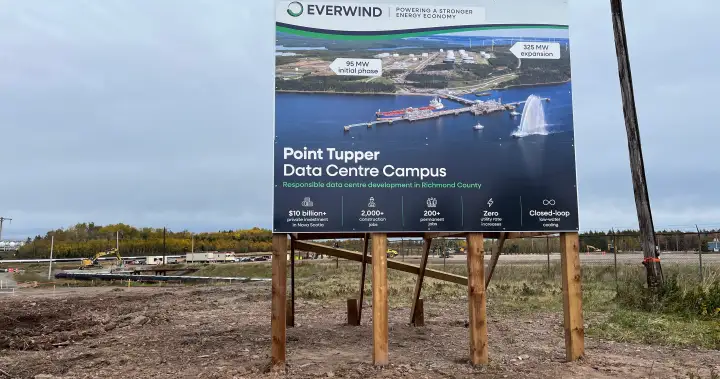
Criticism of Nova Scotia’s move to build a large-scale AI data centre in Cape Breton is growing, as both opposition parties are calling for an emergency sitting of the legislature to debate the project because they say it lacks consultation and regulatory safeguards.

On Friday, energy and infrastructure company, EverWind, announced plans for $10 billion in private investment in a data centre campus at its existing Point Tupper site near Port Hawkesbury, N.S.
AI development company Anthropic, the creator of Claude AI, confirmed it had signed a long-term lease to use the centre.
In a Monday morning social media post, Official Opposition Leader Claudia Chender shared her letter to Premier Tim Houston, in which she said “tough questions about this project must be asked.”
“What is most alarming is that you seem to believe that non-binding federal guidelines endorsed by the AI industry itself and expectations you laid out in a social media post constitute a valid approach to ensure that data centres remain accountable to the people of Nova Scotia,” she wrote in part.
“Non-binding guidelines are not laws. This project needs to be regulated in the legislature, not on Facebook.”

Liberal MLA Becky Druhan voiced her support for Chender’s request for an emergency sitting. In her own letter to Houston, Druhan said Nova Scotians deserve to know what kinds of discussions took place and what commitments were made.
“The need for answers and protections is now even more urgent. In June, you told Nova Scotians that data centres were ‘not a today thing, not even a tomorrow thing.’ Yet last week, you participated in the announcement of a $10 billion project,” she wrote.
In response, Premier Tim Houston told Global News in a statement that “there will be many checks and balances built into the process.”
“The bottom line is that there is a process in place. The (Department of Environment and Climate Change) has a range of approvals and regulations to regulate industry on a case-by-case basis depending on the circumstances of each situation,” he wrote.
“They are stringent and serious and they will be followed. Regulatory decisions are made based using sound technical expertise and evidence, science and facts.”

Get breaking National news
Get breaking Canada news delivered to your inbox as it happens so you won’t miss a trending story.
In June, Canada announced a new AI strategy that includes proposals for the building of “large-scale” data centres.
“The federal Liberal government has established guidelines for data centers. So have I. This is not a partisan issue. This project is going through a process to ensure that it meets these standards,” he wrote.
Residents speak out
Community advocate, Julissa Stewart, said she and fellow residents in Richmond County feel they weren’t properly consulted and want a pause on the project until regulatory safeguards are in place.
“We need to engage the public in this because it’s impacting the residents. The residents are concerned and they want their voices to be heard, and doing it after the fact is just not acceptable,” she said.
“What happens if the project that gets built is not the project that was advertised? So what happens if they say it won’t use much power and then it uses far more than what was proposed?”
But there are environmental and health concerns about large-scale data centres across Canada, with heated debates and moratoriums imposed in some municipalities.
A rally was held in downtown Halifax the day after the EverWind announcement, with protesters saying the data centre seemed to have been “randomly announced” without any consultation.
“These companies don’t have a lot of information that they’re able to give us. We don’t know what this is going to look like,” said protest organizer, Megan Boudreau, on Saturday.

EverWind said its campus will begin with an initial 95-megawatt phase in late 2027. This will be followed by a 325-megawatt expansion targeted for 2028 subject to regulatory conditions.
At full development, EverWind expects the campus to reach a capacity of 420 megawatts to “meet growing demand for artificial intelligence and digital services.”
Part of the $10 billion investment is $2 billion to advance the company’s onshore wind energy projects.
Experts point out that the data centre will quickly become Nova Scotia Power’s largest industrial customer.
“If we’re going to build a project of this size in a province that’s pretty small, with some of the highest electricity rates in the country, some of the highest rates of energy poverty, with limited groundwater resources … then certainly I think there’s a lot that will still need to be clarified,” said Thomas McNeil, senior energy coordinator at the Ecology Action Centre.
EverWind said its plan is to fund the electricity infrastructure costs attributed to the project so costs aren’t passed on to ratepayers. The company noted the data centre will have “several hundred megawatt hours” of battery storage to support the facility.
But McNeil said independent analysis is needed to determine the impact a project of this size will have on the grid and power bills.
“What we can say for sure is that we’re already struggling with the reliability of our grid, so our ability to keep the lights on in regular conditions,” he said.
“We are, of course, starting to see more extreme weather events, more storms. And so there are questions about the long-term resiliency of the power grid in Nova Scotia as well. So, are we in a position in which we’re going to easily be able to increase demand on the grid at that scale without sacrificing reliability and our ability to keep the power on during a storm?”
In his statement, Houston said “the misinformation that is being spread that your household power rate will go up, that is completely false.”
“I have been very clear: protecting Nova Scotia ratepayers is an outright condition of our government’s support. In fact, there are scenarios where adding a new customer can actually decrease rates,” he wrote.
He added that the protection of power rates will be “built into any agreement” signed with the project.
In terms of the impact on the grid, Houston said EverWind “will be building 80 turbines” and that the data centre will be built in phases “with the first being 95 MW and will be fully disruptable.”
He said that means if the power grid encounters a situation where it is reaching capacity, “the power to the (data centre) will be shut down long before there is any impact on any household.”
Meanwhile, the warden of Richmond County, Lois Landry, said town halls are being organized to discuss the data centre.
Landry, who spoke at Friday’s announcement, said she herself only discovered the multi-billion investment involved an AI company and data centre that morning at a technical briefing for reporters.
“So there was really no confirmation about AI because there was no disclosure of the client until the client announced later that day,” she said.
Landry added that there is still no building permit application submitted for the project.
“They can’t apply for a permit without the final design, so I think they’re still working through that. And, the pre-construction work that they’re doing is essentially cutting trees on their own property which they are within their right to do,” she said.
— with files from Mitchell Bailey

