



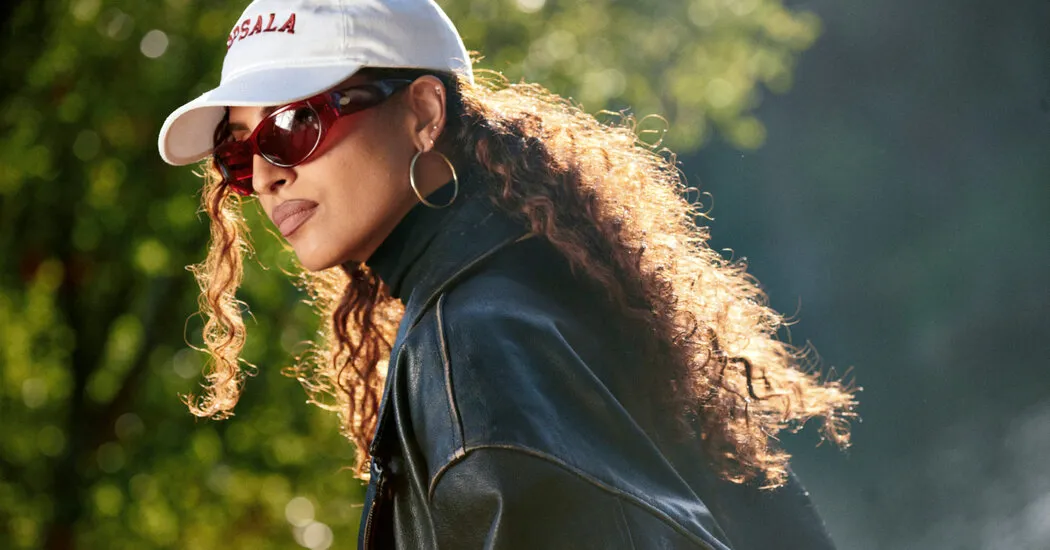
She was born in Uppsala, Sweden, the daughter of Iranian immigrants who arrived there as part of a wave of refugees fleeing the Iran-Iraq war in the 1980s. By the time she was around 2, her parents had divorced, and she spent her early years in a smaller town, Enkoping.
As a kindergartner, she was the only non-blue-eyed, non-blond kid in class, she said, and though her area eventually diversified, “me and all the immigrants, we would still face a lot of racism,” she said. That bullying still shadows her. Like a paper that’s been crumpled, “It doesn’t matter how much you flatten it out, it will never be straight again. And I will carry those insecurities with me and those scars with me.”
She found solace in music. As a child, hearing “I Have Nothing” by Whitney Houston, “I got goose bumps,” she recalled. “I said, whatever this is, I want to learn how to do this.” By age 7, she had announced her intentions to be a singer; her family moved to Stockholm so she could work with a local producer and attend a music high school. She signed a publishing deal with a major label, Sony, at 13.
In the two-and-a-half decades since, Aalegra hopped between Stockholm and London and Los Angeles, where she has now lived for about 12 years, and where she landed on the couch of her first cousin, Izabelle Pourreza Wilson, who became her manager. Under Wilson (and her husband, Dion Wilson, the producer known as No I.D.), Aalegra began defining her career, building her devoted fan base “brick by brick,” she said, and selling out two nights at Radio City in 2022. (She has since moved on to other management — no ill will, but the shift was partly responsible for the new album’s delay.)

