


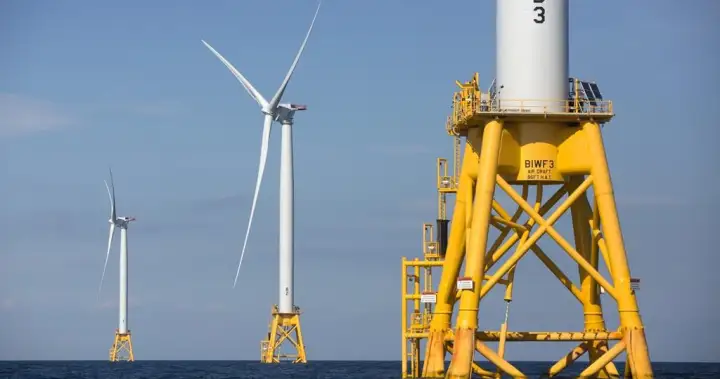
It was a blustery day on the Dartmouth, N.S. waterfront as the federal government announced a $100 million investment to advance offshore wind development in Nova Scotia.


The money will be used to collect wind, ocean and seafloor data for the Wind West project. Wind West is part of the Atlantic Energy Strategy, which was referred to the federal Major Projects Office in September 2025.
Premier Tim Houston called it an “incredible” day for Nova Scotia.
“I’m incredibly excited about what the future holds for our province,” he told reporters.
“(The funding) will shave years off (the project). It will bring us closer to the jobs, closer to the realities. We’re really appreciative of the $100 million. It means a lot. It means a lot for Nova Scotians. It’s a show of confidence in what we have.”
According to the provincial government, Nova Scotia has some of the best, and consistently-fast, wind speeds in the world. The province also sits on a “large continental shelf with vast areas of relatively shallow water that are ideal for floating and fixed wind platforms.”
“Nearly 30 countries are ahead of Canada in developing offshore wind and it’s time to change that,” said federal Energy and Natural Resources Minister Tim Hodgson, who was on hand to deliver the news.
As a first step, Hodgson says $5 million will go toward the development of tools to measure wind speeds and ocean conditions. He anticipates the call for bids will be issued this winter.


Get breaking National news
Get breaking Canada news delivered to your inbox as it happens so you won’t miss a trending story.
“This data will help developers better understand the unique conditions off Nova Scotia’s coast and design offshore wind projects that are safe, that are efficient and built for long-term success,” he said.
Nearly $3 million is being committed to expand transmission modelling and marine survey work.
This work is expected to help lay the foundation for Wind West and support Nova Scotia’s goal of licensing up to five gigawatts of offshore wind energy by 2030.
“Just this five (gigawatts) could be $40 billion of private investment, $50 billion, $60 billion. It’s a big, big number. It means jobs, it means opportunity,” said Houston.
Provincial officials have said Wind West could generate up to 60 gigawatts of electricity if all phases are built.
“When you can take $100 million of public money and leverage it to unlock tens of billions of dollars of private money, that is a good use of public capital,” said Houston.
“Imagine what our province looks like when we have all of that 60 (gigawatts). It’s an incredible opportunity.”
Houston has also suggested the excess electricity could be used to supply 27 per cent of Canada’s total demand. Quebec and Massachusetts have already shown interest in buying electricity from the proposed project.
Affordability still a question
A Canadian Renewable Energy Association (CanREA) poll released this week found 33 per cent of Canadians ranked affordability as a top priority for new electricity supply — ahead of reliability, how quickly new supply can be built, economic growth and energy security.
“Electricity demand in Canada is expected to increase between 26 to 85 per cent by 2050 as the economy grows and electrifies,” said Eddie Oldfield, the association’s director of policy for the Maritimes.
“Canadians need more electricity. They’ve told us they want it to be affordable. Wind, solar and storage are among the top new sources of energy that can provide affordable, reliable electricity in Canada.”
He points out that Wind West would be the first time offshore wind would be introduced on Canadian shores and calls it “an incredible opportunity.”
Official Opposition Leader Claudia Chender says her party supports the expansion of the ocean science and technology sector, but adds that it’s “vitally important” to understand how projects like Wind West ultimately help people afford power bills and “secure our energy future.”
“What people are concerned about when we talk about power is being able to pay their power bills. And so we would like to see federal investment in our transmission and distribution,” the NDP leader said.
Oldfield agrees transmission to get that power to markets is something that needs to be discussed and addressed.
“And that might require a regional framework with clear rules, timelines that investors can count on, (as well as) real partnerships with the Mi’kmaq, Indigenous communities, fisheries and coastal communities to ensure that benefits accrue locally as they develop these great resources,” he said.
— with files from Global News’ Heidi Petracek and The Canadian Press.
© 2026 Global News, a division of Corus Entertainment Inc.