


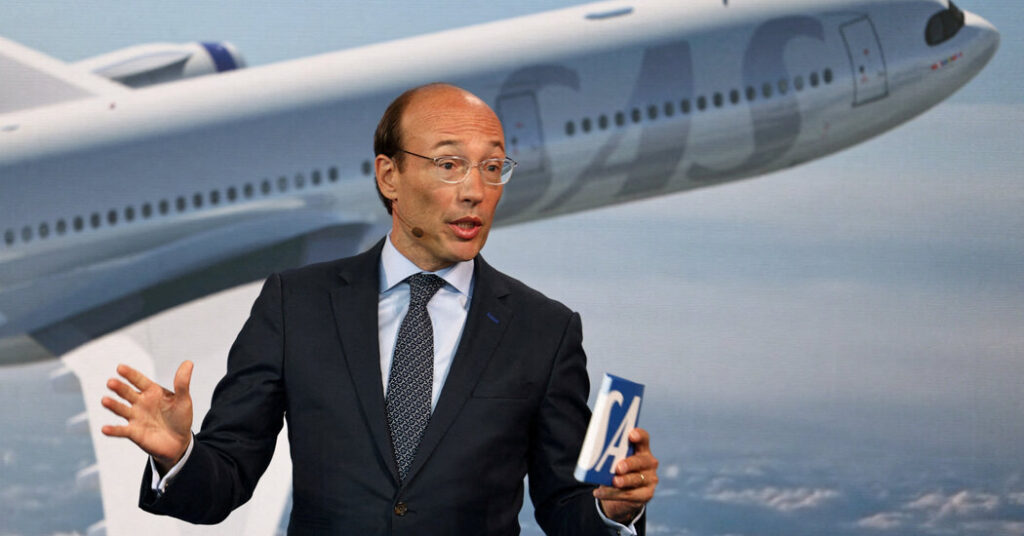
When Air Canada announced the hiring of its new chief executive on Wednesday, the company highlighted one of Anko Van der Werff’s skills: He speaks six languages including, and above all, French.
Mr. Van der Werff, who currently heads Scandinavian Airlines, will replace Michael Rousseau, who came under repeated criticism in the airline’s home province of Quebec for his failure to learn French, which has equal legal status with English in Canada, despite repeated promises to do so.
Mr. Rousseau was widely condemned in the largely French-speaking province in March after an Air Canada Express jet collided with a truck as it was landing at LaGuardia Airport in New York. While one of the two pilots killed was a French speaker, Mr. Rousseau said only two words in French, “bonjour” and “merci,” in a video posted by the airline to address the disaster and comfort victims and their families.
The critics included Canada’s prime minister, Mark Carney.
“We proudly live in a bilingual country,” Mr. Carney told reporters at the time. “Companies like Air Canada, particularly, have a responsibility to always communicate in both official languages regardless of the situation. I’m very disappointed.”
Under federal law, Air Canada is obliged to offer all of its services in both of Canada’s official languages. When the government privatized the company in 1988, it required that it remained headquartered in Montreal, Quebec’s largest city. Beginning in the 1970s, the province introduced a series of language laws to end the once dominant practice of large corporations operating in English with largely English-speaking managers in charge.
Because airlines are federally regulated, Air Canada is not governed by Quebec’s laws.
In 2021, after he delivered his first major speech to a Quebec business group as Air Canada’s chief executive entirely in English, Mr. Rosseau promised to learn French — an objective he never fully achieved.
Air Canada initially defended Mr. Rousseau’s video, saying that he wasn’t up to dealing with such a sensitive topic adequately or appropriately in French. Shortly after, Mr. Rosseau made a public apology.
“Despite many lessons over several years, unfortunately, I am still unable to express myself adequately in French,” he said. “I sincerely apologize for this, but I am continuing my efforts to improve.”
The apology did not end the scorn. Quebec’s provincial legislature passed a motion, which had no legal power, calling for Mr. Rousseau to quit because he was disrespectful of the province’s French-speaking majority.
Four days later, the airline announced that Mr. Rousseau, who has been with the company since 2007, would retire. On Wednesday Air Canada confirmed that he will do so at the end of August.
In announcing the hiring of Mr. Van der Werff, Air Canada said that the Netherlands native speaks Dutch, English, French, Spanish, Italian and Swedish. He has worked for airlines based in a wide variety of non-English speaking nations including the Netherlands, Sweden, Qatar, Mexico and Colombia.
In videos, recorded in both English and French and posted by Air Canada, Mr. Van der Werff said that he is “mindful of the importance of serving Canadians in both official languages” adding that it is “a fundamental responsibility for Air Canada and I’m fully committed to upholding it.”