


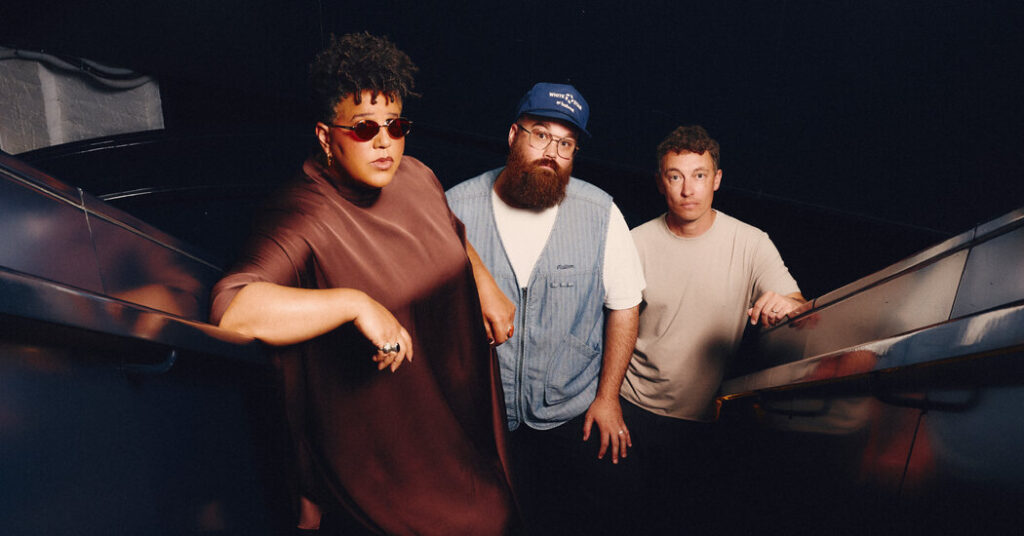
There was no master plan when Alabama Shakes first got back together. It was to be a surprise, one-time appearance at a benefit gig for a brewery in Tuscaloosa, Ala. But the chemistry felt good onstage and, soon afterward, in the studio. After years apart, new songs poured out of the band — the songs that fill its new album, “I Must Be Dreaming,” out on Aug. 28. It has been more than a decade since the group released its second album, “Sound & Color,” in 2015.
“I don’t want to call it a comeback,” said Brittany Howard, 37, the band’s singer, lyricist and lead guitarist, one afternoon in the basement lounge of the Bowery Ballroom in New York.
“It’s not like I ever really quit the band,” Howard said. “It was just a long break while I explored creativity and the fellows were able to raise their children, which is awesome. We all just went and did things so we could come back and have more to say.”
Formed in the small town of Athens, Ala., by high school misfits who turned to music, Alabama Shakes built a sound that was simultaneously rooted and forward-looking, steeped in soul, rock, blues and country but never settling for straightforward revivalism. Howard fronted the band with a commanding stage presence, barbed lead guitar lines and a voice that can be a gentle lilt or a tsunami.
The band’s first album, “Boys & Girls” in 2012, climbed into the Top 10 as Alabama Shakes toured ever-larger venues. “Sound & Color” debuted at No. 1 on the Billboard album chart when it was released. It was nominated for album of the year at the Grammys and won four other awards, and the group stayed on the road into 2017.
But Howard was artistically restless. She put Alabama Shakes on hiatus while she made two complex, widely acclaimed, emotionally whipsawing solo albums: “Jaime” (2019) and “What Now” (2024); she also moved to Taos, N.M., before settling in Nashville. She toured extensively on her own, sticking to her solo catalog and backed by a band that included only one member of Alabama Shakes, Zac Cockrell on bass.
Late in 2024, a Tuscaloosa brewery and club that had struggled through Covid asked Howard to perform at a benefit for its live-music series. Druid City Brewing Company was one of the barrooms where Alabama Shakes often played in its early, struggling years.
The brewery’s owner, Bo Hicks, was an early believer. “I’d heard a lot of bar bands. This was still a little raw, but you could tell that there was so much potential there,” Hicks said in a phone interview. Now, he added, “Here’s this awesome band that has a mixed-race queer lead singer from Alabama, that extols so many virtues I find dear about the South,” he added. “We can go, ‘This is ours. This is something we can get behind.’ This shows that the odds might be against us, but they can rise up through all the challenges they’ve had.”
The band has remained grateful. “Obviously we didn’t make no money then,” Howard recalled. “He would put us on a couch, he’d make us some food — he always took care of us.”
Howard contacted Cockrell and Alabama Shakes’s rhythm guitarist, Heath Fogg; they were in. They had been playing together on and off, including for Fogg’s 2020 solo project, Sun on Shade. The fourth member from the 2010s, the drummer Steve Johnson, was out of the band after family and legal problems.
At the Tuscaloosa benefit show, Howard was billed as the headliner. “She did one song by herself — and then the band ran out there,” Hicks said. “In that room, the electricity would make your hair stand on end.” The band romped through Alabama Shakes tunes they hadn’t played live since 2017. “It felt pretty surreal to be back and doing it,” Cockrell, 38, said in a video interview from his home in Nashville. “When I sat down to brush up on the songs, I was like, ‘Wow, I didn’t realize how much I missed this stuff.’”
The successful Tuscaloosa reunion spurred the band to return to full-scale touring beginning in summer 2025. It also decided to book studio sessions in hopes of writing a handful of new songs for the tour.
Howard had never been a fast or prolific songwriter. “If I’m ever reincarnated, I do not want to be a writer ever again,” she said. “I want to become a mathematician or something — something stuck and true. One plus one equals two. Something uncreative. Maybe a mechanic.”
When a song isn’t working, she continued, “It’s turmoil. It’s absolute terminal dejection, just so miserable,” she said. “Every writer knows this. But then it is so fun and it’s joyous — not just mentally and emotionally joyous, but physically joyous — to crack a song and to be like ‘I love this. I can’t believe I created that feeling.’ That’s what you are always wanting. A volcano of dopamine.”
Howard had toured through most of 2024 after releasing “What Now.” She also voiced the title character in the Netflix animated film “Thelma the Unicorn,” and she wrote (with Ludwig Goransson) the bluesy song “Pale, Pale Moon” for “Sinners,” the Ryan Coogler blockbuster.
So she didn’t have a large cache of unused material for the reunited band’s first recording sessions.
But one week in the studio produced six new songs. “It was pretty low stakes,” Cockrell recalled. “We weren’t planning on making a record. We were basically just bashing out some ideas and it just started coming together. By the end of that session, it seemed kind of silly to not have a couple more and just finish doing an album.”
Cockrell’s homemade demos — riffs, grooves, chord progressions — were the catalyst for the band’s new songs, Fogg, 42, said in a video interview from his home studio in Madison, Ala. “We were all bringing in demos and ideas, but he just had this really amazing batch of ideas,” Fogg said. “A lot of these songs came from that, especially those first six. It just felt like he was really hungry to make a Shakes record, to do something that was his and ours.”
For previous albums with the band and on her own, Howard had often provided “a 75 percent fleshed-out idea,” she said. “All the parts, where they’re going to happen. I was the ship navigator and I knew how to get us where we’re going. This time, it was a lot of, like, ‘Oh, I don’t know what’s going to happen next. I’m not sure. Let’s find out.’”
She added, “It was amazing to surrender instead of trying to control every little bit, every cymbal, every kick drum. And I welcomed that.”
“Sometimes there’s a lot of pressure to know where everything’s going,” she added. “When you do all those details like that, of course it’s really fun. But you’re missing out on the spontaneity of the moment, the experimentation of the moment, and somebody else’s gift that they’ve brought. And I think in the future, I’d like to leave more room.”
As the songs emerged, Howard found herself singing about love, time, tension, resistance and connection. “I can’t help but react to the world around me. And in our society right now, in the United States, it’s tumultuous and chaotic and confusing.”
The album’s love songs take unconventional angles. “How Love’s Supposed to Go” pledges affection to an unbelieving partner over a choppy beat and churning chords. In “Another Life,” which hints at both Motown and trip-hop, the singer hopes that a failed romance could turn out better the next time around, after reincarnation. And in “Garden,” she admonishes someone’s neglectful partner, “If you don’t show her you love her, I will.”
Two songs face current political conditions with inner strength and stubbornly slow, circling bass lines. “American Dream” moves into a molten, echoey psychedelic limbo as Howard sings about betrayed ideals and bleak prospects: “Low grade fever, lower wage people / How many folks got shot this week?” she sings. In “Tea Time,” which Howard said was her favorite song on the album, she seeks “wisdom to turn shields to mirrors / and enemies to lovers.”
For much of the album, the tempos are steadfast and unhurried, while the sound is richly and mysteriously layered. Howard rejects the idea that music that speaks to resistance must be “thrashy or showy or aggressive. Why can’t it look collected?” she asked. “I was just reacting to the music, but also to the energy around me. It feels a little murky, it feels slow, it feels foggy and uncertain, and I’m just reacting to that.”
On Oct. 3, Howard will perform at the Power to the People Festival at the Merriweather Post Pavilion in Maryland, a pre-election protest-music event curated by Tom Morello with Bruce Springsteen, Joan Baez, Public Enemy and many others. For Howard, there is little separation between the personal and the political.
“It’s easy to connect the two, because I’m the connection to the two,” she said. “I mean, in Tennessee, it is not great for Black women or for gays. I don’t get to sit back and hope for the best for everyone else. In this case, myself and my family are the everyone else.
“Some people would be like, ‘Oh, you shouldn’t have an opinion — you’re an entertainer. But musicians are much more than entertainers. Music makes us believe that we can do something. I feel like music sometimes is the only backbone we’ve got. Music saves lives.”