


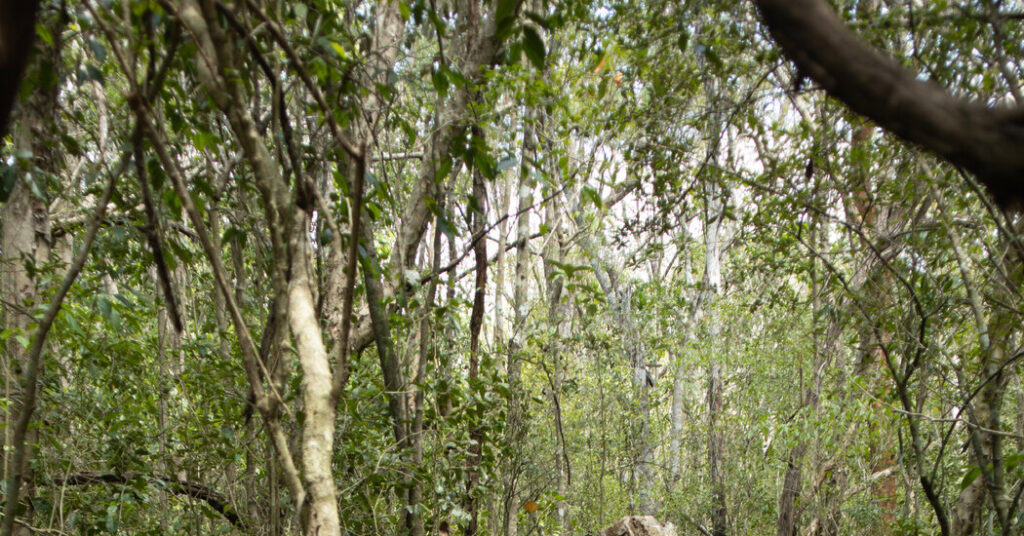
The ruins had lain waiting for centuries behind wetlands and hills, in woods where not even logging trails came close.
Archaeologists first saw hints in aerial scans of Mexico’s Yucatán Peninsula, but there was only one way to know for sure: Go out there themselves.
So they drove down an old forest road and cleaved a path for ATVs. Then the jungle grew too dense for even those all-terrain quads. That left walking, machetes in hand and boots in the mud, for three more miles to the site.
There, the team found Maya altars, stelae, plazas, terraces and structures, among them a well-preserved pyramidal temple that rose more than 40 feet. On one monument, a relief was carved depicting a scene of decapitation, with a calendar sign for A.D. 849. Another bore a date in the late 600s A.D.
That suggests the ruins date to the centuries just before people abandoned large Maya sites en masse.
“What was a big surprise was that there were so many monuments there,” said Ivan Sprajc, the lead archaeologist of the team, whose work was announced by the Mexican authorities last week. “It’s a kind of row of monuments. That was incredible for such a relatively small site.”
The presence of so many monuments — 14 so far — signals that the site was one politically important, “not a minor city,” said María Elena Vega Villalobos, a Mexican historian and expert on Mayan hieroglyphic writing who was not part of the project.
The team was also surprised by the condition of the site. It had “no traces of looters’ activity, which is quite exceptional,” said Dr. Sprajc, a professor at a Slovenian research center, ZRC SAZU.
The trees had not been sought by loggers, he said, though at some point chicleros, workers who collect gum from zapote trees, did pass through. Their cuts to tap the trees can still be seen. But those marks appear to be 70 or 80 years old, he said, from a time when the black market for antiquities was nowhere near as developed as it is now.
“They must have seen the ruins, but they didn’t loot them,” he said.
And then the chicleros presumably moved on, and whatever paths they had cut eventually disappeared in the undergrowth without a trace.
The researchers named the site accordingly: Minanbé, from the Yucatec Mayan for “there is no path.”
That isolation left monuments eroded by time but otherwise untouched, save for alterations made to them by people centuries ago. One shows the beheading scene, with a person wielding a blade or ax against a possible captive. Another has the image of a ruler with feathered headdress, wristbands and hieroglyphs.
The monuments that were changed, either broken or rearranged, all had inscriptions, Dr. Sprajc said. “We suppose there were some groups coming from elsewhere, which were not in very friendly relations with the original inhabitants.”
That would fit with the age of the ruins, he said.
“It was this turbulent period, just the prelude to this famous or notorious collapse of the classic Maya civilization in the ninth and 10th centuries,” he said.
At the time, every city had its own ruler and its own dynasty, and there was a great deal of competition, Dr. Vega said. Defacing monuments in rival settlements, she said, was meant “to erase and destroy the political and social memory of a territory.”
Much of the site, which is in the Calakmul Biosphere Reserve in Campeche, remains buried under mounds of earth that will take later excavation — dozens more people, far more tools and a supply line for water and food — to uncover. But in limited digs, Dr. Sprajc and his colleagues have already unearthed ceramics and other artifacts.
“This site evidently was important on the regional level; we have a name of a ruler and all those monuments,” he said.
The region was full of ancient agricultural modifications visible in aerial scans using lidar, a technology increasingly helping researchers find ruins hidden beneath vegetation or soil.
“It’s so hard to get people to stop thinking about this as the trackless jungle,” said Rosemary Joyce, a professor emeritus at the University of California, Berkeley. “What we’re finding more and more is these towns — and this is not a city but a town — surrounded by intensively cultivated land and connected to each other.”
Other archaeologists not involved with the expedition praised the insights their discoveries were leading to about a long understudied part of Mexico.
“Sprajc’s team is doing the incredibly hard work of walking and recording these very remote areas in person,” said Lisa Johnson, an archaeologist at the University of Nevada, Las Vegas. The findings, she said, show “the extent of urbanization among ancient Maya populations and the degree to which they built and modified the landscape in areas that could previously be described as an archaeological blind spot.”
Most surprising for some was the pristine state of a Maya archaeological site.
Luis Alberto Martos, an archaeologist at Mexico’s National Institute of Anthropology, recalled expeditions that led to ransacked sites. “That’s really painful,” he said, “because it destroys everything.”
Minanbé, he said, will “give us a lot more information.”
Still, Dr. Sprajc, 70, is not sure about another trip into the jungle.
First, there is the expense. For this expedition he cobbled together funding from the Slovenian Research and Innovation Agency and Slovenian companies like Adria kombi, Ars longa and Artos. He also got donations from the Ken & Julie Jones Charitable Foundation, the Milwaukee Audubon Society and two of its members, who have joined in some field work.
And then there is the bushwhacking.
“Obviously, I feel the weight of the years,” Dr. Sprajc said. “I can still walk and everything. I’m still there. But perhaps I should leave this job to my younger colleagues.”
But he didn’t rule it out, either.
“I don’t have any specific plans,” he said.