


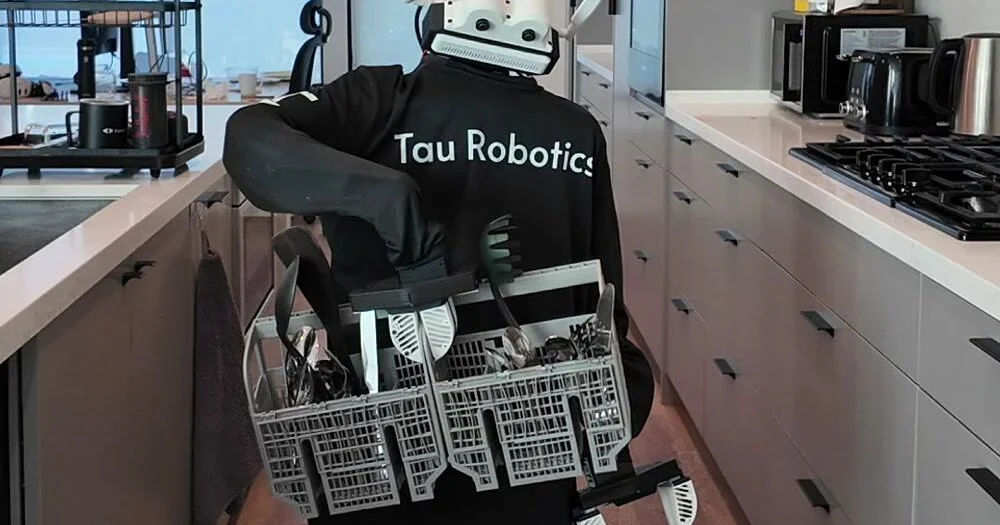
Sick of cleaning your home? One company wants to let you offload the task to a humanoid robot.
For $30 an hour, some San Francisco residents can now hire a robot to clean their home. Tau Robotics, an engineering company that builds AI technology to power robots, announced the service last month as part of a pilot program open to 1,000 households.
The humanoid robots, dressed in black Tau Robotics uniforms and given names such as Chelsea and Elon, perform household chores like vacuuming, cleaning kitchen counters and taking out the trash. Tau trains the bots, which cost $50,000 each to make, using artificial intelligence.
„Initially, they will be trained to imitate human performance, and then they will be trained to exceed human performance,“ Alexander Koch, Tau’s co-founder and CEO, told CBS News.
Tau Robotics 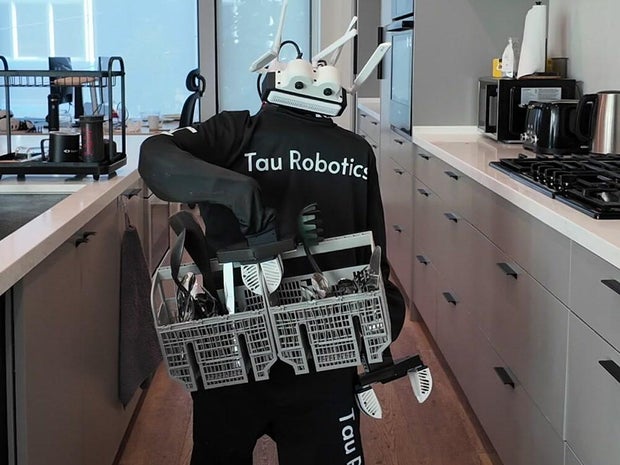

Tau’s service is invite-only for now. But Koch said the company plans to scale up to 1,000 cleanings a week in San Francisco by 2027, then expand to other U.S. cities and internationally by 2028.
Numerous other companies are also starting to roll out humanoid robots, such as IX Technologies‘ Neo. But experts predict it will take at least five or 10 years before they can perform household tasks effectively and reliably.
In the meantime, humans are at the ready in case things go sideways. Tau’s robots are operated remotely by human technicians who supervise the AI that controls them and who can step in if the devices get stuck on a particular task. The supervisors wear VR goggles that allow them to see through the bots‘ eyes into people’s spaces.
Tau’s robot „cannot do everything on its own,“ Koch said. „It doesn’t know how to walk upstairs, for example. It doesn’t know where to vacuum. That’s directed by mostly humans at the moment.“
Safety and security concerns
Ken Goldberg, an engineering professor at the University of California, Berkeley, who researches robotics and automation, said that humanoid robots are still relatively clumsy at this stage in their development, even with remote human assistance.
„They look quite nimble, but they are actually quite heavy,“ he said, noting that robots can fall over. And as they attempt to get back up, they may thrash around and accidentally hit anyone in close proximity.
„You wouldn’t want this thing anywhere near a child or a baby,“ Goldberg said.
Even if the robot is standing, meanwhile, humans may still want to keep their distance. Goldberg said if someone attempts to pick up one of the bots, it can reach out and pinch them with its grippers — robot lingo for hands.
Koch said Tau’s fleet of human technicians is monitoring to prevent humans and humanoid robots from getting too close. If anything goes awry, the technician can put the device into safety mode, which essentially shuts it down by prompting it to lie down on the floor, he said.
Koch said Tau plans to phase out technicians when the bots reach a higher level of self-sufficiency — sometime around 2028 or 2029, he estimated. Until then, it’s a learning process.
„We’re still pushing the limits of what it can do, so we are not entirely sure ourselves where the limits are,“ he said.
Tau Robotics 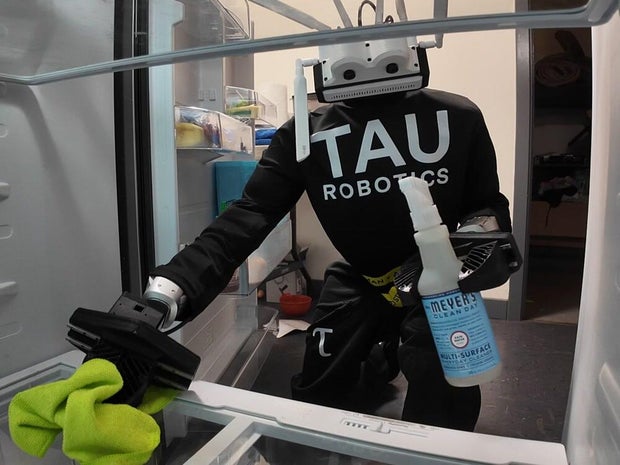
In addition to safety concerns, experts have also raised questions about security and privacy issues around the use of robots.
Outfitted with two cameras as eyes, Tau’s robots record videos that are used to train the company’s AI and improve the technology’s functionality. However, the humanoids‘ cameras could potentially capture footage of personal items in people’s homes, such as receipts and bills, Goldberg said, potentially violating their privacy.
Asked about security protocols for its products, Koch said Tau has „full control“ over the data it collects. „The camera system, the networking and the computers are all our own,“ he said.
Humanoids in the home?
The humanoid robot industry is expected to grow rapidly in the coming years as investors pour more money into artificial intelligence. Barclays Investment Bank predicts that the market, now valued at $2 billion to $3 billion, could grow to $200 billion by 2035.
A separate analysis by Morgan Stanley Research released last year estimates that the humanoid robot population will reach nearly 1 billion by 2050. However, the investment bank said prices will need to decline significantly, and societal acceptance of the bots will need to increase before such devices make their way into homes.
For now, most humanoid robots are being used for other purposes. Barclays estimates that 15,000 such robots were deployed in 2025, 90% of which were used in industrial settings such as manufacturing and warehousing.
Zornitsa Todorova, an analyst at Barclays, predicted that deployment of the technology will be „gradual and incremental“ and that „meaningful adoption“ will take at least five years. As the robots‘ capabilities improve, Todorova believes interest in home applications will spike.
„While adoption remains at an early stage today, the economic opportunity for humanoids performing service-oriented tasks is significant,“ she said in an email.
Goldberg is more skeptical. He estimated that it will take another decade for the science to get to the level it needs to for the robots to effectively perform at-home services like cleaning.
„I’m not saying we will never have them,“ he said. „But we’re not close to having humanoid butlers. The science isn’t there yet.“