


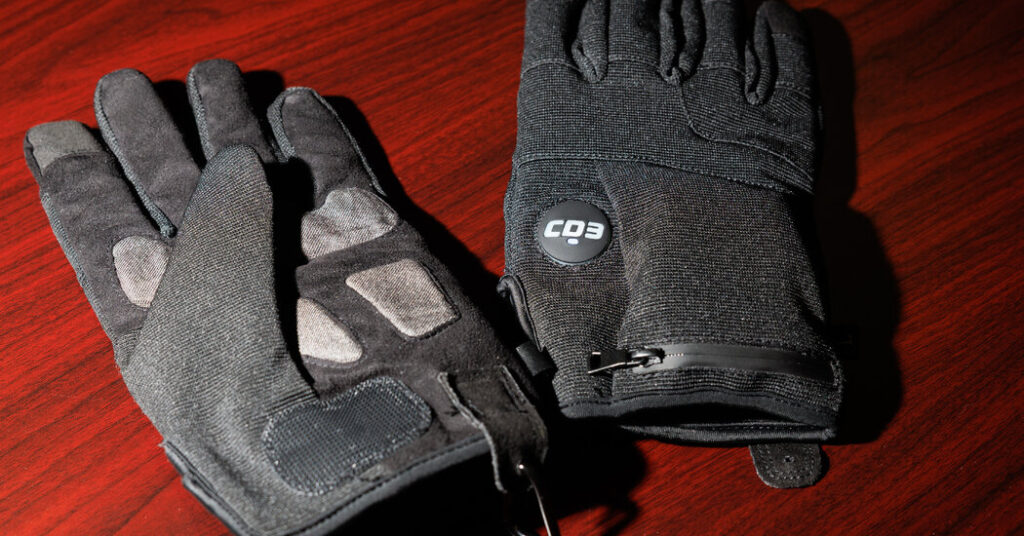
The California Legislature passed a bill on Monday night banning law enforcement officers from using electric shock gloves in an effort to prevent federal immigration agents from deploying them.
The legislation is a direct response from Democratic state lawmakers to the Trump administration, which announced in August that it was planning to spend up to $20 million for the devices. The bill will now head to the desk of Gov. Gavin Newsom, a Democrat, who has not said whether he will sign it.
While the catalyst for the legislative effort was the federal government’s plans to deploy the gloves, the loudest opponents to the bill were law enforcement groups in California, where several local agencies have been testing the devices and hope to use them.
LaShae Sharp-Collins, a Democratic assemblywoman from San Diego who introduced the last-minute bill, described the gloves as “unproven” and a “new and dangerous tool.” She said that one of her biggest concerns was that the gloves “would be in the hands of our least trained and most lawless law enforcement,” referring to Immigration and Customs Enforcement.
Civil liberties groups and immigrant rights organizations supported the bill, saying it was necessary to protect immigrants from a federal force that has faced criticism for aggressive tactics, including fatally shooting at least six people over the last two years. Opponents have also argued that banning the devices was fiscally prudent, warning that the gloves could result in costly litigation.
Shiu-Ming Cheer, deputy director of the California Immigrant Policy Center, said in an interview: “We’ve seen many instances of aggressive, militarized immigration enforcement actions that include excessive use of force. So for us as an organization, we support this bill because we think that any excessive use of force makes Californians less safe.”
But the Department of Homeland Security has described the gloves as a “de-escalation device.” The department on Monday attacked the bill and said it would not comply with it, saying it was unconstitutional.
“Sanctuary politicians attempting to ban our federal law enforcement from any safety equipment is despicable and a deliberate attempt to undermine and endanger our officers,” the department said in a statement. “To be crystal clear: we will not abide by unconstitutional bans. The Supremacy Clause makes it clear that California’s sanctuary politicians do not control federal law enforcement.”
Local police agencies in California have also come out against the bill because it would ban them from using the gloves. Jim Cooper, a former lawmaker who is the sheriff of Sacramento County, said last week that his department had already spent $35,000 to purchase 10 gloves, which are used individually and not in pairs.
He said his department had also acquired 10 electric shock bands that could be used to subdue suspects already in custody by flipping a remote switch. Those would also be banned under the bill.
Mr. Cooper said at a recent news conference that his department was training deputies on how to use the gloves, and he planned to put them into active use in September.
The Santa Monica Police Department also has acquired a few gloves and is in the process of testing them, though it has not yet decided whether to use them in the field, according to Lt. Lewis Gilmour, a spokesman for the department. Another agency, the El Monte Police Department, in eastern Los Angeles County, has acquired two gloves and is testing them.
“We’re waiting to see what others do,” said Lt. Aram Choe, watch commander at the department. “And waiting to see what happens in Sacramento.”
Mr. Cooper described the gloves as one of the department’s important tools, along with Tasers and guns that fire bean bag rounds, that deputies can use to de-escalate confrontations and avoid fatal shootings or other violence.
He said the gloves use pain to force compliance. “Is it uncomfortable?“ he said. “Yeah. Does it hurt? Yeah, it hurts.”
The governor has until Sept. 30 to sign the bill. If he does and it takes effect, it is almost certain to face legal challenges.
States face an uphill battle when trying to limit the actions of the federal government, as California discovered when it tried to ban the use of face masks by ICE agents last year, only to be overruled by a federal judge.
The gloves are manufactured by a Kentucky-based company called Compliant Technologies, and the devices are called “CTG-5 G.L.O.V.E.,” an acronym for Generated Low Output Voltage Emitter.
The company did not respond to a request for comment about how many agencies have bought their devices, but an NPR report, citing a list of customers it had viewed, said that about 50 police departments in 20 states were using the gloves, as well as some prison guards and security staff at hospitals.