


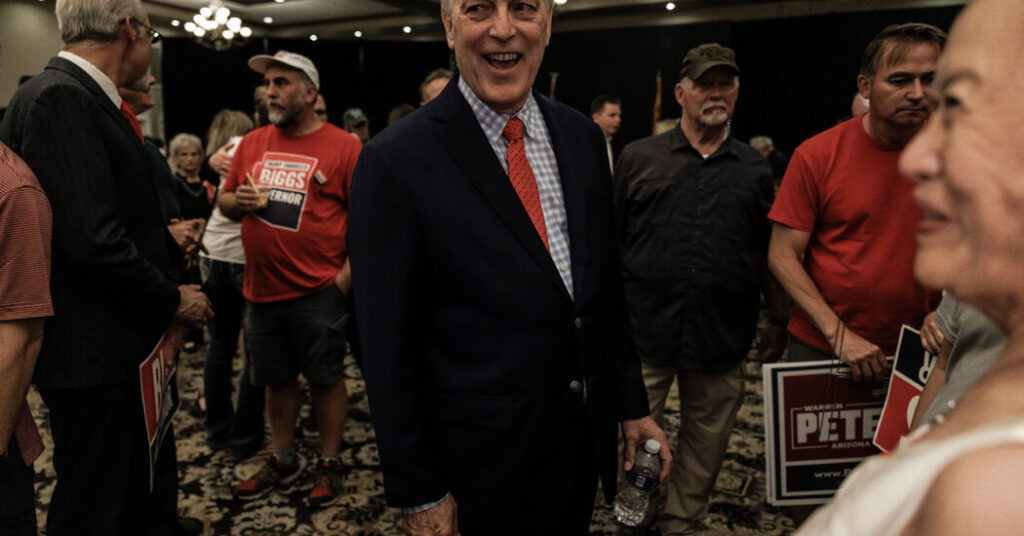
On the debate stage last month in Arizona, Representative Andy Biggs, the leading candidate in the state’s Republican primary for governor, did not try to convince voters that he was the most conservative candidate in the race. He did not tout his Freedom Caucus bona fides, nor his push to overturn the 2020 presidential election.
Instead, he styled himself as a bipartisan deal-maker who has worked with Democrats, including Representative Hakeem Jeffries of New York and Senator Mark Kelly of Arizona.
“Here’s the bottom line: I know how to reach across the aisle,” Mr. Biggs said during the debate.
The eyebrow-raising assertion from Mr. Biggs, a hard-line fifth-term lawmaker and staunch ally of President Trump, underscored the challenge facing Republicans in Arizona. Though it is a conservative state, the party has nonetheless ceded control of most statewide offices and both U.S. Senate seats to Democrats over the past decade by backing divisive primary candidates who have struggled in general elections.
Mr. Biggs thinks he has the solution: moderating his message, if not his actual positions, in this year’s election.
“What I want to do is remind people that we’re not each other’s enemy,” he said in an interview. “We shouldn’t be at each other’s throat, we should come together.”
The bombastic, culture-war brand of politics embraced by Mr. Trump’s most vocal allies in Arizona has proved a poor fit with the moderate Arizona voters who often decide statewide contests. They have repeatedly passed over Republican firebrands, including Kari Lake and Blake Masters, in favor of Democrats they see as less extreme.
Some Republicans fear the party is poised to repeat its mistake this year by nominating Mr. Biggs in Tuesday’s G.O.P. primary to face Gov. Katie Hobbs, a vulnerable Democratic incumbent, in November. Seeking to alleviate those concerns, Mr. Biggs has spent much of his campaign attempting to persuade voters that he is more electable than Ms. Lake, whose polarizing comments and baseless claims of election fraud alienated independents and even some Republicans during her unsuccessful bids for governor and Senate.
“I can be conservative and keep my principles, and still do what’s right for the state by looking for the points of agreement,” Mr. Biggs said.
Arizona Republicans have been at war with one another up and down the ballot, from the governor’s contest to lower-profile races.
Unlike the early years of the Trump era, the intraparty schism is no longer between the MAGA contingent and Republicans opposed to Mr. Trump, exemplified by the late Senator John McCain. Now, with Mr. Trump’s supporters in full control of the party, the president’s most fervent backers are looking to vanquish even some of his allies who see room for moderation.
“The dominant force in the primary at this point is the MAGA wing,” said Paul Bentz, a longtime Republican strategist and pollster. “It’s a contest to see who can be the most MAGA.”
The most influential group in Arizona Republican politics may be Turning Point U.S.A., the Phoenix-based organization founded by Charlie Kirk. The group’s political arm has endorsed a slate of candidates in G.O.P. primaries and fought with fellow Republicans deemed to be out of step with its platform.
In the governor’s race, Mr. Biggs has long been Turning Point’s favored candidate, and he was one of the last politicians Mr. Kirk personally endorsed before he was assassinated in Utah last year. Turning Point activists relentlessly attacked one of Mr. Biggs’s main competitors, the more moderate Karrin Taylor Robson, who dropped out of the race in February after her campaign failed to gain traction in polls and fund-raising.
That left Representative David Schweikert, an eight-term congressman, as Mr. Biggs’s most prominent challenger. Mr. Schweikert has aggressively assailed Mr. Biggs for attending a rally sponsored by far-right extremist groups, including the Proud Boys, and has accused him of antisemitism.
“Fellow Republicans, are you tired of losing?” Mr. Schweikert asked at the debate last month, adding that Mr. Biggs was “wholly owned by Turning Point.”
A lesser-known candidate for governor, businessman Scott Neely, has depicted Mr. Biggs and Ms. Lake side by side with the warning: “Don’t make the Biggs mistake like we did with loser Kari Lake.”
Mr. Schweikert and Mr. Neely remain far behind Mr. Biggs in the polls. And Turning Point’s leaders, who argue their expansive ground game operation was crucial to Mr. Trump’s commanding 2024 win in Arizona, say they can convince less engaged conservative voters to turn out for Mr. Biggs.
Turning Point has invested heavily in the race, hiring hundreds of full-time staffers who have fanned out across the state, said Tyler Bowyer, the group’s chief operating officer.
At a time when Arizona “is trying to figure out who is an acceptable conservative,” Mr. Biggs fits the bill, he said.
The fact that Mr. Biggs appears to be on the verge of a dominant primary victory, indicating an ability to unite the party, proves that concerns about him being too extreme have been overblown, Mr. Bowyer said.
“He’s a conservative guy,” Mr. Bowyer said, “but he doesn’t go out and say obnoxious things, he doesn’t put his foot in his mouth all the time.”
Other key contests have been more fractious, driven in part by Turning Point’s influence. The group has fought publicly with Gina Swoboda, the former Arizona Republican Party chairwoman. When Ms. Swoboda announced that she was running for the highly competitive House seat being vacated by Mr. Schweikert in Scottsdale, Turning Point worked for months to find a candidate to oppose her.
The group prioritized celebrity, reaching out to Danica Patrick, the barrier-breaking professional racecar driver, and Jeremy Roenick, the former N.H.L. star who spent part of his career with the Phoenix Coyotes, Mr. Bowyer said. They both declined to run, saying it wasn’t the right time, he said.
Eventually, Jay Feely, a veteran N.F.L. place-kicker and broadcaster, entered the race with Mr. Trump’s blessing. Ms. Swoboda, who also had the president’s endorsement, opted instead to run for secretary of state, Arizona’s top election official, where she has faced a bitter challenge from a Turning Point candidate.
Ms. Swoboda declined to comment.
Turning Point’s heavy hand has begun to draw backlash, even from Republicans with similar ideological views. In one recent social media exchange, Mr. Bowyer criticized Quang Nguyen, an ultraconservative state representative, for faring poorly on the group’s legislative scorecard.
Mr. Nguyen, who has said he is a member of a county chapter of the Oath Keepers militia group, called Mr. Bowyer “a clown.” Mr. Bowyer replied: “Can you speak English” — a remark that Mr. Nguyen, who is Vietnamese American, labeled racist.
When another state lawmaker, Nick Kupper, pointed out that his own score was not much different from Mr. Nguyen’s, yet he had received an endorsement from Turning Point’s political operation, Mr. Bowyer replied, “Ok we can unendorse you and run someone against you next cycle.”
Mr. Bowyer denied that his message to Mr. Nguyen had been motivated by race, and he said that representatives in deep red districts who spar with Turning Point can expect primary challenges during the next cycle.
Democrats have watched the infighting with glee.
They, along with some Republicans, see a matchup with Mr. Biggs as a boon for Ms. Hobbs, a low-profile incumbent with her own intraparty challenges, though the general election is expected to be highly competitive.
Ms. Hobbs’s campaign has said that Mr. Biggs is “a carbon copy” of Ms. Lake and that his claims of bipartisanship are part of a “desperate rebrand” ahead of the general election. Democrats have highlighted Mr. Biggs’s recent opposition to bipartisan housing legislation.
At a recent rally in Gilbert, Mr. Biggs’s hometown, though, he stayed on message, telling a room full of supporters that working across the aisle was key to winning.
When he mentioned his Democratic collaborators, Representatives Pramila Jayapal of Washington and Ro Khanna of California, the crowd booed.