


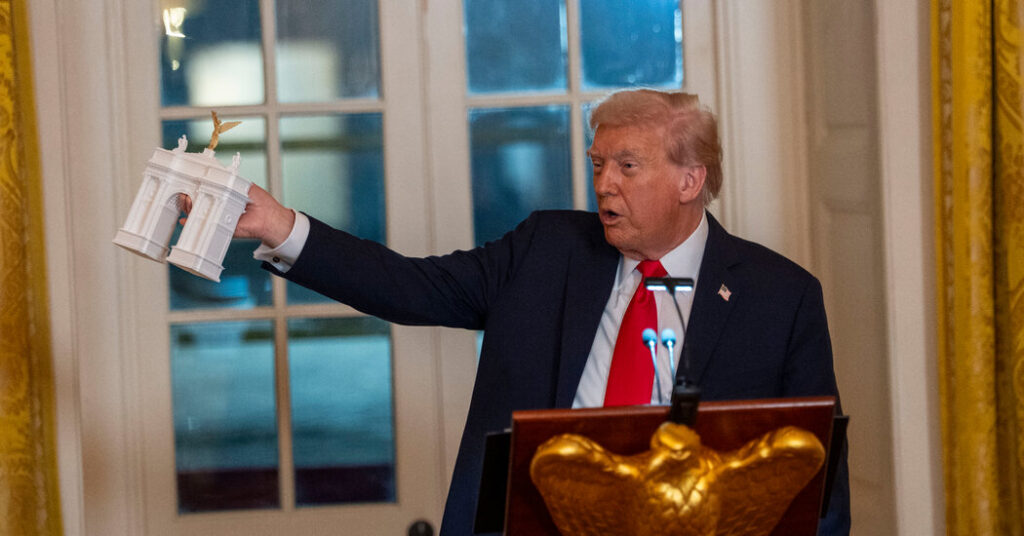
For decades, the planning commission reviewing construction projects in Washington has stood by the principle that the federal law limiting the height of buildings in the capital applies to federal projects.
But now that President Trump has proposed building a giant Triumphal Arch, the commission, which is led by Trump allies, is considering a different, more lenient view.
On Thursday, the National Capital Planning Commission will consider a new interpretation of the 1910 Height of Buildings Act: that it was never meant to apply to federal projects, and certainly not to Mr. Trump’s 250-foot arch.
The act “does not reference federal buildings,” the Interior Department wrote in a memo submitted to the panel, arguing that “Congress did not intend” for the law to be interpreted the way the commission had read it for nearly 90 years.
The effort to get around the Height of Buildings Act is the latest attempt by the Trump administration to bypass federal law or norms in pursuit of the president’s breakneck construction spree, which involves more than $1 billion in construction. If the commission changes its interpretation of the height law to ease approval of the arch, that would likely prompt a new legal fight, adding to the numerous lawsuits already trying to stymie the president’s projects.
The panel is set to approve preliminary site and building plans for the arch. A final approval would come later, and the future of the project remains uncertain. A group of Vietnam War veterans has sued to stop construction, citing the lack of congressional approval for the project and arguing that the arch would obstruct the carefully composed views between the Lincoln Memorial, Arlington National Cemetery and Robert E. Lee’s home.
Democrats have said that the project violates three federal laws, including the Commemorative Works Act, which governs monuments on federal land in Washington, and a 1912 law that says buildings or structures “shall not be erected” on federal land in the capital “without express authority of Congress.”
But the Height of Buildings Act, which generally does not allow buildings more than 130 feet tall in Washington, has become the latest complication.
Will Scharf, the Trump-appointed chairman of the commission who also serves as the White House staff secretary, surprised many planning and architecture experts in the city by arguing last month that the height law did not apply to the federal government, and should be viewed instead as part of Washington’s local zoning code. Since the law was passed, and since the planning commission began applying it in 1938, it has seldom if ever been treated that way.
“For the vast majority of the history of the law, it only applied to the federal government,” said Harriet Tregoning, a former planning director for the city.
There was no locally elected government in Washington when the Height Act was passed in 1910. The city was run by federally appointed commissioners, and by Congress. Washington gained its current measure of local governance only in the 1970s. The idea that the height restrictions were a local zoning matter that the city imposed on the federal government — raising concerns about federal supremacy, in Mr. Scharf’s view — inverts that history. In fact, if the locally elected D.C. Council wanted to change the law today, it could not. Only Congress can.
The act has preserved the airy horizontal feel of the capital, where wide-open views and intentionally planned sightlines point to major civic buildings and monuments. The result has been the preservation of a rare major American city with no skyscraper — and few buildings taller than about 12 stories, even downtown.
The law has tied the height of buildings to the width of streets, allowing buildings up to 130 feet on the city’s broadest avenues. Buildings on narrower residential streets are capped at 90 feet, though local zoning laws often enforce lower heights. And buildings up to 160 feet are allowed on part of Pennsylvania Avenue between the Capitol and the White House. In 2014, a modest change to the law allowed an additional 20 feet of “penthouse” structures intended to be less visible from the street.
As a practical matter, it would have been hard for Congress to preserve the city’s low-slung skyline by limiting the height of buildings used by private businesses and local residents, but not the height of buildings used for federal purposes. Those uses can also shift over time. The Trump administration is currently working to offload a lot of federal property to private buyers.
The original text of the height act mentions no exception for federal buildings.
“What’s the citation that they are relying on?” said Nancy MacWood, a former chair of the Committee of 100 on the Federal City, a nonprofit advocacy group focused on planning and preservation in the capital. “I can’t find anything. Nobody else can find anything.”
The Interior Department memo points to an earlier 1899 law passed by Congress that did include an exception to height limits in the city for federal and municipal buildings. The 1910 law in force today repealed conflicting laws. But the administration argues that it did not explicitly repeal the federal exception, because it said nothing about federal buildings.
Meghan Hottel-Cox, the general counsel for the National Capital Planning Commission, wrote her own memo explaining that the commission had consistently applied the law’s reference to “all buildings in the District of Columbia” to federal projects. And the commission has done that in a number of cases, including when reviewing the F.B.I. building on Pennsylvania Avenue that tops out at 160 feet.
A staff report prepared for Thursday’s meeting recommends that the commissioners ask the administration to revise the arch to comply with the law.
The staff suggested, however, that a 250-foot tall structure could still be possible. The dimensions would have to be adjusted, lowering the main structure to 130 feet, with a 20-foot observation level set back above it. The plan would shift more of the project’s height into the statue on top that would count as an architectural embellishment and not part of the building.
That solution may stretch the intent of the height act by creating a towering 100-foot-tall golden statue that could appear poised to tip off its pedestal. And such a resolution may be unsatisfying to the president, too. Any changes that make the archway smaller would further obscure views meant to be seen through the arch. And the president, who has been deeply involved in the smallest details of his construction projects, has rejected revisions to the arch even from his hand-picked appointees on another review panel.
A White House spokesman did not respond to a request for comment.
If the president’s allies on the commission opt to reinterpret the law, that would throw into question how the planning body has operated for years, and how it would handle other projects.
“If this new theory were to be adopted, according to N.C.P.C.’s own staff memo, it would be inconsistent with the decisions made by N.C.P.C. since its creation,” said Tom Mayes, the chief legal officer and general counsel for the National Trust for Historic Preservation, which has sued the administration over some of the president’s other projects.