


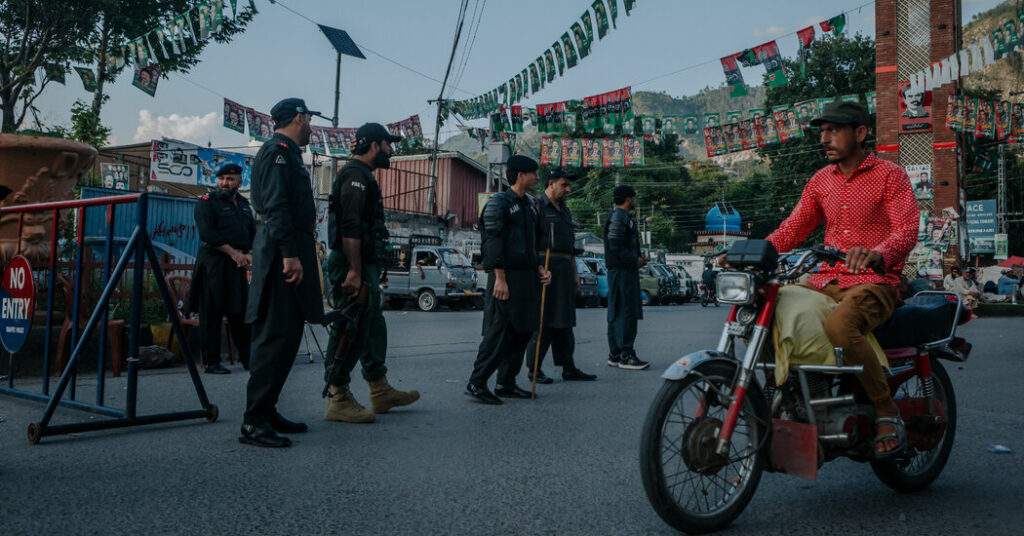
A violent clash broke out on Tuesday morning in Mirpur, in Pakistan-administered Kashmir, as police confronted people from a civil rights group who had gathered to protest violence between police and the group the day before.
It was the latest flare-up in weeks of violence that have left dozens dead and cast a shadow over an election that began Monday in the Himalayan territory.
At least two people died at the district hospital in Mirpur after being brought there with gunshot wounds, according to a district official who asked to remain anonymous to discuss sensitive information.
The Human Rights Commission of Pakistan, an independent rights body, called for “an immediate end to this cycle of violence” and urged an independent investigation into the reported deaths and injuries.
Thousands of supporters of the civil rights group, the Joint Awami Action Committee, had gathered in Rawalakot, a town about 20 miles from the heavily militarized de facto border dividing regions of Kashmir claimed by India and Pakistan. Clashes broke out with the police on Rawalakot’s outskirts as the supporters tried to march toward Muzaffarabad, the regional capital.
The civil rights group said that several of its supporters had died in clashes with the police, though the claim could not be independently verified, and officials had not confirmed any deaths as of Tuesday.
Protesters in Kashmir have staged sit-ins, strikes and demonstrations since early June, calling for electoral changes ahead of the regional parliamentary election that began Monday and is scheduled to unfold in three phases until Aug. 10. The group’s leadership and its supporters want to reallocate parliamentary seats reserved for Kashmiris living elsewhere in Pakistan to those who actually live in Kashmir — a move that Pakistan’s government has rejected, in part by arguing that it would require a constitutional change.
A coalition of businessmen, students and civil society activists, the group has in the past campaigned for subsidized food prices and an end to financial advantages given to elected representatives in Kashmir. Protests also turned deadly in previous years, including in 2024 and 2025, although the current episode appears to be the deadliest since the group was founded in 2023.
At least 30 people, including protesters, law enforcement personnel and bystanders, had died in clashes since early June and before Monday’s latest round of violence, according to local officials and independent estimates. Kashmir’s local government banned the organization under antiterrorism laws days before a planned protest in June.
Umar Nazir Kashmiri, one of its leaders, said in video messages on Monday that the movement was peaceful and that its leadership had instructed supporters not to carry weapons. He said the group still planned on marching to Muzaffarabad.
The police in Kashmir confirmed the clashes on Monday but did not say if there were fatalities. In a statement, they said two officers had been wounded from what they described as “armed mobs.”
The New York Times could not independently verify the casualty figures or the sequence of events, because roads into Rawalakot, which is 70 miles away from Pakistan’s capital, Islamabad, are blocked, and internet services across Kashmir have been suspended since June 5, severely restricting access to the area.
The Joint Awami Action Committee shifted its focus away from economic governance and to the region’s political system this year. It is now campaigning to abolish the allocation of 12 of Kashmir’s 45 assembly seats to refugees from India-administered Kashmir living across Pakistan.
Defenders of the provision say that the seats give displaced Kashmiris a legitimate voice in regional affairs. But the civil rights group says non-Kashmiri political parties have leveraged those seats to influence or unseat local governments, and it has called for a boycott of the election.
The unrest in Kashmir is one of many crises hitting Pakistan, a country of 250 million where the powerful military is battling two insurgencies in the southern and western provinces of Balochistan and Khyber Pakhtunkhwa that have killed thousands of security personnel in recent years.