


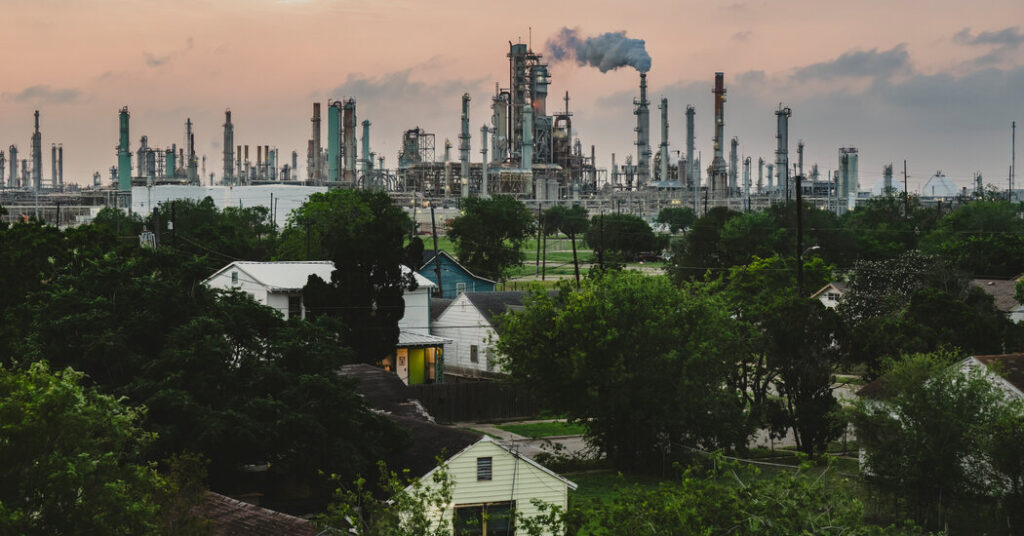
The mayor of Corpus Christi called an emergency meeting last month to deliver a dire warning: The city, among the largest in Texas, was running out of water. City leaders had to make a plan, and fast.
“Every day of delay increases uncertainty,” the mayor, Paulette Guajardo, told the City Council. Officials had warned that demand for water could outstrip supply within months.
Corpus Christi, a coastal city of more than 300,000 and home to a large industrial port, is not alone in grappling with water shortages. Half the nation is dealing with a persistent drought, according to federal data, at the same time as industrial water demand has risen because of growing needs from power plants and data centers.
But Corpus Christi’s struggle to respond could serve as a warning to cities around Texas and across the country, officials said.
“This is actually the canary in the coal mine,” said Charles Perry, a Republican who chairs a committee on water in the Texas Senate.
Faced with a looming water crisis, Gov. Greg Abbott has threatened a state takeover, saying he may be forced to “run that city.” President Trump, during a visit last month, promised the city federal support for water projects.
Corpus Christi’s water problem has been building for several years. Its port and industrial corridor have expanded with the encouragement of the state and local government. New water sources have not kept pace. Then came a major, ongoing drought, now in its fifth year.
Major industrial companies, which use half the city’s water each day, have recently taken some steps to reduce consumption, like using more internally recycled water and cutting back on fleet vehicle washes, industry representatives said. But city officials said the companies have not made drastic cuts.
Bob Paulison, executive director of the Coastal Bend Industry Association, which represents companies with local footprints like Citgo and Valero Energy, said simply shutting down industry is not a viable option.
“There are hundreds of billions of dollars of investment at stake,” he said in an interview, “and the future of an entire region.”
Failure to address the crisis would ripple far beyond Corpus Christi. The city supplies water to about half a million customers in seven counties and the industrial companies that produce products like jet fuel, plastics and steel.
But the City Council, which is tasked with fixing the problem, has been wracked by infighting and high turnover. There is an effort to remove the mayor from office, and even mundane policy discussions devolve into sniping. At the emergency meeting last month, some council members questioned the mayor’s focus on a desalination project that, they said, would not solve the city’s immediate water problems.
“It’s clearly dysfunctional,” Peter Zanoni, the city manager, said in an interview.
Without a quick solution, there has been an all-out scramble for water in recent months. Residents have been asked to conserve as the city drills new wells. Even the school district is looking at drilling. All of the projects could cost around $1 billion, which would increase the city’s debt by 50 percent. Officials have also discussed building multiple desalination plants similar to those used in the Middle East to turn seawater in drinkable water.
Many residents have prayed for rain or, in some cases, even a hurricane. A city program to sell plastic barrels so residents can “catch the rain” at home proved so popular that officials sold out their supply last month. More are on the way.
“God willing, the rain will come,” a city councilwoman, Sylvia Campos, said after the emergency meeting.
Almost everyone agrees on how Corpus Christi got here. The city relies on surface water to provide much of its supply. But after years without significant rain, the lakes have dwindled. Two nearby reservoirs recently dipped below 10 percent capacity, and a third briefly dropped below 50 percent last month.
City officials said a Level 1 water emergency may be declared in September, which means there are just six months until demand exceeds supply. That could trigger mandatory water cutbacks of as much as 25 percent for some customers.
Corpus Christi has spent hundreds of millions of dollars on infrastructure projects over the last five years, said Mr. Zanoni, the city manager. But the city’s water plan, he said, was not designed to handle the current drought, which has lasted nearly five years.
By last summer, he said, he stopped hoping a storm would save them, and realized “this is going to be a serious event.”
City leaders have discussed desalination as a possible long-term solution. Water experts have called it a “drought-proof” option. City officials, however, estimate the desalination plant would not provide drinkable water until late 2029.
The City Council remains divided on the issue. It voted to shelve a desalination project last year after the cost ballooned over $1 billion. The project was renewed at a lower price and under a new firm. The council now wants to ensure the project will be environmentally safe before moving forward. Some residents and council members oppose it altogether because it would be built in Hillcrest, a historically Black neighborhood near the port.
“They put industry as a priority, and not the citizens,” said Monna Lytle, 71, who grew up in Hillcrest.
She worried a desalination plant would further harm her neighborhood, which is already flanked by refineries and industrial storage facilities and has dwindled to about 80 households.
The City Council is scheduled to consider the plant’s next steps in June. At the same time, the council is looking into misconduct allegations against Mayor Guajardo related to a hotel development project.
Carolyn Vaughn, a conservative councilwoman, blamed Ms. Guajardo for the “bickering” on the council, adding that the high turnover has hurt the council’s ability to conduct long term planning. Council members serve two year terms. “We’re doing the best that we can,” she said.
Ms. Guajardo has denied any wrongdoing. She said the removal effort is about “water and my refusal to accept further delays on seawater desalination.”
The city requested $500 million in federal funding for desalination through its congressman earlier this year, Mr. Zanoni said, including for the Hillcrest plant supported by the mayor.
Mr. Trump addressed the city’s needs during his recent visit, vowing in a television interview to help.
“It’s one of the most vibrant places in the country,” Mr. Trump said of Corpus Christi. “We’re not going to say, ‘it’s vibrant, but we’re not going to give you water.’”
A White House spokeswoman said federal officials have offered to meet with lawmakers and industry leaders to discuss the matter further.
The state has offered low-interest loans for the desalination plant. The governor has also tried clearing away some hurdles, including fast-tracking permits from state environmental regulators, to help the city accomplish its short-term fixes — like tapping into underground water.
Over the past year, the city has drilled 15 wells on land it bought in rural parts of Nueces County, where the city is located. It has also gone further afield, planning a massive new groundwater project with 24 wells in neighboring San Patricio County.
The city has faced resistance over these efforts.
“They’re pushing their emergency off on us,” said Kelly Harlan, who is part of a group of Nueces County residents trying to create a new local government entity to manage groundwater drilling in the area. He said water levels in rural wells have already dropped since the city began drilling nearby.
The nearby city of Sinton — population 5,500 — has taken Corpus Christi to court over its attempts to tap into their underground water. “It’s kind of like the bully in the neighborhood,” said John Hobson, the city manager in Sinton.
Mr. Zanoni, of Corpus Christi, said he hoped its groundwater projects would prevent a serious water emergency in the coming months.
“If everything goes our way, we should be OK,” he said, sitting in a city hall office. “We should make it.”