


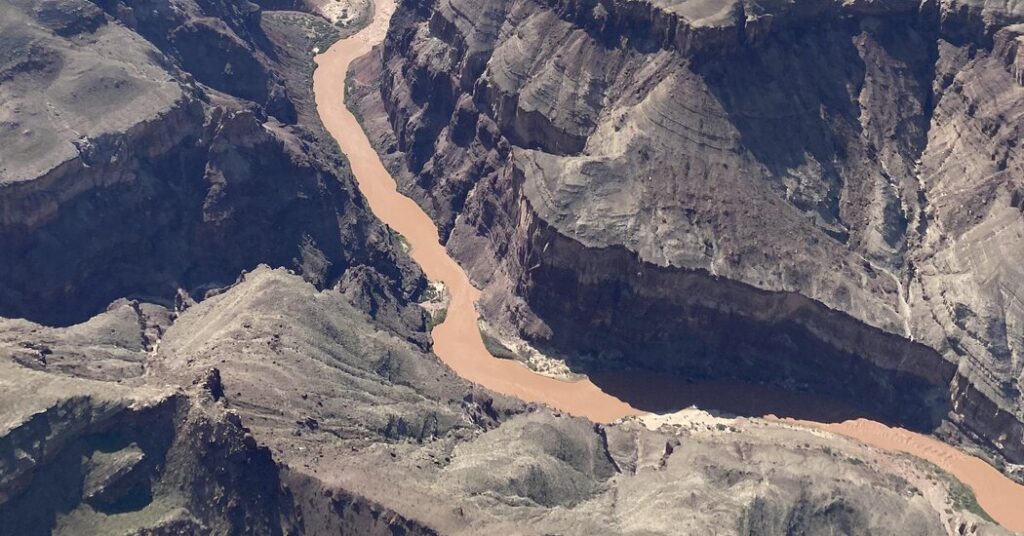
Two people were killed and a third was still missing after a downpour over the weekend sent torrents of water barreling through Grand Canyon National Park, officials said late Monday.
The flash flood in one of the country’s most celebrated natural sanctuaries occurred Saturday after bursts of intense rain.
More than 80 people were rescued from the park on Saturday and Sunday, most of them by helicopter, said the park’s incident commander, Dave Black. But park rangers and members of the Coconino County Sheriff’s Office said that it was not until Monday that they were able to locate a dozen people who were unaccounted for.
At a news conference on Monday evening, Mr. Black and other officials offered the first detailed accounts of the response to the flash flood. Mr. Black said officials had combed through the list of overnight visitors, who are required to have permits. Park officials also tracked down hundreds of tips about day visitors to the park who might have been missing.
“As of right now, we have one known person unaccounted for,” Mr. Black said.
The authorities said they were not releasing the names of the two people who died, both men, at the request of the families.
Witnesses to the deluge described the wall of water sounding like a freight train as it moved through the canyon on Saturday. A video posted to Facebook by park officials showed a churning flume of milk-chocolate-colored water rushing down a hillside.
Mr. Black said rain and the threat of storms had hampered ground rescue teams on Monday but that four teams of rescuers with cadaver dogs would search the affected area on Tuesday for the missing person. “We are absolutely holding out hope that that person is still alive,” he said.
The floodwaters also badly damaged a crucial pipeline that supplies water to the South Rim of the canyon, prompting officials to order the closure of hotels during the final surge of the peak summer rush. But the park remains open to visitors, officials said.
Search efforts over the past two days focused on Bright Angel Creek, which runs from near the North Rim down to the Colorado River, the National Park Service said.
Officials announced late Sunday that rescuers had found the first body, a 46-year-old man, near Crystal Rapids along the Colorado River. Then early on Monday the Park Service said the body of a second victim had been recovered.
The flash flood was driven by sudden bursts of rainfall, and it buried trails beneath rock slides, washed away bridges and cut off access to a remote area on Saturday.
Park officials closed the Colorado River to rafts after the flooding but reopened it on Sunday.
The flooding damaged or destroyed about 40 percent of the Transcanyon Waterline, park officials said. The pipeline carries water from the North Rim, where water is more plentiful, down to the floor of the canyon and then up to the more arid South Rim. Although park officials ordered hotels closed, day use of the park would continue, they said. Water from the pipeline is also used for fire suppression.
Spigots in most campgrounds on the South Rim have been shut off, and camp fires are not permitted on the South Rim or the inner canyon, park officials said.
Brian Drapeaux, the park’s deputy superintendent, said the park had two weeks’ worth of potable water in storage on the South Rim.
Arizona and other parts of the Southwest are subject to the North American monsoon, which brings rainfall and sometimes violent storms from June through September. This year, meteorologists noted that a marine heat wave in the Pacific Ocean was bringing extra moisture into the atmosphere. The National Weather Service recorded .84 inches of rainfall in a single hour on Saturday afternoon in the area of the flooding.
Interior Secretary Doug Burgum said Monday in an interview on an Arizona radio station that an aggravating factor was the effect of last year’s Dragon Bravo Fire, which burned nearly 150,000 acres along the North Rim and deprived the area of vegetation that might have held land in place that instead slipped away in the downpour.
Mr. Burgum, who visited the Grand Canyon last week, said that water tanks on the South Rim would allow the park to accommodate day visitors while workers repair the waterline. But those repairs could take time.
“It sounds like entire sections may be taken out,” he said on the radio station, KTAR.
Flooding wiped out nearly all the footbridges spanning Bright Angel Creek, which follows along the North Kaibab Trail as it winds from the North Rim down to the Colorado River. The entire trail is closed until further notice, the Park Service said.
For future visitors to the park, there appeared no clear timeline for repairing the damage to the Transcanyon Waterline. Even before Saturday’s deluge, the aging pipeline had frequently ruptured, with 85 major breaks since 2010. In 2023, the National Park Service awarded a $208 million contract to repair and replace the pipeline system to Stronghold Engineering, a California-based company.
The project had been scheduled to be completed in 2027. Scott Bailey, the chief operating officer of Stronghold Engineering, declined to comment on Monday and referred questions to the Park Service, which did not immediately respond to a request for comment.
On Sunday, Mr. Bailey had said in an interview that the damage to the pipeline would set back the project at least two or three months.
Charles F. Sams III, who led the Park Service under President Joseph R. Biden Jr., said he worried that the new damage could constrain firefighting efforts.
“While we are hopefully coming into cooler temperatures, I would still have a very strong concern about the need for that water for fire suppression work,” Mr. Sams said.
Christina Morales, Maxine Joselow, Lauren McGaughy and Jonathan J. Higuera contributed reporting.