


The Venice Biennale can’t seem to escape debates over Russia. The country’s return to the art event, despite the war in Ukraine, set off months of controversy earlier this year. In July, the European Union weighed in on the dispute, withdrawing a multiyear grant to the Biennale.
Now, one of Russia’s most celebrated ballerinas has become part of the story. Last weekend, the Dance Biennale, a sister event to the much bigger art Biennale, quietly welcomed Diana Vishneva, a star of Mariinsky Ballet in St. Petersburg. The performances with WinnDance, a new company dedicated to dancers over age 40, were Vishneva’s first time back on a Western stage since 2023, an absence connected to Russia’s 2022 invasion of Ukraine.
On Saturday, as Vishneva took an unassuming bow as part of WinnDance’s ensemble, it was easy to forget what she represents. Ballet has long been one of Russia’s most successful cultural exports, a source of international prestige and soft power. But since the full-scale invasion of Ukraine, much of the international dance world has sought to distance itself from Russia, severing ties with the country’s state-funded companies and their performers. Just this year, Svetlana Zakharova, a star of the Bolshoi Ballet in Moscow, had performances in Florence and Rome canceled.
Although Vishneva was also a principal dancer with American Ballet Theater from 2005 to 2017, and initially expressed opposition to the war, she has maintained connections to state institutions that have backed the invasion of Ukraine. The Mariinsky Ballet is led by the conductor Valery Gergiev, who is closely aligned with President Vladimir V. Putin. Vishneva is also the founder and artistic director of Context, a St. Petersburg festival and platform sponsored by Gazprom, the state-owned energy giant. And she is enough of a national hero that in July, Putin wished her a happy 50th birthday via the Kremlin website.
In Venice, her return was handled with a conspicuous lack of fanfare. Vishneva declined an interview request for this article, and a WinnDance spokesperson said she had been included in the international ensemble “in her individual capacity as an artist.”
In answer to written questions, a Biennale spokesman said that the event “will never exclude anyone on the basis of geographic origin or nationality” — a departure from its stance just after the 2022 invasion, when the Biennale vowed to shun any artists or delegations with ties to the Russian government.
Vishneva’s presence threatened to overshadow the debut of WinnDance, a small company hoping to carve a niche in the ballet world. Co-founded by Slava Tutukin, a Russian-born entrepreneur who is a former dancer, and Marijn Rademaker, a longtime principal artist with Stuttgart Ballet in Germany, WinnDance brings together dancers who want to continue their careers into their 40s and beyond, when most ballet performers have retired.
It’s not a new concept: Nederlands Dans Theater 3 served as the “older” sister to the Dutch company Nederlands Dans Theater from 1991 to 2006, and in the field of contemporary dance, the Berlin-based DanceOn Ensemble has built lasting success since its inception in 2015. But what these companies had, and what WinnDance lacks at this stage, is high-caliber productions.
WinnDance’s debut program, “Scirocco,” was loosely inspired by Venice itself. “Death in Venice,” the unwieldy first half, is named after Thomas Mann’s 1912 novella, though you would never know it from the choreography. Only a black-and-white film, by and with Javier de Frutos, explicitly drew on the story of Gustav von Aschenbach, the middle-aged writer who becomes obsessed with a teenage boy in Venice.
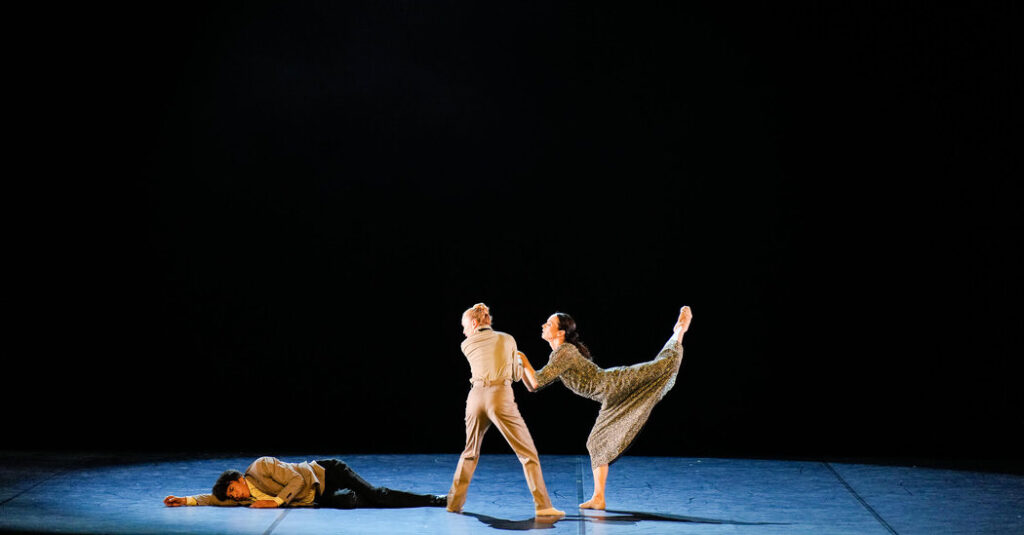
In between film sequences, four choreographers — Imre and Marne van Opstal, Omar Román De Jesús and Rainer Behr — offered dance platitudes that never matched the performers’ maturity. Vishneva appeared in a ménage à trois with a self-absorbed man, played by Gil Roman, and his presumed mistress (Silvia Azzoni). Only the final scene, by Behr, touched on von Aschenbach’s death, by turning him into a Christ-like figure surrounded by mourners in white.
WinnDance’s ensemble returned after an intermission in “Bridge of Sighs,” a new work by the 87-year-old American choreographer John Neumeier, a giant of 20th-century neoclassical dance. Its mood was nostalgic: Rademaker’s boyish character appeared to look back on past relationships in slow, deliberate tableaux.
While “Bridge of Sighs” offered more coherent dramaturgy, the women of WinnDance were still ill-served. Mara Galeazzi and Igone de Jongh, two highly individual ballet stars, mostly blended into the background. Even Vishneva, with her considerable gifts, was stuck playing plaintive mother figures. For now, it’s unclear what WinnDance wants to stand for — artistically or politically.
It made for a dissonant conclusion to this year’s Dance Biennale. Under the direction of the British choreographer Wayne McGregor, the event has explicitly taken up questions of power and colonialism. The 2026 Golden Lion, the festival’s top prize, went to Bangarra Dance Theater, an Australian company of Aboriginal and Torres Strait Islander performers; the Silver Lion was awarded to Mamela Nyamza, a South African choreographer and activist who has examined social inequality in her work.
One production simply asked: “What Is War”? In it, Wen Hui of China and Eiko Otake of Japan, both senior, experienced performers and choreographers, dived into their countries’ painful shared history. In a mix of spoken text, video and intimate Tanztheater-style vignettes, Hui recalled the death of her grandmother during a Japanese bombing raid in 1941; Otake, meanwhile, remembered her father’s short-lived days as a Japanese soldier, and Japan’s complex legacy as an aggressor country.
Early on, the two walked slowly toward each other from opposite sides of the stage. Hui clutched her skirt stiffly, while the frail-looking Otake reached forward, hunched, as if hoping to touch her. As Hui simply walked past, she looked stunned and anguished — suggesting that reckoning with the ripple effects of conflict remained out of reach, even decades later.
“Does the war have anything to do with my person?” one of them asked in a video conversation early on. Their shared vulnerability — down to a painful scene in which they stripped and took turns writing on the other’s body with force — made the question seem current, too. As new wars unfold, how should art address them? The Venice Biennale has no clear answer.