


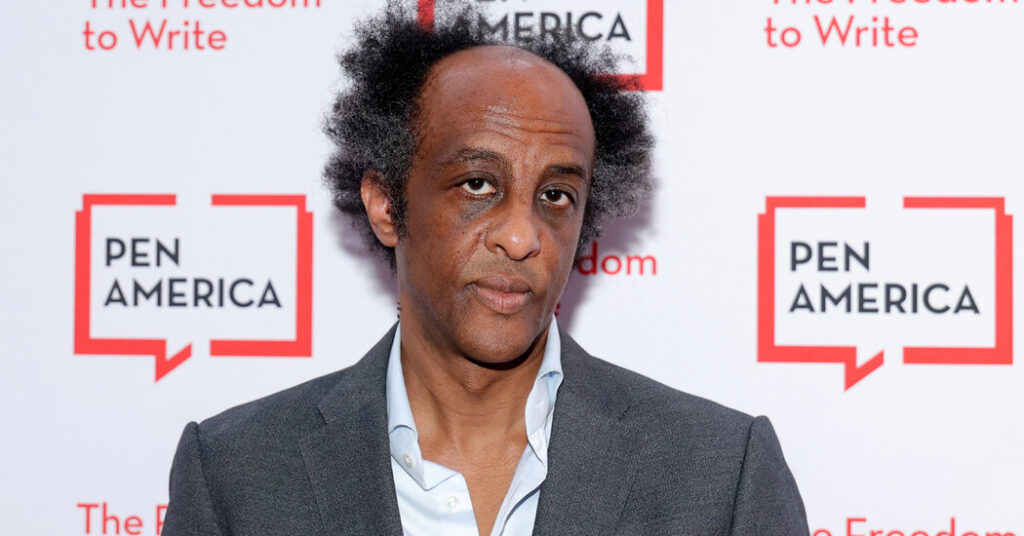
Dinaw Mengestu said he resigned as president of the free expression group PEN America on Thursday, in part because of an article about Israeli and Jewish writers in which the group outlines its opposition to cultural boycotts.
He called that approach “unethical” because it could portray the Boycott, Divestment and Sanctions movement, which seeks to economically isolate Israel because of its treatment of Palestinians, as discriminatory conduct instead of protected political speech. In an email, PEN America said it rejected any effort to read the article that way.
“We have the responsibility,” Mengestu said in an interview on Friday, “to be conscious and aware of how our work can impact and influence those debates, and especially if that means producing work that might actually restrict or limit or suppress what is constitutionally protected speech.”
The article, published on Thursday with the headline “A Silent Moratorium,” explores how Israeli and Jewish authors have experienced harassment and professional challenges since the Hamas-led attacks on Oct. 7, 2023, and Israel’s retaliation. In an early section, PEN America says that boycotts such as those employed by pro-Palestinian activists represent a threat to free expression rights for writers.
“PEN America has long opposed cultural and academic boycotts, but we have always drawn a clear line between disagreeing with a tactic and defending the right to use it,” the organization said in an email on Friday.
It added that the group had previously opposed anti-B.D.S. laws and defended writers who were punished for their involvement with the movement.
Mengestu, an award-winning Ethiopian American novelist, was elected PEN America’s president in December. He said the article was the most recent in a series of moves by the nonprofit organization that he felt were counter to its values and could harm broader efforts to preserve freedom of expression.
“This report is not an isolated incident,” Mengestu said. He added that the article “continues this approach toward defending some rights while not defending others.”
In its email, PEN America said it was grateful for Mengestu’s leadership.
“We respect that he’s made a decision he believes in,” it said. “We recognize people can disagree about how best to apply free expression principles in this extraordinarily difficult environment.”
It also affirmed PEN America’s commitment to “tell hard stories, in politically challenging moments, about writers from a range of perspectives, even when it’s uncomfortable for us given our own recent history.”
Mengestu’s resignation is the latest upheaval at the organization, which has been on shaky ground in recent years because of criticism toward its response to the war in Gaza. In the face of a boycott by writers accusing it of anti-Palestinian bias, PEN America canceled its annual book awards and global literary festival in 2024.
Past presidents of PEN America include Jennifer Finney Boylan, Salman Rushdie, Ayad Akhtar and Jennifer Egan.
When Mengestu was elected president in December after serving on the group’s board for about a decade, he told The New York Times that it was important to “mend and rebuild” relationships with writers who felt the group had not done enough to support Palestinian authors.
“We have worked to help relocate Palestinian writers and artists to other countries,” he said. “For those with no way of remaining in Gaza, we were able to work to help them rebuild new lives.”
On Friday, Mengestu said that there had been a lack of transparency within the organization and that several staff members had reached out to express “anger and frustration that they were kept entirely in the dark about the publication” of the article about Jewish writers.
PEN America said in its email that it felt vital to share stories of exclusion and isolation from writers in its community. “We are proud of this piece,” it said, “and believe it is exactly the kind of important work that PEN America is uniquely positioned to do.”
Suzanne Nossel, the former chief executive of PEN America, resigned in 2024 after more than 10 years in the role. Under her leadership, PEN America transformed from a niche literary society into a civil rights powerhouse, which has left the organization more vulnerable to criticism.
Jennifer Schuessler contributed reporting.