


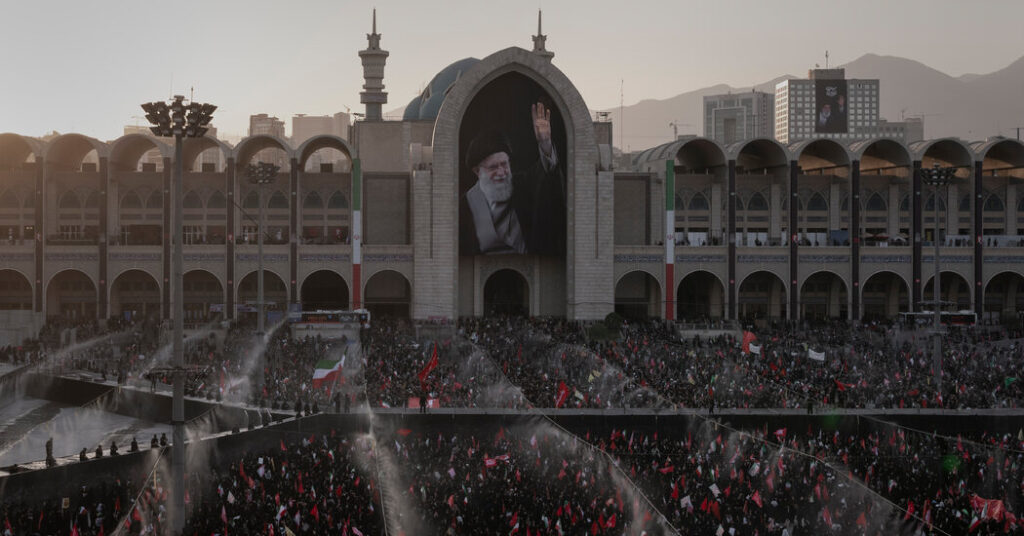
Even before the United States launched new strikes Wednesday on Iran and President Trump cast doubt on the countries’ cease-fire, divisions over the agreement were already emerging within Iran’s leadership.
The developments of the past day have deepened those fractures, pitting one faction of Iranian officials who favor negotiation with Washington against hard-liners who vehemently oppose making a deal with the United States.
The faction that favors talks has at the same time accused the United States of violating the terms of the truce agreement. These officials include President Masoud Pezeshkian, who on Wednesday said Washington was “bullying rivals, creating obstacles and cheating.”
The rival group, drawn from a minority of hard-liners, has directed its anger at the Iranian president and negotiating team.
The rising tensions inside and outside of Iran have unfolded against the backdrop of Iran’s weeklong funeral for its slain supreme leader, Ayatollah Ali Khamenei, with ceremonies taking place in five cities in Iran and Iraq. Mr. Khamenei’s body had reached Najaf, Iraq, when the American airstrikes began and was scheduled to return to Iran for burial in Mashhad on Thursday.
All week, as the funeral has progressed, the hard-line faction in Iran has targeted government officials.
Mr. Pezeshkian was attacked on Monday by a crowd of hard-line supporters, who tried to tackle him while shouting “death to the appeaser,” as he attended the funeral procession, according to videos on social media and shared by his office. Mr. Pezeshkian swayed, looking dazed, as his security detail dragged him and pushed away the crowd.
Another government official in his camp, Foreign Minister Abbas Araghchi, was assaulted with a rock on Monday as he was chased down an alley during the funeral. His attackers, waving flags, cursed him and called for his death, video of the incident posted on social media showed.
Government officials and supporters called for the arrest of the people who attacked the president and foreign minister, and urged the judiciary to hold the hard-liners accountable.
Not long after those incidents, hostilities over the Strait of Hormuz had begun again. Iran’s Islamic Revolutionary Guards Corps targeted several commercial ships passing through the critical waterway this week. Early Wednesday, the United States carried out intense airstrikes on dozens of targets along Iran’s southern shores. Iran retaliated by launching ballistic missiles and drones targeting American military bases in Kuwait and Bahrain.
By Wednesday night, the United States was striking Iran again. Two senior Iranian officials, with knowledge of internal leadership deliberations, described the situation inside Iran’s political circles as being in disarray. The officials spoke on the condition of anonymity because they were not authorized to discuss government security matters. They said no decision has been made about how to proceed — whether to resume conflict or continue diplomatic engagement — and that a blame game was in full swing within Iran.
But the officials said Iran would retaliate forcefully to new attacks, echoing statements made this week by the Revolutionary Guards.
“What shall be done in response to someone who has no commitment to their own word or signature?,” Mehdi Tabatabaie, the deputy communication chief for the president’s office, asked on social media on Wednesday, in an apparent reference to Mr. Trump’s comments about the cease-fire.
Yousef Pezeshkian, the son and adviser of the president, wrote a long defense of the policy of engagement with the United States on social media. He condemned the attacks on his father and other officials by hard-liners. “If this anger is directed at our own officials and targets domestic unity and larger Islamic unity, it means it has become a tool for the enemy,” he said.