


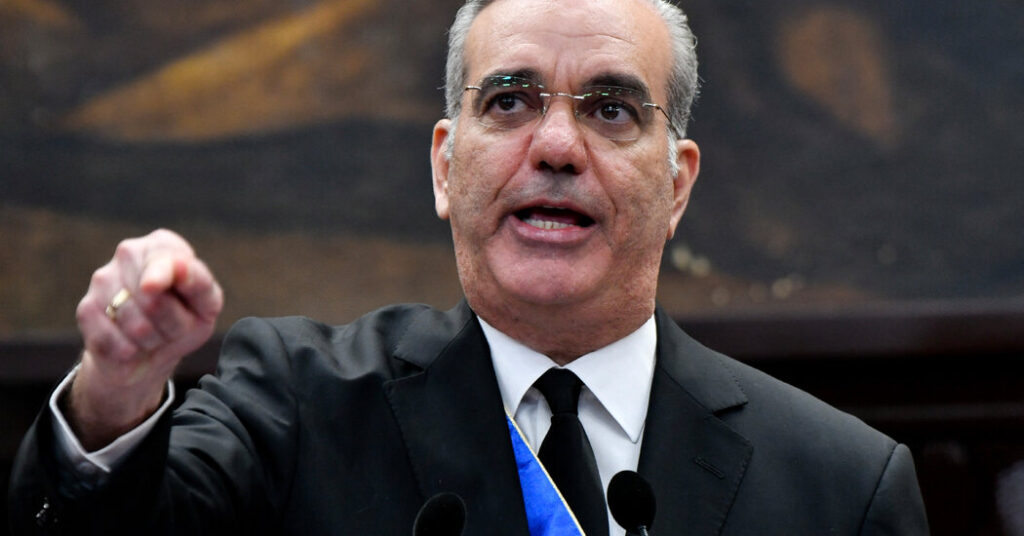
The Dominican Republic said on Tuesday it had agreed to take third-country deportees from the United States, as the Caribbean nation sought to strengthen its ties with the Trump administration and join other Latin American countries that had struck such deals.
The move was an about-face for the country’s president, Luis Abinader, who said last year that the Dominican Republic would not accept deportees from other countries — “only Dominicans, who we have the duty and the right to do so.”
The new pact is part of President Trump’s efforts to find nations willing to take migrants detained in the United States. Many deportees have come from countries in Africa, Eastern Europe and Asia, where the U.S. authorities cannot easily send them back. Many migrants also cannot legally be returned to their home countries for fear of persecution or abuse.
The Dominican foreign ministry announced a “nonbinding memorandum of understanding” with the United States to accept third-country deportees without criminal records. They would not include Haitians or unaccompanied minors. It said the deportees would be considered “in transit” through the country. Dominican law doesn’t specify a time limit for those in transit.
It was also not immediately clear how many deportees would be sent from the United States. The Dominican government said that it would be a “limited number.”
Bernardo Vega, an economist and former Dominican ambassador to United States, said in a Dominican TV interview that the deal was “bad news” and a sign that the United States was pressuring the Dominican Republic.
In other countries across the region, such as El Salvador, Costa Rica and Panama, the U.S. deportation of migrants from other countries has come under heavy scrutiny and legal challenges.
Under Mr. Abinader, the Dominican government has been aggressively deporting Haitians, including unaccompanied children, to violence-torn Haiti, with which it shares an island. Nearly 380,000 Haitians were deported last year, according to Dominican government figures.
The Dominican government said that the U.S. deportations would occur on a case-by-case basis, and have “financial and operational support from the U.S. government to ensure adequate conditions during temporary stays and facilitate orderly return to countries of origin.”
The Dominican foreign ministry and the U.S. Department of Homeland Security did not immediately respond to requests for comment regarding the number of deportees or the frequency of deportations.
“Cooperation between the Dominican Republic and the United States is based on mutual respect, shared responsibility and transparency, with the aim of strengthening regional security, combating drug trafficking and transnational organized crime, fighting terrorism in all its forms, and contributing to the orderly and humane management of migration flows,” the ministry said in a statement.
It was not clear why Mr. Abinader had reversed course. He has maintained a strong relationship with the Trump administration and was among the conservative Latin American leaders invited to an inaugural Shield of the Americas summit organized by Mr. Trump in Florida in March.
Secretary of State Marco Rubio also praised the Dominican Republic last year as one of the Latin America countries that was “doing it the right way.”
Before Mr. Rubio’s visit to the island in February 2025, Mr. Abinader was asked if his country would join other nations in accepting foreign migrants deported from the United States.
“We do not have, nor will we accept, nor are we obligated to, nor will we accept receiving people from other countries,” he said then.
The U.S. ambassador to the Dominican Republic, Leah F. Campos, said in a social media post on Tuesday that the deal allowed the United States to repatriate migrants “more expeditiously” while respecting Dominican law, sovereignty and border procedures.
“The United States is grateful for our friendship with the Dominican Republic as we collaborate to strengthen regional security,” she added.
The Dominican government also announced on Tuesday that it had granted a temporary extension to the U.S. military to operate inside restricted areas on its part of the island. That deal was originally announced in November. Mr. Abinader said then that the Pentagon could use restricted areas within the San Isidro Air Base and Las Américas International Airport outside the Dominican capital, Santo Domingo, to refuel aircraft and to transport equipment and technical personnel.
The Pentagon has been attacking boats it says are trafficking drugs in the Caribbean and eastern Pacific. The U.S. military has conducted nearly 60 such strikes since September, killing at least 192 people.
In another sign of further alignment with the Trump administration, the Dominican government announced on Tuesday that it had designated Iran’s Islamic Revolutionary Guards Corps and Hezbollah, the Iran-backed Lebanese militant group, as terrorist organizations.