


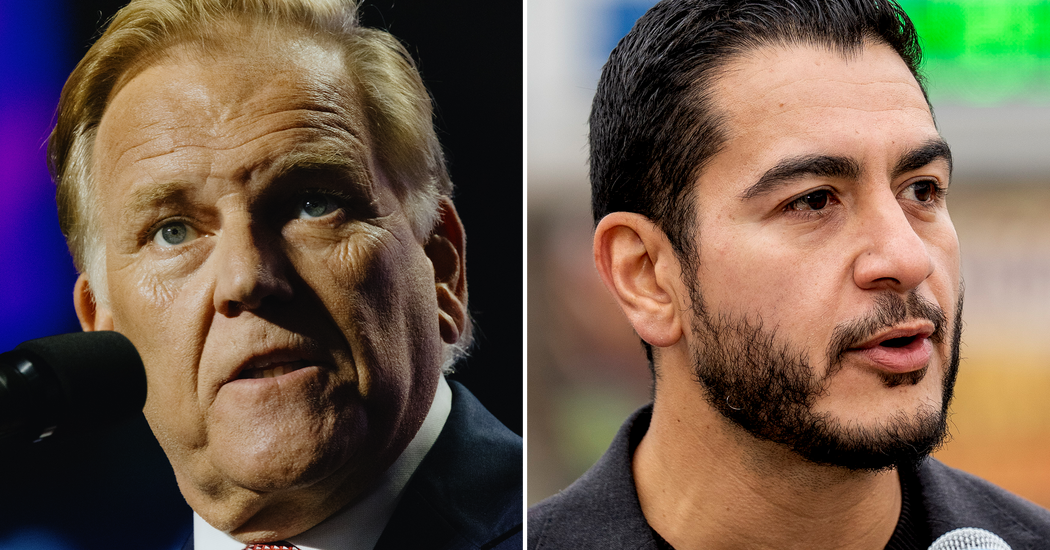
Dr. Abdul El-Sayed, the Democratic nominee for Senate in Michigan, holds a modest lead over the Republican nominee, Mike Rogers, with six weeks until Election Day, according to a new poll from The New York Times and Siena University.
Dr. El-Sayed has a five-point edge over Mr. Rogers, 49 percent to 44 percent, the survey found, and is viewed more favorably by voters. The race in Michigan, a perennial swing state, is one of a handful of competitive contests that could decide control of the Senate.
Mr. Rogers, a former congressman backed by President Trump, has sought to distance himself from the increasingly unpopular president in recent days, including by calling for an end to the war with Iran. Dr. El-Sayed, a progressive, is working to heal wounds from a bitter primary.
Here are seven takeaways from the poll.
Dr. El-Sayed is viewed more positively overall, but remains polarizing.
Forty-six percent of Michigan voters said Dr. El-Sayed, a former public health official, had good character, while 39 percent said the same of Mr. Rogers, a former congressman. Dr. El-Sayed also held an edge in the number of people who view him favorably, 47 percent to 39 percent. But a significant number of voters also view Dr. El-Sayed very unfavorably, 35 percent for Dr. El-Sayed, compared with 27 percent for Mr. Rogers.
Older voters prefer the older candidate.
Mr. Rogers, 63, led Dr. El-Sayed, 41, by nine points with voters ages 45 and up, a bloc that makes up two-thirds of the likely electorate. Among voters 44 or younger, Mr. Rogers trails Dr. El-Sayed by 39 percentage voters, the poll found.
Independents are roughly split on the candidates.
Mr. Rogers has been trying to win independents and peel off Democrats by portraying Dr. El-Sayed as an extremist. The results suggested he has met with mixed results: Dr. El-Sayed held a one-point lead with independents. And just 3 percent of Democrats said they planned to back Mr. Rogers, which was about equal to the share of Republicans who said they planned to support Dr. El-Sayed. Still, more voters in the poll said Dr. El-Sayed was more extreme (50 percent) than said Mr. Rogers was more extreme (36 percent).
A.I. has emerged as a high-profile issue.
Dr. El-Sayed has called for strong A.I. guardrails (including a pause on A.I. development), and Mr. Rogers split with Mr. Trump, who has largely dismissed any risks, by saying he would make A.I. regulation a top priority if elected. Dr. El-Sayed held an 11-point edge over Mr. Rogers in a poll question about who would be better on A.I. data centers.
A streamer who campaigned with Dr. El-Sayed is deeply unpopular among voters who know him.
The streamer, Hasan Piker, campaigned with Dr. El-Sayed in the Democratic primary. A fierce critic of Israel who has a history of provocative commentary, Mr. Piker is viewed very unfavorably by 29 percent of Michigan voters, somewhat unfavorably by 5 percent, according to the poll. Only six percent viewed him very or somewhat favorably, according to the poll. Still, despite Mr. Rogers’s efforts to push Mr. Piker to the center of the campaign, most Michigan voters said they had not heard of him.
Democrats don’t regret their bruising primary.
Dr. El-Sayed’s primary victory over Representative Haley Stevens featured sharp insults and barbed disagreements about Israel. But 62 percent of Democrats and Democratic-leaning voters in Michigan said the vigorous debate during the primary made the party stronger, according to the poll, compared with 27 percent who said it weakened Democrats by exposing divisions.
Voters are split on who would make a more effective lawmaker.
Mr. Rogers served for more than a decade in Congress, but voters are not sure he would be a better senator than Dr. El-Sayed, who has never been a lawmaker. Forty-seven percent of voters said Dr. El-Sayed would be more effective in Congress, while 43 percent said Mr. Rogers would be better, the poll found.