


In the beginning, jazz was dance music.
Jazz musicians played for dancers. Whether those dancers were amateurs in juke joints and dance halls, or professionals in nightclubs and theaters, the communication between the people making the music and the people moving to it was fundamental, almost the whole point.
In the years after World War II, though, the connection frayed. And nowadays, a prominent jazz musician like the bassist and vocalist Esperanza Spalding can ask, “Why the hell don’t we dance to jazz anymore?”
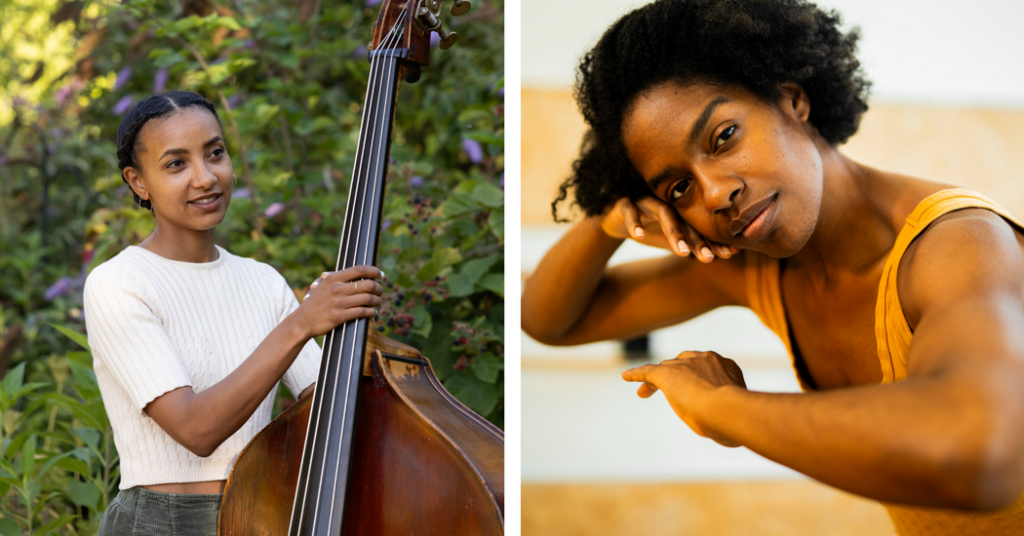
That question is an origin point for Spalding’s collaboration with the dancer and choreographer Kayla Farrish. On Aug. 8, the two artists join fellow musicians and dancers for a free public showing of what happens when they improvise together.
The event at Robert F. Wagner Jr. Park in Lower Manhattan is the latest in Spalding’s recent explorations of different ways for artists to collaborate, some involving dance. At Harvard University, she taught a course on the connections between Black improvisational music and dance. With the choreographer Antonio Brown, she toured a dance-music hybrid called Off Brand Godds.
Her first exposure to Farrish came through a 2020 video that Farrish made as a resident artist of the Louis Armstrong House Museum in Queens. In the video, Farrish dances through Armstrong’s house, responding with idiosyncratic sensitivity, rather than period accuracy, to “On the Sunny Side of the Street.”
“So many things I was witnessing in that video made me think, ‘I need to talk with this person,’” Spalding said in an interview. “And then when we met, I was like, “Oh, actually we need to make things together. We need to play.”
Farrish was in accord. “Improvisation is at the center of my practice,” she said. “I feel through jazz, riffing this idea or that. In our conversations, I had this visceral sense of what might be possible. It felt like spongy potential.”
Watching Farrish at work with other dancers seemed familiar to Spalding. “It was what you might call a jazz modality,” Spalding said, “very different from other dance spaces or dancer-led projects.”
It reminded her of jazz musicians like the great Wayne Shorter, with whom she collaborated on an opera. “It’s this curious balance between directing things and also total handover,” she said, “because for those things to come alive, you have to trust the ensemble.”
Spalding characterized her interactions with Farrish — including the Wagner Park event, part of the Lower Manhattan Cultural Council’s River to River festival — as an experiment. “I have a life of experimentation and study around this intersection of music and dance, and Kayla does too,” she said. “And when we get together, it’s like, ‘Hey, what if you go at this longitude and I try this latitude?’”
From this private exchange, which Spalding said “no one else will get to see because it’s ceremony and holy,” the two devise “structures, forms, agreements, grammars that allow us a shared coherence of communication that we can drop into in front of an audience.”
For example, they have been working on song form. In traditional jazz practice, an ensemble plays the start of a song together, then each member takes a turn soloing over the same series of chord changes. What, Spalding and Farrish wondered, is the dance equivalent?
Spalding described one possibility. First, Farrish and her dancer collaborators Jamal Abrams and Kar’mel Antonio Wade Small created a dance phrase. Then the saxophonist Dayna Stephens responded with melodies until Spalding chose her favorite, and the drummer and keyboardist Justin Tyson built a harmonic progression for it.
This is what the ensemble plays and the dancers dance, while dancer-instrumentalist pairs take the equivalent of solos. “And because we’re all paying attention,” Spalding said, “the movement of soloists is going to morph how the company works and vice versa.” It’s all about communication.
At one rehearsal Farrish brought the idea of what she called “soul cry.” Each artist responded to the prompt, “and that became an accumulation,” she said, “an alchemy that we composed together.”
Spalding noted the necessity of working with artists who are committed to honoring a prompt. “The impulse is to slip out of it,” she said, “but there’s weirdly a different type of liberation when we stay in agreement together and find everything there is to find in that place.”
“If we stay committed,” she added, “you’re going to bring me out of the limits of what I thought was beautiful or worked or whatever.” And this is doubly true when dancers and musicians collaborate. “I keep witnessing new levels, new layers, new expanses in people’s playing,” she said.
Spalding and Farrish acknowledged that their experiments aren’t exactly new. Some people — Lindy hoppers and tap dancers especially — never stopped dancing to jazz. Farrish cited as inspiration “things I never learned in dance history courses,” from the choreographer Dianne McIntyre’s work with jazz musicians in the 1970s and ’80s to a clapping game she learned in her aunt’s house.
“These things have always existed,” she said. “We’re just trying to reconnect them, in a way that it feels like now.”