


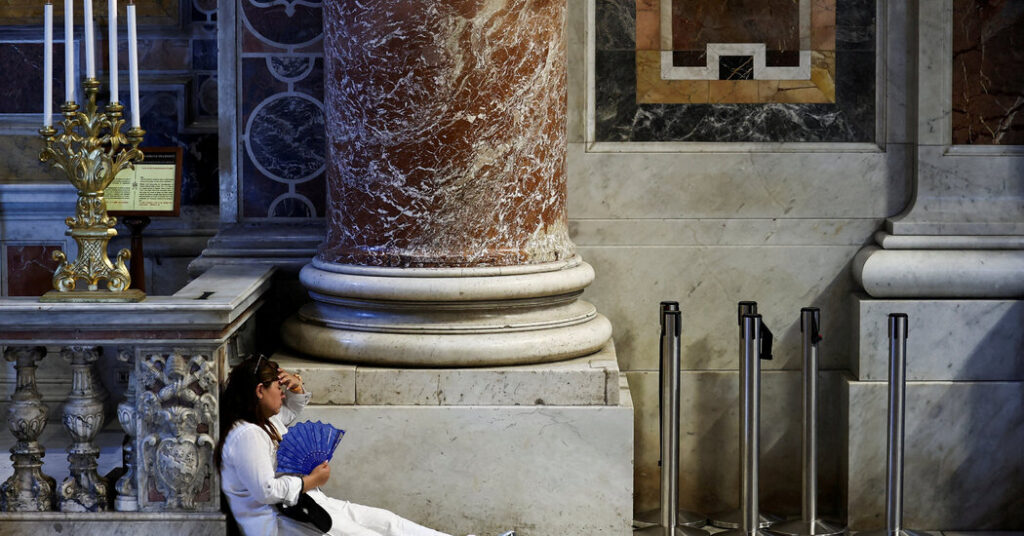
Europe braced on Wednesday for a fifth heat wave of a record-breaking summer that has already spurred wildfires of rare ferocity, caused water shortages across the continent and, for many Europeans, sapped the joy from a season they once savored.
The heat is expected to sweep from the west, with a high of 109 degrees Fahrenheit, or 43 degrees Celsius, predicted in Spain on Thursday, before hitting more eastern countries like Germany over the weekend.
In Britain, the government convened a special ministerial meeting on Wednesday morning to prepare for the fallout, as tourists and residents from Madrid to Rome spoke wistfully of the milder climates of summers past.
Irina Nedelcu, 42, who sells wine at a food market in Rome, said she had never felt so hot and that summer had lost its appeal. “I used to love the heat and hate the cold, but starting this year, basta,” Ms. Nedelcu said, using the Italian word for “enough.” “Now I hate the heat.”
At her stall, she has kept her air-conditioning unit switched off — it’s too expensive to use, she said. Instead, a fan churns warm air, making her feel as if she was “in a ventilated oven,” she said.
“It’s unbearable,” she said.
In Paris, Sarah Weyenbergh, 22, also used the word “unbearable” to describe her life this summer in an apartment without air-conditioning. “Taking shower after shower after shower” gave temporary relief, said Ms. Weyenbergh, who works in the fashion industry, adding that this solution was “counterproductive” because it ended up making her “feel even hotter.”
Still, as a resident of Paris, she at least had unrestricted access to water.
In more than 70 percent of mainland France, water use is limited because of the widespread droughts. Groundwater levels have declined in more than 90 percent of underground water reserves in mainland France, the country’s national geological service reported this month. In some regions, people could be fined for using water in certain contexts, like washing their cars or filling swimming pools.
Across the channel in Britain, nearly three-quarters of England is now in drought, according to officials, with tens of millions of people in Britain under a hose ban.
In Spain’s northern province of Burgos, Charo Barriuso, 65, said that residents of this traditionally cooler region were not used to such high temperatures.
“The last few summers have been criminal,” Ms. Barriuso said. “We used to sleep with a blanket in the summer here. Now we sleep naked.”
Much of the country braced for more wildfires, particularly as hundreds of thousands of people prepared to gather in the arid countryside for a rare solar eclipse.
The new heat wave comes after Western Europe recorded its hottest June-to-July period on record, according to Copernicus, the European Union’s climate monitoring service.
Droughts, magnified by climate change, are crippling some of the continent’s critical waterways, including the Rhine. In Serbia, the Danube River’s receding water levels exposed ships from a Nazi fleet that sank at the end of World War II.
Droughts and hail produced by uncharacteristically violent rainstorms have played havoc with farmland, harming farming revenues. Coldiretti, Italy’s largest agricultural trade association, estimates that climate-related damages have exceeded three billion euros, or nearly $3.5 billion.
The situation has amplified calls for cultural and logistical changes to the way that Europe operates in the summer, including a push for better water management in Italy.
“It’s clear that we must equip ourselves and prepare, including mentally, to live in this kind of climate,” said Lorenzo Bazzana, Coldiretti’s chief economist.
City life has been affected, too. In Rome, tropical evening temperatures appeared to have dulled interest in outdoor dining, while alcohol consumption was significantly down, according to Claudio Pica, the president of the Rome branch of a small business association. A survey of wholesalers and some 150 Roman eateries and bars showed a drop in sales in July, and a change in restaurant menus.
“Tourists still eat pasta carbonara and amatriciana because they’re traditional dishes, but Romans are asking for salads,” he said.
Some tourists are rethinking vacation plans.
“We knew it was going to be really hot; we weren’t expecting it to be so bad in the sun, that’s what gets you,” said Hannah Cutter, 24, a speech-language pathologist from New York sheltering in the shade in a Roman piazza.
Her sister Julia Cutter, 23, who works for a manufacturing company in Connecticut, said the “stifling” heat would make her think twice about visiting Italy in August again. “I mean, we have heat like this at home, and this is just next level,” she said.
At a central cinema in Rome, Mario Del Pane was taking advantage of a city-sponsored initiative offering free afternoon movies at several cinemas.
“It’s a way to pass the hottest hours in a cool place,” Mr. Del Pane, 44, said. The other options were to stay home, or go to the beach, which wasn’t much of an alternative, he said.
“The temperature is very hot on the sand and you suffer,” Mr. Del Pane said. “I much prefer to be in a cool cinema.”