


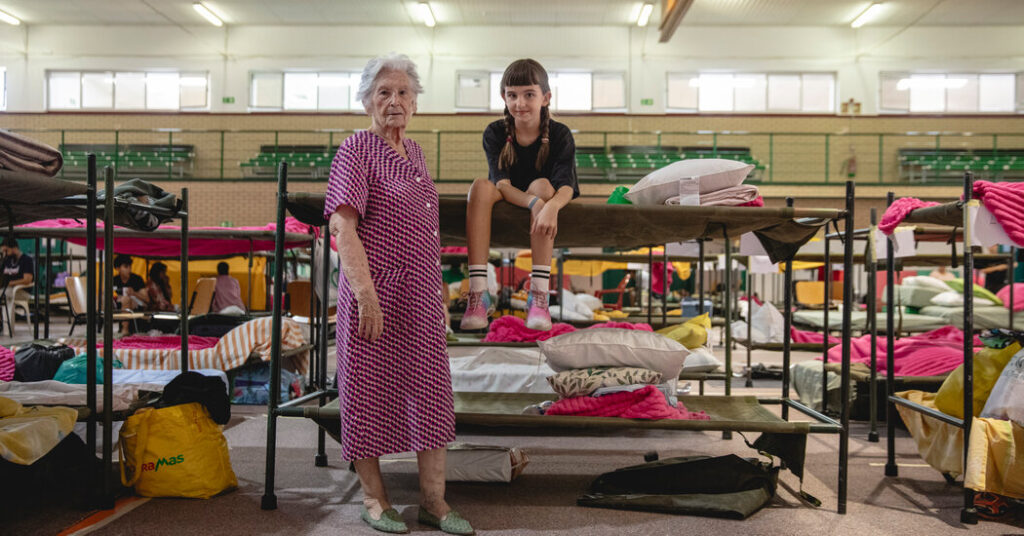
Arantxa Alcázar stepped into her garden on Thursday when she heard police officers shouting at residents to evacuate their homes in Villa del Prado, a town west of Madrid. The blazes that had been raging in the distant mountains were now sweeping down their street.
“Like a river of fire,” she said.
She fled with her mother, Consuelo Lorza, 88, and her 11-year-old daughter, Sara, to another town, only to have to evacuate again hours later, to a nearby village. The following day, they were forced to flee once more, this time to the town of Villamanta.
“I’ve been sleeping here for three days — if you can call that sleep,” Ms. Lorza said on Sunday morning. She shared a bunk with her granddaughter, while Ms. Alcázar spent the night in her car with the family dog. They eventually found out that Ms. Alcázar’s home had been spared.
More than 200 people were staying on makeshift bunks inside a sports hall in Villamanta on Sunday, anxiously waiting to learn whether they would be allowed to return home or whether the flames were advancing toward them. Some tried to nap after lunch while children kicked a football around, using one of the hall’s goals.
In total, around 90,000 people in central Spain had been evacuated from their homes or ordered to take shelter as firefighters battled what Isabel Díaz Ayuso, the Madrid region’s president, described as “the worst wildfire” in the region’s history.
Ms. Lorza had just been comforted by King Felipe VI and Queen Letizia, who visited the sports hall to show their support. “The queen told me she couldn’t believe it. Evacuated three times!” Ms. Lorza said.
King Felipe VI said on Sunday that the wildfires in Madrid and the neighboring Toledo and Ávila regions remained active but that there were some “positive signs” in the fight against the blazes.
In the Madrid region, fire had destroyed 43 homes and severely damaged more than 300 others, Ms. Díaz Ayuso said. “That number will rise enormously, as we have never seen before,” she said, tears welling in her eyes.
Across central Spain, 77,000 hectares — about 190,000 acres — have burned, the country’s public broadcaster reported.
Some evacuees in Villamanta complained that they had received little information about the status of the fires. They waited nervously near their cars, eating churros.
“We watch the fires every minute” through security camera feeds, said Carmen Bautista, 53, who had slept, along with her husband, in their van beside the sports center. They had watched the flames approach their home in Caravan Garden, a nearby development, but it was now safe.
Ms. Bautista lamented that residents had endured one natural disaster after another — the pandemic, then the deadly floods that swept away three bridges — and that each one seemed worse than the last.
“With the previous catastrophes, you could stay at home. Now …” she broke off, spreading her arms in resignation.
While firefighters struggled to bring the blazes under control, some residents took matters into their own hands. In the mountains around Robledo de Chavela, where the flames had torn through pine forests and holm oaks, several residents on Saturday slipped past police roadblocks to fight the fires.
“We may be doing something slightly illegal, but we have saved this part of the mountain,” Javier Quijada, 30, said on a video call. Mr. Quijada and dozens of other residents, all members of the local hunting association, had been fighting the flames with hoses, shovels and even green branches they used to try to smother the fire. He said police officers eventually waved them through, warning them to be careful.
“This is our mountain. Our lives are going up in flames,” Mr. Quijada said. “I’ve lost count of how many tears I’ve shed since the fire began.”