


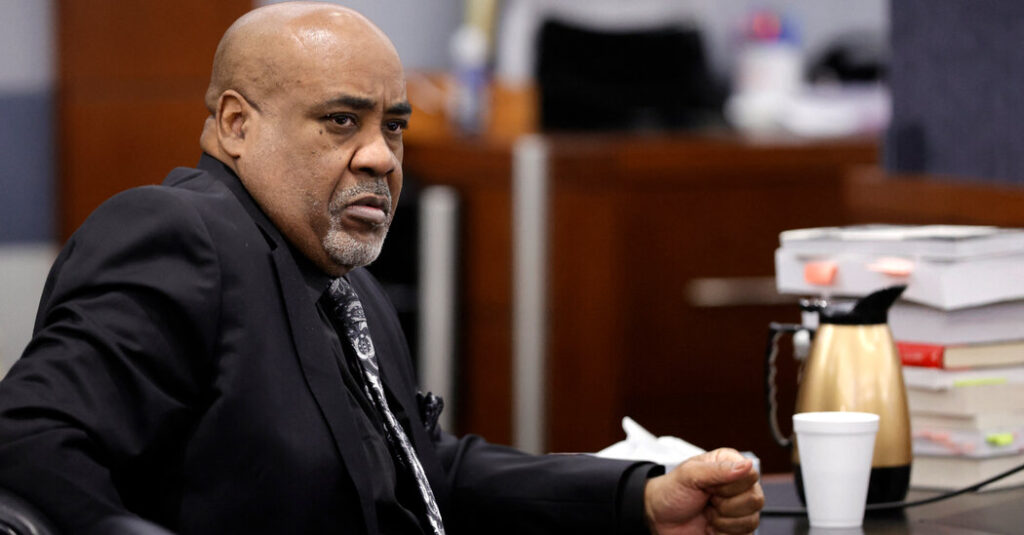
A jury in Las Vegas on Monday found a man guilty of orchestrating the 1996 murder of Tupac Shakur, delivering a conviction nearly 30 years after one of hip-hop’s most notorious killings.
Duane Keith Davis, 63, was accused of obtaining the gun used in the shooting and pursuing Mr. Shakur during a gang war that had become entangled with a feud between East Coast and West Coast hip-hop labels.
After about three hours of deliberations, the 12 jurors announced they had found Mr. Davis guilty of first-degree murder. Members of Mr. Shakur’s family who were seated in the courtroom embraced and passed around tissues to wipe away tears.
Straight-faced but agitated after the verdict, Mr. Davis addressed the judge to promise he would appeal. He is scheduled to receive his sentence — up to life in prison — on Oct. 13.
In a three-week trial, prosecutors depicted Mr. Davis as a shot caller for a group of Crips from Compton, Calif., who were out for revenge on the night of Sept. 7, 1996, when they happened to encounter Mr. Shakur in a black BMW stopped at a traffic light. Mr. Shakur, who was 25 and in the prime of his career, was shot four times and died at a hospital days later.
A socially conscious poet who was on his way to becoming a cultural icon, Mr. Shakur became only more popular as he was increasingly associated with violence and gang culture. His death turned him into a hip-hop martyr, joined only six months later by Christopher Wallace, the rapper known as the Notorious B.I.G., a onetime friend who turned into a bitter rival.
After Mr. Wallace was gunned down in Los Angeles in March 1997, the shootings became twin tragedies that had never led to a conviction, until now.
For years, the Shakur case had languished as important evidence, including the murder weapon, remained missing and key witnesses — including Mr. Shakur’s label boss, Marion Knight, known as Suge — refused to cooperate. The standstill turned the case into fodder for true-crime enthusiasts and conspiracy theorists.
Then, in 2008, Mr. Davis began speaking to the police in an effort to avoid drug charges that could have put him in prison for life. Law enforcement considered him untouchable because he had shared the information under an agreement that he could not be charged based on it.
But prosecutors changed their calculation once Mr. Davis began repeatedly addressing the shooting publicly — in podcasts, a documentary and a 2019 memoir.
“I’m one of the only living eyewitnesses to Tupac’s killing,” read the introduction to the memoir, “Compton Street Legend.”
Under the mistaken belief that he was fully immune from prosecution, Mr. Davis effectively handed prosecutors the evidence they needed to bring a case.
After he was indicted on a charge of murder in 2023, Mr. Davis, who is known by the nickname Keffe D, asserted that the statements in his memoir and in interviews were fictional stories invented to turn a profit on the hip-hop media circuit.
“Mr. Davis is attempting to escape responsibility for a crime everybody knows he committed — even him,” Marc DiGiacomo, a prosecutor in the case, said in court on Monday, “and he admits to it seven or eight times over the course of 30 years.”
Throughout the trial, Michael Sanft, Mr. Davis’s lawyer, argued that the prosecution’s case was based on presumptions rather than hard facts, and that it was absurd to rely on Mr. Davis’s own statements, which were riddled with inaccuracies and inconsistencies.
“What facts do they have to even put Keffe D in a car in Las Vegas on Sept. 7, 1996? What facts?” he said at the trial.
The two weeks of testimony at Clark County District Court chronicled a story that had long been told in books, podcasts and true-crime specials, but never at a murder trial.
Prosecutors painted a picture of simmering gang tensions in Compton between local sets of Bloods and Crips, the temperature increasing by their entanglement with the bicoastal rap beef of the 1990s.
The Bloods were aligned with Mr. Shakur and Mr. Knight’s Los Angeles-based Death Row Records, prosecutors said, while the Crips were hired to provide security when New York’s Bad Boy Records, run by Sean Combs, traveled out west.
In 1996, two gang skirmishes sent hostilities boiling over.
There was a brawl over a Death Row chain between young Crips and Bloods at a Southern California mall. Then, in September, both sides converged in Las Vegas for a Mike Tyson prizefight. After the fight, Orlando Anderson, a member of the Crips who had been present at the mall, received a beating by a group of men that sent him to a hospital.
Among the assailants, identified to jurors on hotel security footage at the MGM Grand, were Mr. Shakur and Mr. Knight.
According to Mr. Davis’s account to the police and in interviews, he obtained a .40-caliber Glock from an associate and set out with a group of Crips to find Mr. Shakur and his boss. “Them jumping on my nephew gave us the ultimate green light,” his memoir read.
Driving around Las Vegas in a white Cadillac, the group spotted Mr. Shakur on the road, visible in the passenger’s seat of a black BMW driven by Mr. Knight.
In an interview with law enforcement in 2009, Mr. Davis described how his associate behind the wheel made a U-turn to pull up alongside Mr. Shakur and Mr. Knight’s vehicle.
A woman in a car nearby, Ingrid Stokes, testified that a hail of gunfire erupted. “All hell broke loose,” she told jurors.
The BMW was riddled with bullet holes, the tarmac glinting with spent cartridge cases. Mr. Knight had been grazed in the head; Mr. Shakur, in far worse condition, was loaded into an ambulance.
Garry Dale, a former police officer who rode with Mr. Shakur on the way to the hospital, testified that he had asked him to divulge the names of the assailants but that Mr. Shakur had brushed him off.
“We’ll take care of it,” Mr. Shakur replied, according to Mr. Dale.
Word soon spread in Compton that Mr. Anderson had been the person to open fire in retaliation for the beating at the MGM Grand, but other accounts suggest it was Deandrae Smith, who had been sitting next to him in the back seat. Mr. Davis is the only person still alive who was said to have been in the white Cadillac.
Although Mr. Davis did not testify, the prosecution centered its case on his own words, played for the jury through audio of interviews with police officers, documentary filmmakers and YouTube personalities.
Prosecutors acknowledged that his statements could be inconsistent, and they did not embrace everything as true. His repeated allegation that Mr. Combs had offered him $1 million to kill Mr. Shakur and Mr. Knight, which the music mogul has vehemently denied, was left on the far periphery of the case.
In total, the jury heard more than eight hours of Mr. Davis’s voice, according to prosecutors.
“I didn’t tell nobody, nothing, that we killed Tupac,” Mr. Davis said in 2009, when he was speaking to the police.
He added: “I was gonna keep this secret.”
Jonathan Abrams contributed reporting.