


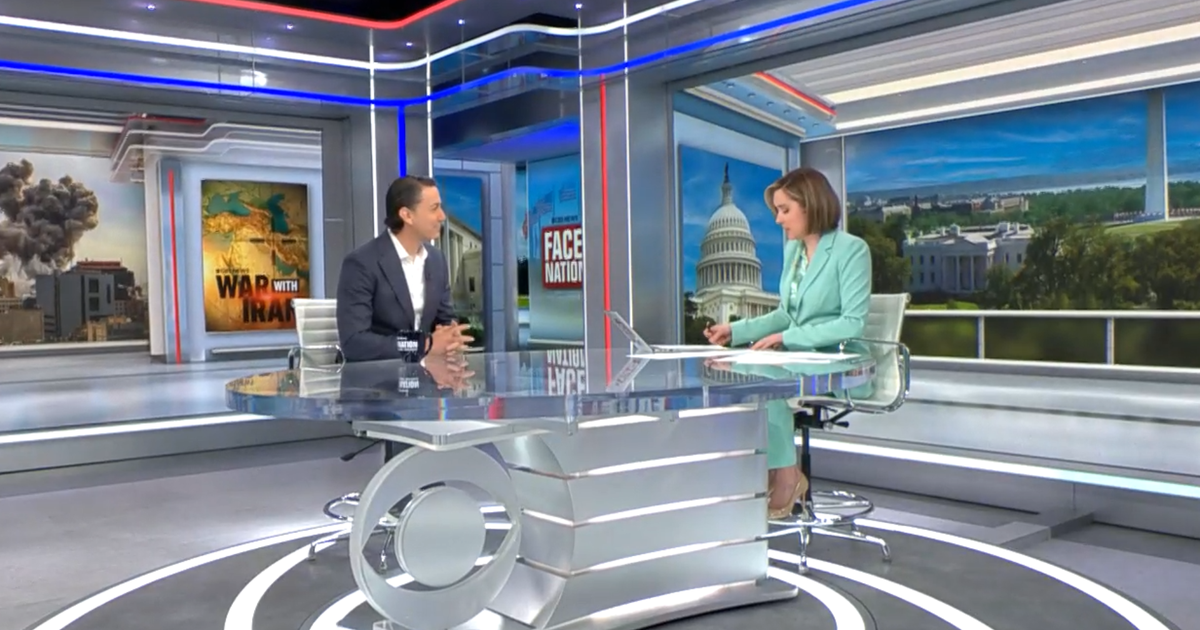
On this „Face the Nation with Margaret Brennan“ broadcast, moderated by Margaret Brennan:
- U.N. Ambassador Mike Waltz
- Amos Hochstein, Biden administration senior energy adviser and Middle East negotiator
- Former U.S. Surgeon General Jerome Adams
- Former U.S. Attorney General Eric Holder
Click here to browse full transcripts from 2026 of „Face the Nation with Margaret Brennan.“
MARGARET BRENNAN: I’m Margaret Brennan in Washington.
And this week on Face the Nation: The struggle for control over the Strait of Hormuz could threaten the fragile cease-fire between the U.S. and Iran. The short-term truce in the war with Iran is holding for now, but tensions are escalating over the status of the vital waterway that provides passage for about 20 percent of the world’s oil and energy supplies.
Iran reversed course this weekend, closing it to ships and firing at vessels attempting passage.
(Begin VT)
DONALD TRUMP (President of the United States): They wanted to close up the strait again, as they have been doing for years. They can’t blackmail us.
(End VT)
MARGARET BRENNAN: We will get the latest from U.N. Ambassador Mike Waltz.
Former White House adviser on energy security Amos Hochstein will also join us with analysis on how the war continues to spike energy prices. How long will it last?
Meanwhile, new developments in what the president calls his push to make America healthy again, an executive order loosening restrictions on psychedelic drugs.
And a new pick for head of the CDC. We will ask former U.S. Surgeon General Jerome Adams to explain it all.
We will also hear from former Attorney General Eric Holder on the latest in the redistricting wars.
Plus, we will check in on Pope Leo’s tour through Africa, as he downplays his dispute with President Trump.
It’s all just ahead on Face the Nation.
Good morning, and welcome to Face the Nation.
President Trump announced another round of talks in Islamabad starting tomorrow evening. And three White House officials tell CBS News that President – Vice President Vance, special envoy Steve Witkoff, and President Trump’s son-in-law Jared Kushner will be leading the delegation.
President Trump also once again threatened to knock out every single power plant, every single bridge in Iran unless it agrees to a deal with the U.S., all of this as traffic through the Strait of Hormuz remains at a near standstill.
Senior foreign correspondent Imtiaz Tyab has the latest.
(Begin VT)
MAN #1: You are ordered to go back to your port immediately. You are ordered to go back to your port immediately. Do you get my message?
IMTIAZ TYAB (voice-over): This video posted online appears to show the moment Iran’s military ordered an Indian ship to abort its passage of the Strait of Hormuz.
MAN #2: I will turn back. And there is no permission to transit Hormuz. Is that correct, sir?
IMTIAZ TYAB: For a brief moment, Iran had reopened the world’s most contested waterway following a cease-fire deal in Lebanon. But when President Trump announced the U.S. would continue blockading Iranian ports, Tehran reversed the decision.
We were on the strait in the hours before Iran’s announcement, a rare trip into a waterway that is off-limits to journalists.
We have only been on our journey for a few minutes now, and we have already seen tanker after tanker, and they have been stuck like this for weeks now.
An analysis by Reuters has found the Iranian blockade of the strait has seen $50 billion worth of oil lost from the global market since fighting began. Overnight, Iran’s Revolutionary Guard forces reportedly shot gunfire at an oil tanker and cargo vessel attempting to cross these waters.
(WOMAN SPEAKING IN FOREIGN LANGUAGE)
IMTIAZ TYAB: In a statement read out on state TV, apparently from the supreme leader, Mojtaba Khamenei, he said Iran’s navy would – quote – „make their enemies taste the bitterness of new defeats.“
Still, the cease-fire in Lebanon, a key demand of Tehran, is holding. Thousands of Lebanese returned to the south of the country to see what’s left of their homes after weeks of intense Israeli strikes.
(End VT)
IMTIAZ TYAB: And the second round of talks between the U.S. and Iran in the Pakistani capital, Islamabad, will come just days ahead of when that two-week cease-fire brokered by Pakistan is set to expire.
Now, the Gulf between Tehran and Washington is, frankly, enormous, with major disagreements over Iran’s nuclear program, its regional proxies, and, of course, the Strait of Hormuz, Margaret. And the fear is, if a deal isn’t reached, both sides will return to all-out war.
MARGARET BRENNAN: That’s Imtiaz Tyab reporting from Dubai.
We turn now to the U.S. ambassador to the United Nations, Mike Waltz, who joins us this morning from New York.
Welcome back to Face the Nation, Ambassador.
MIKE WALTZ (U.S. Ambassador to the United Nations): Thank you. Good to be with you.
MARGARET BRENNAN: So, the president said Iran broke the cease-fire, but he is still offering them a deal. Is this a presentation of terms, or should we expect an actual prolonged negotiation?
AMBASSADOR MIKE WALTZ: Well, I think this will be a continuation of the terms that the vice president offered a week ago.
And, look, we have to take a step back here, in that President Trump, the U.S. Navy is controlling what is coming out of the straits. We’ve had the highest-level engagement in the history of the Iranian regime, with the vice president leading.
We have historic cease-fire talks going on between the Israelis and the Lebanese. The markets are up. Oil prices are relatively stable. The Iranian economy is devastated, and they’ve never been – I can tell you, here at the United Nations, they’ve never been more diplomatically isolated.
So Iran does not have the cards, and we are confident they will come to the table and finally give up their obsession with having a nuclear weapon.
MARGARET BRENNAN: Well, Iran has not yet announced that it’s sending a delegation to Islamabad. I know there’s this back-and-forth all morning long about whether the vice president would be leading it or not. CBS, as you just heard, is reporting he will be.
But why is it important that he be there in person? Is it because Iran has refused to send anyone with decision-making authority unless he is there?
AMBASSADOR MIKE WALTZ: Well, you’ve seen the chaos, I mean, that you just pointed to on the Iranian side the last 48 hours.
You have their foreign minister announcing that they’re going to stop attacking shipping. Then you have the IRGC saying that they will and then doing so, as President Trump pointed out, an absolute violation. So, the Iranian side is in a bit of chaos.
And this is absolutely due to the devastating strikes on their leadership. But I think the vice president leading shows, look, the level of engagement from the U.S. side, that we are absolutely serious.
And I, for one, thank God for future generations that we are arresting a problem before it’s too late. We’re not waiting until the U.S. has no options…
MARGARET BRENNAN: Well…
AMBASSADOR MIKE WALTZ: … and Iran has some kind of breakout, which would lead to a nuclear breakout all over the Middle East.
MARGARET BRENNAN: … let me follow up on what you just said, though, because that’s important. The Iranian side is in chaos. So how do you know you’re negotiating with the right person?
It’s been reported, The Institute for the Study of War says that the IRGC Commander, General Vahidi, has secured control over the negotiations and the military within the past 48 hours. Does that mean Foreign Minister Araghchi is not the person to be sitting across the table from? Who’s in charge?
AMBASSADOR MIKE WALTZ: Well, look, again, the Iranian regime, we’ve put them in chaos.
At the same time, we are never going to take an approach of trust. Any deal that comes out of this will have to absolutely be verifiable and be enforceable. I can tell you, from sitting in my seat at the U.N., we’ve been in extensive discussions with the International Atomic Energy Agency, the IAEA, which would have ostensibly a key role in ensuring Iran lives up to any deal that it signs to.
This – signs up to. There is no trust on this side. There is verified and enforceable provisions that are – that are on the table from the U.S. to ensure they never have a nuke.
MARGARET BRENNAN: OK. That’s important in terms of enforcement.
Does that mean, if you actually get to a negotiated deal, and the U.N.’s nuclear watchdog would be very much in those details of going in and perhaps securing that enriched uranium, does this mean you’re going to put a deal for approval before the United Nations? Is it going to be codified like that?
AMBASSADOR MIKE WALTZ: Well, I will tell you, there are dozens and dozens of resolutions over the years, not just the United States, the entire world, saying Iran cannot have a nuclear weapon.
MARGARET BRENNAN: Right.
AMBASSADOR MIKE WALTZ: We had snapback provisions that are in place now for global sanctions and that Iran cannot enrich. So, anything that would change those resolutions would then need to come back before.
But let’s not get ahead of ourselves. Let’s see if the Iranians actually sign up to a very reasonable offer that is sitting on the table from the United States…
MARGARET BRENNAN: Yes.
AMBASSADOR MIKE WALTZ: … which is an off ramp from them, and also will ensure the region, the United States, Europe and the world, is never threatened by a regime with its hand on a nuclear button.
MARGARET BRENNAN: OK.
So – but back to the point of who’s in charge, President Trump says he hopes they take the deal. That was the post this morning. But on Friday afternoon, he spoke to my colleague Weijia Jiang, and he gave us an incredibly optimistic read.
He said Iran had – quote – „agreed to everything, including to stop enriching uranium forever and to stop backs – backing all proxy groups like Hezbollah.“ He made it sound like it’s all been sorted out. So, which is it? Was there an agreement with certain parts of the Iranian government, but now there are others in charge, or was he just, you know, I don’t know, speculating about something he hopes comes true?
AMBASSADOR MIKE WALTZ: Margaret – Margaret, anybody who has dealt with the Iranians will tell you it is often two steps forward, three steps back. They’re incredibly slippery. They can’t be trusted.
They cheated over the years, which is one of the reasons that President Trump withdrew us from the JCPOA. They were hiding sites. They were hiding capabilities, and this is why he made the bold decision…
MARGARET BRENNAN: Yes.
AMBASSADOR MIKE WALTZ: … last year in Operation Midnight Hammer to just end it once and for all.
And, again, we have to take the perspective that we’re not waiting. We’re not trusting. We are reducing their capabilities. Their military is in shambles. Their missile program is in shambles. And now, hopefully, diplomatically, they will do it the easy way, rather than the hard way, of finally giving up on this illegal ambition.
MARGARET BRENNAN: Well, the Defense Intelligence Agency told Congress this past week Iran has thousands of missiles and one-way attack drones that can still threaten the United States. So there’s still a threat in certain ways.
General Caine said on Thursday the U.S. is going to pursue Iranian-flagged vessels or any vessel providing support, including those carrying Iranian oil. Beijing is the top customer. Are you going to start boarding vessels headed to China? When do these operations begin?
AMBASSADOR MIKE WALTZ: Well, I’m not going to give – get into operational timelines, but I will tell you all options are on the table.
The president is prepared to escalate, to de-escalate. He means it when he said nothing that benefits Iran is coming out of the strait. And then, on top of that, Secretary Bessent announced Operation Economic Fury, where we are prepared to put secondary sanctions on banks who are transacting in illegal Iranian oil dollars.
So we are truly putting maximum pressure on every aspect of the Iranian economy. And, at some point, they are going to see some level of common sense and pragmatism and say enough is enough with this nuclear obsession.
MARGARET BRENNAN: Is that the first step before you go back to combat? Because President Trump was talking about bombing power plants. Are the sanctions and the seizing of vessels step one?
AMBASSADOR MIKE WALTZ: Well, we’ve taken – well, we’ve taken – I – you know, again, I’m not going to publicly sequence the steps.
But the blockade was – was a tremendous step and has been tremendously effective, with dozens of ships turned around. Others that are already out on the water, our Pacific Command is prepared to interdict. We’re going after the banks. We’re going after this shadow fleet, one of which was run by a relative of Khamenei.
So we are taking a number of steps. We’re even looking – our acting attorney general has made it very clear he is going to start aggressively prosecuting. Our Threat Finance Unit is going…
MARGARET BRENNAN: Yes….
AMBASSADOR MIKE WALTZ: … after their illegal dollars. So this is a whole-of-government, full-on press.
I hope we don’t have to go back to a military option, but President Trump’s made it very clear. And, by the way, bridges, power plants that are run by the IRGC, which runs the entire military, are absolute legitimate military targets, not only now, but have been historically. That is a false, fake and ridiculous notion that this is some type of war crime.
MARGARET BRENNAN: Well, we’ll talk about that, and we’ll see if that happens.
But Germany and other allies have said they will help the United States with that navigation through the Strait of Hormuz eventually, once combat ends, but they said they need cover. They need an international mandate at the United Nations. Will Russia and China get on board? Are you trying to do that at the U.N.?
AMBASSADOR MIKE WALTZ: Well, as our Gulf Arab allies made it very clear at the U.N., I guess that would be nice to have after the conflict, but they need help and are ready to take action now, particularly Bahrain, UAE, Qatar, Kuwait, Saudi Arabia.
We had a historic resolution to the U.N. with 135…
MARGARET BRENNAN: Yes.
AMBASSADOR MIKE WALTZ: … nations condemning Iran for its attacks on civilian infrastructure, on resorts, civilian airports, ports, shipping. That was truly tremendous.
It’s disappointing the Russians and Chinese chose to side with Iran, rather than our Gulf Arab allies and freedom of navigation.
MARGARET BRENNAN: And you still lifted sanctions on Russia.
AMBASSADOR MIKE WALTZ: But you’re going to see – yes, you’re going to see continued action this coming week.
The entire world is united that you – that a country cannot hold an international waterway and cannot hold the world’s economies hostage because it has a conflict with another country. You don’t see that in the Straits of Gibraltar…
MARGARET BRENNAN: Well…
AMBASSADOR MIKE WALTZ: … the Bering Strait, the Straits of Malacca, or any other international waterway. Iran is absolutely in the wrong here from a legal, diplomatic and economic standpoint.
MARGARET BRENNAN: Let me ask you about Lebanon.
President Trump posted Friday that – quote – „Israel will not be bombing Lebanon any longer. They are prohibited from doing so by the USA. Enough is enough.“
How is the U.S. prohibiting ally Israel from bombing in Lebanon? And what is the United States doing to confiscate weapons from Hezbollah? Like, how are you helping the Lebanese military do that?
AMBASSADOR MIKE WALTZ: Well, to answer your last question first, the U.S. contributed over $250 million to the Lebanese armed forces.
This is a tremendous, historic opportunity for Lebanon, the Lebanese government, led by President Aoun, a former general, the head of the Lebanese armed forces, to take their country back. Finally, with Iran on its back foot and militarily devastated, with Syria…
MARGARET BRENNAN: Yes.
AMBASSADOR MIKE WALTZ: … in a much better place with the fall of the Assad regime and the effective diplomacy that we’ve had there, and from the pager and beeper operation to now, Hezbollah has never been in a worse place.
This is a true moment. And it was a real honor for me to be at the opening of the…
MARGARET BRENNAN: Yes.
AMBASSADOR MIKE WALTZ: … first Israel – Israel-Lebanon talks, first ever…
MARGARET BRENNAN: How are you going to prohibit Israel from bombing?
AMBASSADOR MIKE WALTZ: … in modern history.
So, we have – look, but, Margaret, we have diplomacy on the march in a number of places…
MARGARET BRENNAN: Uh-huh.
AMBASSADOR MIKE WALTZ: … backed, of course, by military strength.
MARGARET BRENNAN: OK.
AMBASSADOR MIKE WALTZ: But we have to take a moment to understand the magnitude of what’s going on.
MARGARET BRENNAN: Ambassador Waltz, we will be watching to see what happens in the coming days. Thank you for your time this morning.
Face the Nation will be back in a minute. Stay with us.
(ANNOUNCEMENTS)
MARGARET BRENNAN: And we’re joined now by Amos Hochstein. He was a former Biden White House senior energy adviser and Middle East negotiator, and he’s now managing partner at the investment firm TWG Global.
Good to have you back here.
AMOS HOCHSTEIN (Former Senior Energy Adviser to President Joe Biden): It’s great to be here.
MARGARET BRENNAN: So, President Trump said current gas prices are not very high. But regular gas costs are – average like $4.05 a gallon. Last time we saw that was under the Biden administration when Russia invaded Ukraine.
So, if you were advising President Trump today, how do you make sure this spike isn’t long-lasting?
AMOS HOCHSTEIN: Well, we’re over $4 now because we have a real disruption.
In the Russia invasion of Ukraine, we had a concern of a disruption that never actually happened, and it went all the way up to $5. For the president right now, any continued duration of closure of the Straits of Hormuz will have to have a spike in prices.
We’re at a – when you have an energy crisis like the Strait of Hormuz, it’s very slow moving, and then it’s like falling off a cliff, because, when you close the straits, the world still has all the tankers that were on the water before, and that take – could take 25, 30 days to get to their destination.
But, right now, there are no tankers on the road – on the – on the seas to Asia and to Europe. So we’re getting to the point now where certain countries no longer have any fuel, no longer have jet fuel. Now, those are poor countries and now middle-income countries.
MARGARET BRENNAN: Yes.
AMOS HOCHSTEIN: But that eventually comes to the U.S. So he’s got a couple of weeks before this can go much higher.
MARGARET BRENNAN: But he’s got to get a deal quickly, in other words.
AMOS HOCHSTEIN: He’s got to get a deal quickly.
MARGARET BRENNAN: So, because we are seeing all these economies get hit, I mean, in Europe, they’re saying jet fuel is only a few weeks – there’s only six weeks left or so.
Secretary Bessent said he expects a price drop sometime between June and September. Is that realistic?
AMOS HOCHSTEIN: I think what – right now, what they’re doing in the administration is saying things further out to say, OK, we’ll deal with that in June. If we get to June, and prices are high, we’ll say it’s August to November.
MARGARET BRENNAN: They’re trying to talk the markets down.
AMOS HOCHSTEIN: They’re talking the markets down.
As – if the straits are closed – you talked about Europe. Certain Asian countries are already canceling flights. They don’t have any jet fuel. They’re running out, and probably two to three weeks, at most, before large parts of Asia.
But remember, Margaret, when a plane leaves the United States, they can’t take jet fuel with them. The administration has been saying, we have plenty in the U.S. Great, but if you leave the U.S. and there is no jet fuel on the other side.
So, what happens is, the fuel surcharges that Americans are going to see, that – already starting to see, and ahead of Memorial Day in the summer, tickets are going to be very expensive. When jet fuel is expensive in the rest of the world, it is also expensive here.
MARGARET BRENNAN: And we saw Spirit Airlines really struggling under that with the bankruptcy issue.
Let me ask you about your Mideast experience here. In July 2024, Secretary Blinken claimed Iran was one or two weeks away from having enough fissile material, breakout capacity to eventually make a weapon if Iran had decided to do so. There were indirect negotiations that the Biden administration did, but it went nowhere.
So, when President Trump argues that he did, when no other president would, is it just simply that the bill was coming due and it fell on his watch?
AMOS HOCHSTEIN: I do think there’s a certain element to that.
And that’s why I was supportive of President Trump joining in, in June to take the strikes that we had thought internally in the Biden administration we may have to take if there was a second term. We thought that the spring, summer of 2025 was probably – we may have to be there in the same place.
MARGARET BRENNAN: Really?
AMOS HOCHSTEIN: And we did – we did war games. We did some practice runs on what it would look like to look into it, because that may have had to happen under our watch as well.
But we – he said, we obliterated their nuclear program. The question then is not about what he did in June. This war we were in now did not attack the nuclear facilities again. This was not about the nuclear.
So the question now becomes, can you do a deal with the Iranians? And the maximalist positions that both sides have are right now very far apart, despite all the rhetoric that we’re – we’re almost there, or we are there, but, if we’re not there, we’ll bomb the hell out of them.
MARGARET BRENNAN: Right. Or who knows who’s going to show up or not show up from the Iranian side to negotiate with? I thought that was interesting, that the ambassador acknowledged that.
AMOS HOCHSTEIN: Well, look, Margaret, when you have a negotiation that’s being done loosely, right, phone calls and no real paper, you get to a point where Iran says Lebanon was included. The U.S. says, no, it wasn’t.
The Iranians say, we’re opening the straits because it’s completely open, and the Americans say, no, the blockade is staying. There’s no – if there’s no paper, no serious negotiation on this, and we’re trying to do it really quickly to assuage markets, then you get to these misunderstandings, and now we’re in a worse position.
This is a very serious issue. And I think it shouldn’t take just three days to do a nuclear deal. It’s really, really critical.
MARGARET BRENNAN: Right.
AMOS HOCHSTEIN: But if the straits are not opened soon, the leverage that they have – and my concern is, no matter how the war ends, the Iranians now have a card they never had before in practice.
In theory, we knew they can close the straits, but they never did. And now, for the foreseeable future, they have this card against us and against their neighbors.
MARGARET BRENNAN: Why do you think President Trump isn’t deploying his top diplomat and his national security adviser? Why aren’t we seeing Secretary of State Rubio leading on this?
AMOS HOCHSTEIN: I mean, that’s a mystery that I think many in the region and around the United States are asking. Why is this not being run by the secretary of state, who’s also his national security adviser?
Maybe the secretary of state doesn’t believe that this is the right approach. I don’t know. You have to ask him, if you can get him to answer that question.
MARGARET BRENNAN: We would love for him to join us.
AMOS HOCHSTEIN: I’m sure you would.
But that’s – that’s a real mystery. Look, the vice president of the United States has been…
MARGARET BRENNAN: But does it – does it show, you know, when you’re going to the negotiating table, the vice president going is important? Because the last two times Witkoff and Kushner showed up with the Iranian delegation, the talks fell apart. In fact, they ended in bombing.
So you need someone who wasn’t there the last two times it failed, right?
AMOS HOCHSTEIN: And you need someone who is senior enough that the Iranians believe speaks for the president.
So I think that it’s important that the vice president or someone go. I think it would have been great if we can get to a point where you have preparatory talks, and you send the vice president at the end of the process in order to break the logjam.
MARGARET BRENNAN: Yes.
Stay with us, if you would. I do have to take a break, but I have more to finish on this topic with you, Amos.
We will be right back with a lot more Face the Nation. Stay with us.
(ANNOUNCEMENTS)
MARGARET BRENNAN: We will be right back with Amos Hochstein, plus an update on the pope’s tour through Africa. Former Surgeon General Jerome Adams joins us and former Attorney General Eric Holder.
(ANNOUNCEMENTS)
MARGARET BRENNAN: Welcome back to „FACE THE NATION.“
We return to our conversation with former Biden adviser Amos Hochstein.
I want to pick up on Lebanon. You brokered that 2024 ceasefire in Lebanon. On Friday of this past week, we saw the president announce ten days of pause to halt the fighting between Hezbollah and Israel, which is basically linked to the big deal he really wants to get to with Iran. What do you make of this truce?
AMOS HOCHSTEIN (Former Senior Energy Adviser to President Biden): So, a few things. One, I’m glad to see that the fire is halted, even if it’s a pause. The worrisome part is that it was seen as a ceasefire that was brokered by Iran, by insisting on a Lebanese ceasefire before they would show up to talks in Pakistan. That’s a disaster because the one thing we have always been emphasizing, Iran does not control Lebanon. It is none of their business what happens in Lebanon.
Hezbollah’s been unmasked in this conflict over the last couple years as not really a Lebanese fighting organization or terrorist organization as they claim, but rather they said we are doing this at the behest of the Iranians. And so, allowing the Iranians to dictate terms is not a good thing. However, direct talks between Israel, even at the lower level, at the ambassador level, is a good development. Most of the Lebanese people want to see a lasting ceasefire. Even if they don’t want to see a peace agreement, they want to see end of conflict.
But we have to have a serious effort here. There’s such a great moment of opportunity. It will not be a moment of opportunity if Israel is occupying a significant part of Lebanon to re-establish a buffer zone. That won’t work. Because, ultimately, that will help Hezbollah re-establish its political footing and their narrative. So, we have to get to the table. We need to make sure Israel withdraws from Lebanon, stop the fighting and give the actual help to Lebanon to disarm Hezbollah.
MARGARET BRENNAN: Right.
AMOS HOCHSTEIN: They cannot do it on their own.
MARGARET BRENNAN: This is what I asked Ambassador Waltz on that, can they do that.
And to be clear, the Israelis have said not only that they – they’re going to stay in southern Lebanon, but also take some of the territory that they had seized after Assad fell in Syria. So, it’s –
AMOS HOCHSTEIN: This is –
MARGARET BRENNAN: It’s a serious negotiation that has to take place.
AMOS HOCHSTEIN: This is a tactical victory for Israel that will lead, once again – an overreach that will lead them to lose more ground.
MARGARET BRENNAN: I want to ask you, as a Democrat, there was this extraordinary vote this past week in the Senate. Forty Senate Democrats tried to block a U.S. weapons sale to Israel. And that adds to this growing rift we have seen between your party and Benjamin Netanyahu.
Do you think Democrats are going to come to regret this break in the alliance?
AMOS HOCHSTEIN: So, I hope that it’s not a break in the alliance. I think this – what it really demonstrates is for the last several years Prime Minister Netanyahu has sacrificed Israel’s interests in the United States.
The most important asset Israel has is not its military or its intelligence. It’s the relationship – it’s the special relationship with the United States that has been bipartisan for so many decades. He has destroyed that because he has decided to become, not just part of the Republican Party, but he’s decided to become just an appendage of Donald Trump.
And so, every Democrat now says, if you want to be Trump, great. If we’re anti-Trump, then by de facto we’re against you. I think this has a lot to do with Bibi Netanyahu and his extremist right-wing government and not to do with Israel.
MARGARET BRENNAN: Yes.
AMOS HOCHSTEIN: Look, you have – half of Israel is voting against Bibi.
MARGARET BRENNAN: Yes.
AMOS HOCHSTEIN: So, I think this – Democrats should be aligning with Israel, not with Bibi. But I think this is a very big wake-up call this week, that vote.
MARGARET BRENNAN: A significant vote.
Amos, thank you for your insights.
And we’re going to turn now to Pope Leo XIV, who has spent the last week traveling through Africa. This morning he praised the temporary ceasefire in Lebanon as a reason for hope, encouraging leaders to seek a more permanent peace.
But much of his tour has been marred by these tense exchanges with President Trump. And now the pope says some of his remarks have been misinterpreted. CBS foreign correspondent Chris Livesay has more.
(BEGIN VT)
CHRIS LIVESAY (voice over): Its nickname is Shepherd One. But this week, the papal plane has been ground zero of a clash with the Trump administration that’s overshadowed a papal trip. The pope is now clarifying his primary mission is to preach peace to the people of Africa, not the president of the United States.
POPE LEO: There’s been a certain narrative that has not been accurate in all of its aspects, but because of the political situation created when on the first day of the trip the president of the United States made some comments about myself.
CHRIS LIVESAY (voice over): Instead, he’s trying to keep the focus on the people he came to see. In Cameroon, where a separatist conflict has killed thousands and displaced more than half a million, the pontiff proclaimed –
POPE LEO: The world is being ravaged by a handful of tyrants.
Woe to those who manipulate religion in the very name of God or their own military, economic or political gain, dragging that which is sacred into darkness and filth.
CHRIS LIVESAY (voice over): The pope now tells us that the speech was written two weeks ago, before President Trump first lashed out on Truth Social over their differences on the Iran war.
POPE LEO: And yet, as it happens, it was looked at as if I was trying to debate again the president, which is not in my interest at all.
CHRIS LIVESAY (voice over): The pope’s first stop in Africa was Algeria, once home to St. Augustine, a key architect of Catholic doctrine for determine if a war is just. Hours after the pope’s visit there, Vice President Vance challenged the leader of the Catholic Church over his anti- war statements and questioned his grasp of the doctrine itself.
J.D. VANCE (Vice President of the United States): I think it’s very, very important for the pope to be careful when he talks about matters of theology.
CHRIS LIVESAY: Last night the vice president thanked the pontiff for saying he did not want to debate the president, while acknowledging real disagreements. Today the Pope is celebrating his first mass in Angola. Later today, he’ll travel to a church where Catholic priests once baptized slaves before they were shipped off to the Americas.
(END VT)
MARGARET BRENNAN: That was our Chris Livesay reporting from Angola.
And we’ll be right back.
(ANNOUNCEMENTS)
MARGARET BRENNAN: We turn now to former U.S. Surgeon General Dr. Jerome Adams, who joins us this morning from Indianapolis.
Good to have you back, Doctor.
The country has been without a Senate-confirmed CDC director since Secretary Kennedy fired Dr. Monarez just a month into her term. But this past week the president nominated Dr. Erica Schwartz to lead the CDC. I know she worked as your deputy surgeon general.
Do you see this as a deliberate choice by the White House to pick someone who actually does support vaccines?
DOCTOR JEROME ADAMS (Former U.S. Surgeon General): Well, absolutely. And again, we’ve talked in the past about the fact that the – Fabrizio and Ward poll showed that Republicans were going to pay in the midterm elections if they continued on an anti-vaccine push.
But I want to say, Doctor Schwartz is a home run pick. She has an M.D., a J.D. and an MPH and more than two decades of public service in the Coast Guard, where she was chief medical officer, and in the public health service, as you mentioned, which she retired from as a rear admiral. And it’s why I personally selected her to be my deputy surgeon general.
MARGARET BRENNAN: Do you have concerns that she will be able to, you know, conduct herself without political interference?
DOCTOR JEROME ADAMS: Well, it’s a great and it’s a fair question, Margaret. I’d say she is objectively the most qualified health nominee we’ve seen from this administration so far. And I want to give the president and senior HHS Adviser Chris Klomp credit for tapping her.
But that said, my optimism, as yours, comes with a healthy dose of caution about the environment around Doctor Schwartz. We’ve seen this before, as you mentioned, with Susan Monarez. And just last week the acting CDC director held back an MMWR report showing Covid vaccines reduced E.R. visits in healthy adults this winter.
Further, Doctor Schwartz still has to get through senate confirmation, where she will clearly be pitted against RFK on vaccines, and recent history tells us, if she’s confirmed, she will be under real threat to follow ideology over evidence in what is a vaccine-skeptical HHS, while also confronting a growing measles outbreak, low CDC morale and ongoing DOGE cut impacts.
MARGARET BRENNAN: Well, the secretary will be before Congress again this week. You mentioned measles. The U.S. is already at over 1,700 measles infections in the first four months of this year. We did note that when Secretary Kennedy was under oath this past week he seemed to change his rhetoric around the MMR vaccine, that’s the vaccine that prevents measles infections.
Take a listen.
(BEGIN VC)
REPRESENTATIVE MADELEINE DEAN (D-PA): Can you tell me, can you tell all of us, is the MMR vaccine safe and effective? Yes or no?
ROBERT F. KENNEDY JR., HHS SECRETARY: The MMR vaccine –
DEAN: Yes or no?
KENNEDY: Yes.
DEAN: Thank you.
KENNEDY: It’s safe for most people.
DEAN: Can you agree that getting a vaccine is a lot safer than getting measles?
KENNEDY: Yes.
(END VC)
MARGARET BRENNAN: So, that was a qualified response, but it was still an endorsement, it seemed. Is he persuaded by the evidence, do you think?
DOCTOR JEROME ADAMS: Well, he also acknowledged under oath it was possible vaccination could have saved the life of a child who died in the recent Texas outbreak. So, these statements represent his strongest public endorsement of the measles vaccine to date. Not coincidentally, as you mentioned, this tepid support comes after reports the White House has instructed him to stop talking negatively about vaccines ahead of midterms.
But the qualified and tempered answer he gave, it still risks, Margaret, sending mixed messages at a time when we’re facing our worst measles resurgence in decades, falling vaccination rates, preventable outbreaks, incurring millions in state and local costs and thousands of days of school missed.
MARGARET BRENNAN: Yes. And I know that the CDC data shows that the vaccine rate, the vaccination rate, has been sliding.
I didn’t know – this one exchange that I also want to play for you here because the secretary was asked a few times about past statements both he and the president of the United States have made linking Tylenol use in pregnant women to autism in their children. A Republican lawmaker, Blake Moore of Utah, told Kennedy that his own 10-year-old son, Winnie, is neurodivergent and he said that Kennedy’s remarks were hurtful.
Listen to this.
(BEGIN VC)
REPRESENTATIVE BLAKE MOORE (R-UT): I was underwhelmed with what we ultimately put out. My wife was hurt. And she felt, for a split second, until we – she came to her senses and we talked about this, that there was any way she was responsible. We don’t even know if she took Tylenol during her pregnancy, but that was a hurtful moment for her.
(END VC)
MARGARET BRENNAN: But on this, Kennedy did not give ground. He is still saying that studies showing there is no linkage are, quote, „garbage.“ What is the reality?
DOCTOR JEROME ADAMS: Well, the reality is that for pregnant women dealing with fever or significant pain, Tylenol remains one of the safest and most studied options we have. And suggesting otherwise without evidence is dangerous and it’s irresponsible. And as you heard the congressman say, it is extremely stigmatizing toward parents and risks real harm to moms and babies.
The science moves forward with data, not with dogma and with dismissal. And the garbage he was referring to was a Danish study of 1.5 million children that came out and it presents clear high-quality evidence that pregnant women who use Tylenol do not have an increased risk of autism. In fact, in that study they had a lower risk of autism.
MARGARET BRENNAN: I want to ask you about what the president announced yesterday in the Oval Office. He was surrounded by podcaster Joe Rogan, a number of Navy SEALs. And he said he wants to boost federal research into psychedelic drugs and make them more available. Specifically, they were touting this one drug, Ibogaine, I believe is how you say it.
DOCTOR JEROME ADAMS: Correct.
MARGARET BRENNAN: What do Americans need to know about this particular drug and the uses of it?
DOCTOR JEROME ADAMS: Well, first of all, almost 15 million Americans experience serious mental illness every year. And among veterans, that burden is about one in four. So, it’s clear we do have to accelerate rigorous evidence-based research into promising treatments.
Early studies of psychedelics, such as Ibogaine and Psilocybin have shown potential for rapid improvements from symptoms and functioning in treatment resistant cases. So, yesterday’s executive order, it directs 50 million in research funding, instructs the FDA to prioritize reviews for vouchers for breakthrough therapy, and directs the FDA and DEA to ease barriers under Right To Try.
MARGARET BRENNAN: OK.
DOCTOR JEROME ADAMS: Also importantly, it maintains full FDA and DEA oversight. So, it’s not legalization or reclassification of psychedelics. But the content, while reasonable, was overshadowed by the rollout, as you mentioned, with Joe Rogan.
MARGARET BRENNAN: Yes.
DOCTOR JEROME ADAMS: It was a spectacle resembling a WWE promotion. And people such as Kevin Sabot (ph) actually have said, well, this actually overshadows the substance that we’ve seen in what I think could be a productive E.O.
MARGARET BRENNAN: OK. Executive order.
All right, thank you there, Doctor Adams. Always good to get your insights.
We’ll be right back.
(ANNOUNCEMENTS)
MARGARET BRENNAN: We’re joined now by Eric Holder, who served as attorney general under former President Obama.
Good to have you here.
ERIC HOLDER (Former U.S. Attorney General): Good to be here.
MARGARET BRENNAN: So, you’ve been working on redistricting. You’re chairman of the National Democratic Redistricting Committee. Voters out in Virginia are set to make this decision about redrawing districts in a way that would advantage Democrats. As I understand it, it’s not just you, it’s former President Obama, it’s the governor of Virginia, all pushing for this, saying that this gerrymandering will restore fairness. But how is drawing a map along partisan lines, how is that not just stacking the deck? How is that about fairness?
ERIC HOLDER: Well, you have to look at this in its totality. This is really a national fight. It’s not a fight only about Virginia. And when the president told Governor Abbott in Texas, I need five additional seats in the House of Representatives, there had to be a response to that. And the governor in California decided, all right, we’ll put – we’ll ask the people of California, do you want to respond to what has happened in Texas? We’re asking the people of Virginia, do you want to respond to what’s happened not only in Texas but in Missouri as well and North Carolina as well. And what we’re trying to do is come up with a system whereby the people actually decide what’s the composition of the House of Representatives so that it can be an effective check on this president.
So, what Virginia is doing, what California did is only in response to that which Republicans started in Texas.
MARGARET BRENNAN: But in Virginia there already was a bipartisan commission that was set up to do these things. I mean that sounds fair, bipartisan commission. So, by holding this referendum and changing the maps, I know you said that this is just a temporary measure. How do you guarantee that this is temporary and that this doesn’t keep happening?
ERIC HOLDER: Well, the measure itself says that it is time limited. It is only for this cycle, an additional cycle. And after the census –
MARGARET BRENNAN: But that could be changed again.
ERIC HOLDER: No.
MARGARET BRENNAN: Right?
ERIC HOLDER: Well, no. I – that’s nothing that we would be pushing. We need to deal with the crisis that we have right now, come up with a way in which we deal with that crisis, and then get back to the redistricting commissions in California and in Virginia.
And one thing I think’s really important to understand is that the people have the ability to make this decision in Virginia, as they did in California, as opposed to –
MARGARET BRENNAN: Because they have a referendum.
ERIC HOLDER: As opposed to it being imposed upon them in Texas and in Missouri and in North Carolina, which proved to be wildly unpopular but Republican politicians ignored the will of the people in those states and put in place these mechanisms.
MARGARET BRENNAN: But if we put this another way, I mean, look at all the headwinds the president’s party is facing right now. We’re talking about the war and the energy costs that go along with it. Historically the president’s party doesn’t usually do well in the midterm races. So, why do Democrats need to do this? I mean it sounds like it’s acknowledging that the Democratic Party can’t win on its own, that it has to go through these measures.
ERIC HOLDER: The Democrats can certainly win if it’s a fair fight. And the question I have –
MARGARET BRENNAN: It wasn’t going to be a fair fight in Virginia?
ERIC HOLDER: No, it wasn’t going to be a fair fight nationally if you try to steal seats in Texas, in North Carolina, and in Missouri. And so, the question I have for people who are critical of that, which we’re doing, is, what were we supposed to do, nothing? Just allow them to try to stack the deck, to try to steal seats? And all we’re trying to do is meet them and try to make the system as fair as it possibly can be. And that’s all that this is about. And it’s temporary and it is also something that the citizens have the ability to say yes or no to.
MARGARET BRENNAN: Well, I don’t have to explain to you the negative parts of gerrymandering because you have talked about it for years and years.
ERIC HOLDER: Sure.
MARGARET BRENNAN: I mean we looked back at some of your quotes. You said, „it puts in place governments that don’t reflect the policy desires of the American people.“ In 2019 you said, „it leads to gridlock, it leads to lack of compromise because it caters to the extremes of the party.“ You said, „I don’t stand for gerrymandering for Democrats.“
So, practically speaking, aren’t you endorsing all these things now? I mean, how does the situation get better? How do people lead to compromise now?
ERIC HOLDER: Well, we have to deal with this crisis that is in front of us and that the Republicans put before the nation. Once we get past this crisis, we can get back to that which I’ve been fighting for since 2017, which is fairness.
But we have to, if we want to, get to that fairness fight. We have to save our democracy now. And I’m not being hyperbolic or alarmist. If we don’t respond to that which they are trying to do, we could lose our democracy and not have the ability to get back to that fairness fight.
MARGARET BRENNAN: The Supreme Court upheld the actions in Texas.
ERIC HOLDER: Right. The Supreme Court upheld the actions in Texas as well as in California. The Supreme Court –
MARGARET BRENNAN: But you still think it’s illegal basically?
ERIC HOLDER: I think it’s inappropriate. And hopefully the next time we have a new Democratic president and control of both the House and the Senate, I hope we’ll pass federal legislation that will ban partisan gerrymandering just outright and get away – just do away with this altogether.
MARGARET BRENNAN: So, even if this is a short-term measure, there are some specifically in the state of Virginia who have concerns about what happens near term. There was an op-ed written by Phillip Thompson, I’m not sure if you saw it, he’s the executive director of the National Black Non-Partisan Redistricting Organization, and he said that specific to Virginia, „the redrawn map fails to consolidate black political influence despite the fact that black voters form a critical component of the Democratic leadership and voting bloc in Virginia.“ And he raises this question, „what’s in this for us?“ If you need to get people out there excited and voting, how do you respond to something like that?
ERIC HOLDER: That’s simply untrue. That is simply untrue. And what I would ask, whoever that gentleman is, do you think that another two years of unchecked Trump power is in the best interests of African Americans in this nation? No. The answer to that is clearly, clearly no. And so, we have to look at this not, again, only on a Virginia scale, but what is going on nationally. And the impact of having a positive vote in Virginia will be to put in place, help put in place a check on that which the Trump administration has been doing.
MARGARET BRENNAN: OK. Mr. Holder, thank you so much for your time.
ERIC HOLDER: Thanks for having me.
MARGARET BRENNAN: We’ll be back in a moment.
(ANNOUNCEMENTS)
MARGARET BRENNAN: Americans are accustomed to hearing biblical terms from the pulpit on Sunday, but these days they’re frequently invoked from the Pentagon podium.
(BEGIN VC)
PETE HEGSETH (U.S. Secretary of War): Pray with me, please.
(END VC)
MARGARET BRENNAN: This past week, Secretary of War Pete Hegseth said he’s frustrated by journalists scrutinizing America’s Middle East war and invoked scripture, comparing journalists to the ancient Jewish scholars who opposed Jesus.
(BEGIN VC)
PETE HEGSETH (U.S. Secretary of War): You see, the Pharisees, the so-called and self-appointed elites of their time, they were there to witness, to write everything down, to report. But their hearts were hardened. Even though they witnessed a literal miracle, it didn’t matter. They were only there to explain away the goodness in pursuit of their agenda. As the passage ends, the Pharisees went out and immediately held counsel against him, how to destroy him.
I sat there in church, and I thought, our press are just like these Pharisees. Not all of you. Not all of you. But the legacy Trump-hating press. Your politically motivated animus for President Trump nearly completely blinds you from the brilliance of our American warriors. The Pharisees scrutinized every good act in order to find a violation, only looking for the negative.
(END VC)
MARGARET BRENNAN: Hegseth called it unpatriotic and said it’s hard to figure out what side some of the press are on.
But what side are journalists supposed to be on? Recently, Federal Judge Paul Friedman invoked a Supreme Court opinion that the press is meant to, quote, „serve the governed, not the governors,“ when he twice ruled Hegseth’s new Pentagon press restrictions to be unconstitutional. As he put it, quote, „the curtailment of First Amendment rights is dangerous at any time and even more so in a time of war.“ He cited the First Amendment, „Congress shall make no law respecting an establishment of religion, nor abridging freedom of speech or of the press.“
That’s it for us today. Thank you all for watching. Until next week. For „FACE THE NATION,“ I’m Margaret Brennan.
(ANNOUNCEMENTS)