


One thing to start: An executive at Crispin Odey’s hedge fund “felt physically threatened” by the financier after recommending he work from home or take a sabbatical to safeguard female staff after sexual misconduct allegations against him, according to a court filing.
And another: A Republican-led congressional committee has demanded information from a financial firm linked to the Trump family about its role facilitating the US IPOs of Chinese stocks implicated in pump-and-dump schemes.
Welcome to Due Diligence, your briefing on dealmaking, private equity and corporate finance. This article is an on-site version of the newsletter. Premium subscribers can sign up here to get the newsletter delivered every Tuesday to Friday. Standard subscribers can upgrade to Premium here, or explore all FT newsletters. Get in touch with us anytime: [email protected]
In today’s newsletter
-
Goldman’s new short strategy
-
The Telegraph is sold, seriously!
-
Another First Brands-linked spat
So you want to short a software loan
Last year when the FT revealed that Apollo Global Management had wagered against the auto parts supplier First Brands, there was something of a frenzy among big credit traders.
DD reporters were inundated with calls from curious portfolio managers wondering how exactly the private investment giant had executed the trade.
In the months that followed, including after the FT unveiled that Apollo had also shorted the loans of software companies vulnerable to AI, credit funds began hunting around for ways to pull off similar bets.
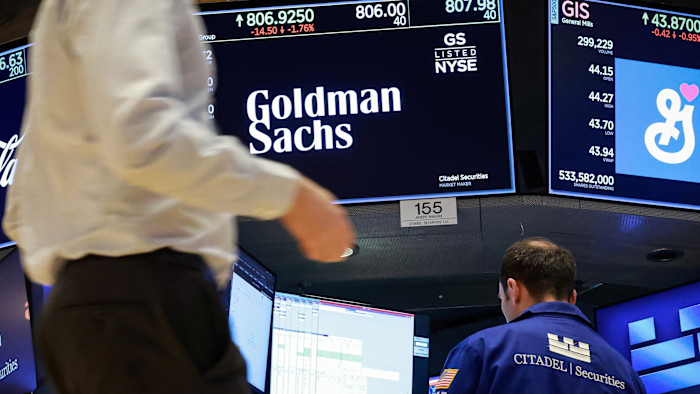
Enter Goldman Sachs, the powerful investment bank now widely known for betting against bundles of shoddy mortgages before the 2008 financial crisis.
It has been informally calling clients in recent weeks with a relatively niche way to bet against corporate loans using so-called total return swaps, derivatives that would allow investors to profit if a loan price declines, the FT scooped.
The trades would allow hedge funds to wager against software companies that have financed themselves in the $1.5tn US leveraged loan market, many of which were taken private in multibillion-dollar leveraged buyouts. Private equity firms spent hundreds of billions of dollars buying these companies up from 2020 to 2024. And now, their business models are under serious threat with every new update from Anthropic.
Goldman is not just pitching its clients on the trade. It has received a number of requests in recent weeks from traders keen to short loans to technology companies, especially after publicly traded software companies began to plummet at the start of the year.
Helping clients short corporate loans is a sensitive business. PE groups are some of the bank’s most important clients, paying lucrative fees each year, and other parts of the bank compete to underwrite these types of loans.
Using swaps to short loans isn’t entirely new. While some specialised hedge funds have pulled off these trades, multiple investors told the FT that they had been unable to find counterparties willing to take the other side of the bet.
While there’s been a lot of interest, it’s not entirely clear how many will get done. One person familiar with the matter said Goldman had not yet executed any of these trades.
“As a market-maker, we obviously engage constantly with clients on facilitating the trading strategies they want to execute,” Goldman said. “This happens every day, across many asset classes, in every market environment.”
At long last, The Telegraph is sold
More than 1,000 days have passed since the UK’s Telegraph newspaper last had a permanent owner, following an “auction from hell” that saw off suitors ranging from Wall Street power brokers and Conservative Party grandees to the royalty of Abu Dhabi.
In a suitably dramatic denouement, Germany’s Axel Springer swooped in with an eleventh-hour £575mn bid, meaning that its 6ft 7in boss Mathias Döpfner finally fulfilled a long-thwarted ambition to own a major media outlet in the UK.
Axel lost out in the last Telegraph sale in 2004 and again when bidding for the FT in 2015. This time, however, Döpfner accepted no excuses, securing an all-cash knockout deal significantly higher than rivals in whirlwind negotiations over just a few days.
Axel also managed to gazump an agreed deal with DMGT, the owner of the Daily Mail, gatecrashing the ambitions of its aristocratic proprietor Lord Rothermere to challenge Rupert Murdoch head-on with his own right-leaning tabloid/broadsheet combo.
For Döpfner, the opportunity to not just build on the title in its UK market but also expand its centre-right politics into the US market as a stablemate to Politico and Business Insider proved enticing.
Döpfner also sees the opportunity to bring greater digital and AI tools to the title, as well as leverage its resources in digital advertising, subscriptions and events.
But Döpfner, who has had money in the bank since splitting Axel Springer’s online classified businesses in April last year, will still face questions about making the deal work financially.
Analysts at Enders described the price of 14.7x earnings before interest, tax, depreciation and amortisation in 2024 as a “trophy-asset multiple” but with the enticing prospect of a rare news media portfolio “with genuine transatlantic scale”.
Jefferies to Western Alliance: caveat emptor
As lenders to First Brands prepare for losses totalling billions of dollars, a war of words has broken out over a loan linked to the bankrupt auto parts supplier.
At the centre of the dispute is the investment bank Jefferies’ Point Bonita Capital fund, which built up $715mn of exposure tied to First Brands’ dubious customer invoices.
The Arizona-based bank Western Alliance made a $337mn loan to that fund in August last year, weeks before First Brands collapsed in an alleged fraud.
On Friday, Western Alliance sued Jefferies, charging that the investment bank “became aware of serious problems at First Brands” while it was negotiating the loan and failed to file crucial claims over the collateral, “likely facilitating the double- and triple-pledging of receivables”.
The regional bank’s chief executive Ken Vecchione told investors he’d “never witnessed a breach of contract that so deliberately places the reputation and operating integrity of a counterparty at risk”, in reference to Jefferies’ alleged failure to repay $126mn still outstanding under the loan.
Two of the investment bank’s top brass shot back on Monday, claiming in a public letter that Jefferies doesn’t owe the bank anything, and accusing Western Alliance and its chief executive of making “false and misleading” statements.
Jefferies chief Rich Handler and president Brian Friedman wrote that rather than extending credit to the bank itself, Western Alliance “made non-recourse loans in increasing amounts to special purpose entities that held First Brands receivables”.
In other words: caveat emptor.
Handler and Friedman added that they were “genuinely sorry” that Western Alliance was facing losses. But the Jefferies duo’s sympathy was qualified with their observation that “unlike many other investors, which have yet to recover any of their investments in First Brands, Western Alliance has been repaid more than half the amount it has loaned”.
Time, and a lot of lawyers’ fees, will tell which side prevails.
Job moves
-
Former Meta executives Sheryl Sandberg and Nick Clegg have joined the board of Nvidia-backed AI cloud provider Nscale.
-
Weil, Gotshal & Manges has hired Andrew Nichol as a private equity partner in New York. He joins from Kirkland & Ellis.
-
Phillips 66 has named ex-Dow finance chief Howard Ungerleider and former ConocoPhillips executive Kevin Meyers to its board in a move endorsed by Elliott Management.
-
Jeff Soar, a former top EY executive, is launching a UK tax business, WTS UK, backed by private capital group EQT Partners in an attempt to challenge the Big Four accountancy firms’ dominance of the sector.
-
JPMorgan Chase has hired Fergus Horrobin as head of international real estate investment banking in London. He joins from UBS.
-
Robert Lighthizer has resigned from the board of Trump Media & Technology Group. He was US trade chief during President Donald Trump’s first term.
Smart reads
Starving artistry The world famous Metropolitan Opera is in desperate financial straits, the New York Times reports. Amid plummeting box office receipts, it’s searching for a sponsor.
Oil island The US and Israel have refrained from striking a highly exposed Iranian site: Kharg Island. How the US deals with the island’s critical oil export infrastructure will shed light on any long-term strategy, the FT reports.
Salary data New York Magazine asks the taboo question: how much money is everyone making? A dog walker, psychoanalyst, publicist, pastor, plastic surgeon and dozens of other New York City residents answered.
News round-up
Concert promoter Live Nation settles US monopoly case over ticket sales (FT)
US reaches agreement to end prosecution of Turkey’s Halkbank (FT)
EQT takes 42% stake in Yorkshire Water (FT)
Virgin Media O2 owner eyes broadband deals to take on BT Openreach (FT)
Investors reverse bets on central bank rate cuts as oil crisis deepens (FT)
Trump sons back launch of new military drone company (FT)
Anthropic sues the Pentagon over being declared a ‘supply chain risk’ (FT)
Wall Street banks offer UAE staff option to relocate temporarily (Bloomberg)
Due Diligence is written by Arash Massoudi, Ivan Levingston, Ortenca Aliaj, Alexandra Heal and Robert Smith in London, James Fontanella-Khan, Sujeet Indap, Eric Platt, Antoine Gara, Amelia Pollard, Kaye Wiggins, Oliver Barnes and Julia Rock in New York, George Hammond and Tabby Kinder in San Francisco, and Arjun Neil Alim in Hong Kong. Please send feedback to [email protected]
Recommended newsletters for you
The AI Shift — John Burn-Murdoch and Sarah O’Connor dive into how AI is transforming the world of work. Sign up here
Unhedged — Robert Armstrong dissects the most important market trends and discusses how Wall Street’s best minds respond to them. Sign up here