


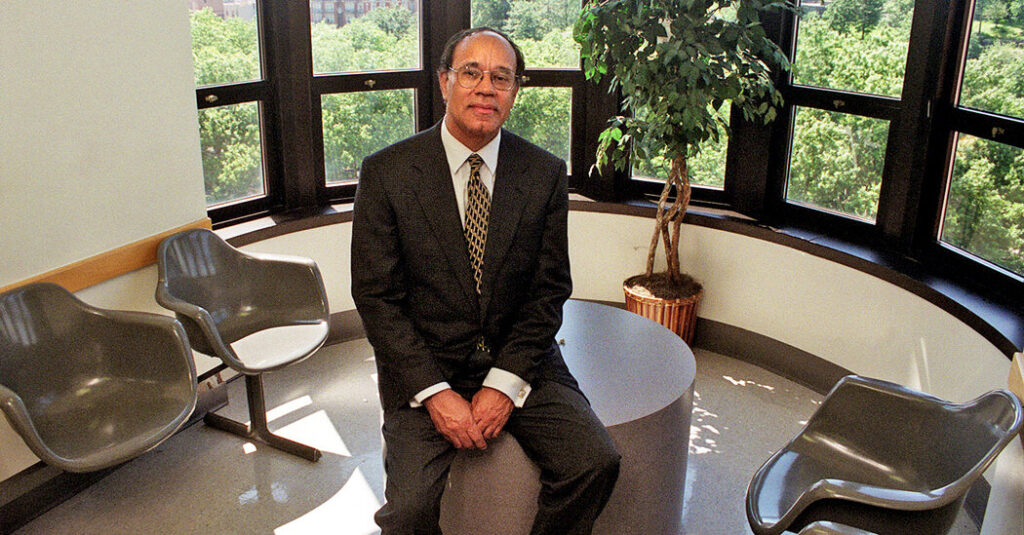
Harold P. Freeman, an influential oncology surgeon whose knowledge of the devastating effects of breast cancer on poor Black women inspired him to create a landmark program at Harlem Hospital Center, helping patients navigate the health care bureaucracy, died on Aug. 11 in Atlanta. He was 93.
His death, at a hospital, was confirmed by his son Neale.
Dr. Freeman’s patient navigation program became a model for hospitals around the world, helping to eliminate barriers to early cancer detection. The program’s success influenced the passage of the federal Patient Navigator Outreach and Chronic Disease Prevention Act of 2005, which provided $25 million for similar programs across the United States. In 2024, Medicare began providing providers with reimbursement for some navigation services for cancer, heart failure, H.I.V./AIDS and other high-risk conditions.
“There are no navigation events or meetings that don’t acknowledge Dr. Freeman’s role in patient navigation,” Dr. Shanthi Sivendran, the interim chief patient officer of the American Cancer Society, said in an interview. “There wasn’t a patient navigation concept before him.”
When Dr. Freeman, who was Black, arrived at Harlem Hospital in 1967, he was convinced that his skills as a surgeon were the most effective weapon he had in the fight against cancer. But the obstacles — for him and his patients — were more daunting than he anticipated.
“I imagined that I could ‘cut cancer out of Harlem,’” he wrote in an opinion essay in The New York Times in 2014. “But I soon learned that the disease would not yield to a surgeon’s knife.”
His patients — often poor, single and uninsured, with children to care for — were frustrated by the barriers they faced. Some felt rebuffed when they initially sought treatment, only to return much later, once their cancers were advanced.
He queried some two dozen breast cancer patients about why they had waited so long to come in for treatment.
One woman’s explanation, he said, epitomized the problem: She had been turned away from the hospital’s emergency room after a doctor told her that a lump in her breast was not an emergency. The doctor had instructed her to go downtown to get a Medicaid card — the office was about 100 blocks away — and then return to the hospital to make an appointment at the proper clinic, where she would have to register and provide proof of insurance, which she may not have had.
Confronted with a series of obstacles, patients “may decide that the process of registration is more painful than the painless lump,” Dr. Freeman wrote in CA: A Cancer Journal for Clinicians in 1989, while he was serving as president of the American Cancer Society. “In this manner, poor people are often triaged negatively back to their communities, returning months later with incurable cancer.”
Ten years before he wrote the article, he had opened the Breast Examination Center of Harlem, which did not require women to register with the hospital. The facility was funded by the state and Memorial Sloan Kettering Cancer Center.
In 1990, Dr. Freeman started the patient navigator program at Harlem Hospital, which provided a variety of services, including assessing patients’ clinical, financial and transportation needs; helping them make appointments to have mammograms and to see oncologists and surgeons; and guiding them through continued care. By 1995, the five-year survival rate for breast cancer at the hospital had increased to 70 percent from 39 percent.
“There are some individuals whose impact is so broad — who change their field and the world — that it’s hard to remember what things were like before them,” Dr. Larry Norton, the medical director of the Evelyn H. Lauder Breast Center at Memorial Sloan Kettering, said in an interview.
Harold Paul Freeman was born on March 2, 1933, in Washington and grew up in a segregated world. His mother, Lucille (Thomas) Freeman, was a teacher; his father, Clyde Freeman, was a cabdriver and security guard who became a lawyer when he was 40. Harold had a grandfather who was a doctor and a great-great-grandfather who had been a slave and had saved $1,800 to buy his freedom.
When Harold was 13, his father died of testicular cancer. “Even though I was still a young boy, I saw the underlying cruelty of cancer,” he told The ASCO Post, an oncology journal, in 2022. “Which, of course, was devastating on many levels.”
In 1954, he received a bachelor’s degree from the Catholic University of America, where he majored in biology and was captain of the tennis team. After earning a medical degree from Howard University in 1958, he completed residencies at Howard University Hospital and Memorial Sloan Kettering. In 1963, he returned to Howard as chief resident in general surgery; a year later, he headed back to Memorial Sloan Kettering as a senior resident in surgery. Three years later, he moved to Harlem Hospital, where he was promoted to director of surgery in 1974.
In Dr. Freeman’s early days at Harlem Hospital, at least half of the patients admitted with breast cancer were considered incurable because their tumors were so advanced.
That was alarming enough, but his concern extended further: He was focused on the broader effects of breast and other cancers on Black Americans, whose survival rates were lower than those of white Americans, Latinos, Native Americans and some Asian Americans.
In 1984, Dr. Freeman became chairman of the American Cancer Society’s National Advisory Committee on Cancer Minorities, which studied whether Black people were dying disproportionately of cancer because they were poor.
“No matter what your background, if you have the education and resources, you’re about equal as far as your chances for survival are concerned,” he told a meeting of the society in Westchester County in 1987. “However, if you are poor and from any ethnic group, your survival chances drop about 10 to 15 percent. If you are poor and Black, your chances are a bit worse than if you are poor and white.”
In 1989, a year after being named president of the society, Dr. Freeman oversaw a series of public hearings on the effects of poverty on cancer patients. Afterward, the society, along with the National Cancer Institute and the Centers for Disease Control, issued a report stating that poor people endured greater pain and suffering from cancer than other Americans, and made greater personal and financial sacrifices to pay for care.
“We need to declare a new kind of war on cancer — a guerrilla war — that will tear down the economic and cultural barriers to early and adequate cancer prevention, diagnosis and treatment,” Dr. Freeman told The Citizens’ Voice of Wilkes-Barre, Pa., after the report was released.
Soon after, he started the patient navigation program at Harlem Hospital, which introduced his ideas to a wider world.
He went on to chair the President’s Cancer Panel, advising Presidents George H.W. Bush, Bill Clinton and George W. Bush on national cancer policy, and served as associate director at the National Cancer Institute and the founding director of the institute’s Center to Reduce Cancer Health Disparities.
In 1999, Dr. Freeman left Harlem Hospital to become the president of North General Hospital in East Harlem; two years later, he became the director of its cancer center. In 2003, he became the medical director of the Ralph Lauren Center for Cancer Care and Prevention in Harlem, a collaborative effort between Memorial Sloan Kettering, Mr. Lauren’s fashion company and North General (which closed in 2010). The facility is now the MSK Ralph Lauren Center, and has incorporated the Breast Examination Center’s services. At the center, Dr. Freeman established the Patient Navigation Institute, a national training program.
Dr. Freeman married Artholian Palmer in 1957. In addition to their son Neale, she survives him, along with another son, Hal, also a doctor, and three grandchildren.
Dr. Norton, the oncologist, remembered a meeting between the National Cancer Advisory Board, which he served on, and the President’s Cancer Panel, then under Dr. Freeman’s leadership.
At one point during the meeting, Dr. Norton suggested that the race of a person should no longer be recorded when someone took part in a clinical drug trial.
“I was concerned because there is no biological definition of race; I thought it was unscientific,” he said. “And Harold said, ‘There may not be such a thing as race, but there is such a thing as racism.’”
Dr. Freeman was concerned that without knowing the race of the people in the trials, researchers couldn’t be sure that they had an adequate cross-section of Americans.
“In his quiet, powerful way, he corrected me in public,” Dr. Norton said. “It was one of many experiences with him that stand out.”