


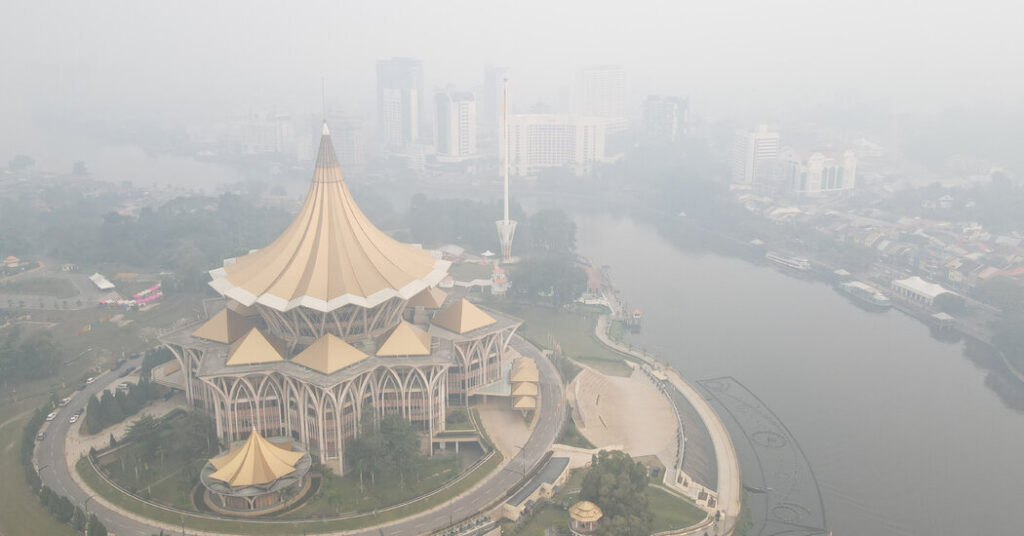
Toxic haze and smoke from wildfires in Indonesia that have been intensifying for weeks has spread hundreds of miles across seas, shrouding a vast swath of Southeast Asia in bad air and raising fears of a regional health crisis.
On Friday, Malaysia, among the worst affected of Indonesia’s neighbors, declared a state of emergency in a town in the state of Sarawak, which abuts some of the most fire-stricken Indonesian provinces on the island of Borneo. Sarawak last month temporarily shut down hundreds of schools because of poor air quality.
Across the South China Sea, Kuala Lumpur, the country’s capital on Peninsular Malaysia, has been engulfed by smoke from fires burning on the Indonesian island of Sumatra, to the south. Some parents are keeping their children home from school, said Geraldine Arulsamy, the head of a local Montessori school.
“We can actually smell the poor air quality,” said Ms. Arulsamy, who added that some children had fallen ill.
Irfan Zulkarnain, a fruit stall worker in the city, said a nosebleed and coughing fit had recently sent him to a doctor, who told him his symptoms were from the haze and prescribed him medication.
“But I still have work here at the stall, outside in the heat,” he said.
In neighboring Singapore, where some areas of the city have become clouded by sepia-toned smog, authorities have urged the public to be on alert for worsening air quality in the next two weeks. More than 1,000 miles east, in Cebu, a city in the central Philippines, Edrine Durante, a 27-year-old resident, said the air felt thick and greasy from the smoke.
“It would normally look bluish, but now it is gray,” she said of the view from her window.
It is a sign of how dire this year’s fires are.
“For a long time, the Philippines was largely insulated from this,” said Gerry Bagtasa, an atmospheric physicist at the University of the Philippines, referring to the trans-boundary smoke. But this year, even Manila, the capital, which lies 350 miles north of Cebu, had received a share of it, he added.
Indonesia, a vast archipelago that stretches across three time zones, is currently in the midst of what some experts fear is shaping up to be the worst fire season in years. More than 490,000 acres of land have burned since the beginning of this year, according to the country’s forest ministry. In addition to the impact on human health, the fires and choking smoke are imperiling the country’s wildlife, including threatened species. In Borneo, at least one orangutan has died from inhaling the smoke, the ministry said.
Driving the fires, in part, is a powerful El Niño, a weather phenomenon marked by shifting ocean temperatures that brings drought to countries such as Indonesia, while unleashing torrents of rain on others.
In the first 10 days of August, more than 90 percent of Indonesia had little to no rainfall, according to the country’s meteorological agency. That month, the number of fire hot spots in peatlands — a type of fire-prone landscape — soared to more than 160,000 from around 45,000, according to data from Pantau Gambut, a nonprofit organization that tracks forest fires in Indonesia.
That surpassed the number of peatland hot spots recorded over the same period in 2015, according to Wahyu Perdana, a spokesman for the group. That was another fire season made devastating by El Niño, when the government said about 6.4 million acres burned.
While El Niño has historically exacerbated fires, experts have long pointed to the degradation of Indonesia’s peatlands as the deeper reason that fires in recent years have so easily spiraled out of control.
A type of spongy wetland, peatlands are resistant to fire in their natural, waterlogged state. But much of the country’s stock has been dried by decades of large-scale plantation farming of cash crops like palm oil, leaving behind a highly potent fuel. Forestry experts and government officials have said that human activity, such as companies or individuals deliberately burning them to clear land, is also largely to blame for peatlands catching fire in the first place.
“Once drained peat ignites, combustion continues underground for weeks, generating dense trans-boundary haze,” Mr. Wahyu said, adding that around a fourth of the peatland fire hot spots recorded in August were located in plantation concessions.
Emilia, a 40-year-old smallholder rubber farmer on Sumatra who like many Indonesians goes by one name, said that fires routinely break out around this time of year as the 49,000-acre sugar cane plantation just across from her village begins its harvest. This season has been no different.
Sometimes the smoke is so thick that visibility shrinks to about 10 feet, she said, adding that it enters kitchens and bedrooms, triggering respiratory illnesses. On Thursday, the fire spread to her own farm, filling her with financial despair. Still, none of the 1,300 villagers have evacuated.
“Where else would we go?” she said.