


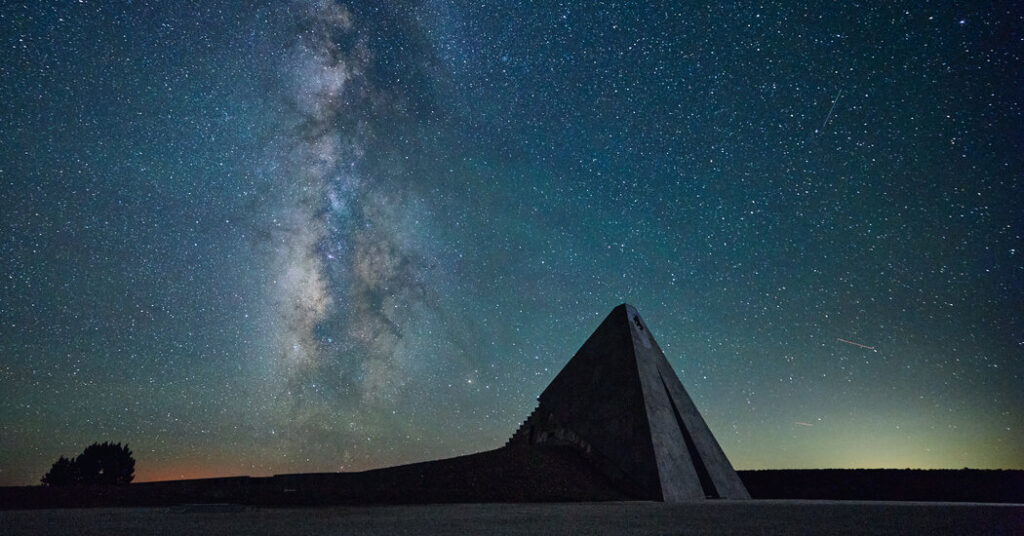
This spring, Charles Ross sat in his studio in SoHo, but his mind was elsewhere: a mesa in eastern New Mexico, where his life’s work, a monumental naked-eye earthwork called “Star Axis,” — part observatory and part pyramid — juts at the cosmos. “If you’re there in the winter when there’s a snowstorm, it’s like the sky is painting the earth white,” he said. “And the thunderstorms. And rainbows several times a week.”
Ross has a degree in math and a yen for physics. He says he can sense celestial alignments, and feel the difference between colors of light in a spectrum. When he needed a well dug for his desert home, he called a dowser.
The artist, 88, belongs to a generation of land artists who shed galleries and cities to work at a scale more common in ancient Egypt and Mesoamerica. In 1975, he had been crisscrossing the Southwest for four years, hunting for the perfect location for “Star Axis,” when a cowboy appeared and handed him a business card.
The cowboy’s father, W.O. Culbertson Jr., happened to own the surrounding 62,000 acres. Ross called him up and explained his plans for a sculpture that would help people sense the deep past and distant future, by visualizing the changing position of Earth’s current north star, Polaris. He wanted to see the night sky as Cleopatra might have seen it.
Ross imagined visitors observing Polaris through a metal ring at the top of a long staircase, aligned to the Earth’s celestial axis. “I said, ‘I need about a square mile.’ And I’ll never forget the answer. He said, ‘Well, hell, we’ve got plenty of those.’” The rancher deeded Ross about 400 acres. In exchange, Ross built a bridge over a culvert to help Culbertson’s limo reach his hacienda.
Ross broke ground during the U.S. Bicentennial year. Fifty years and more than $10 million later, he says “Star Axis” will be done by winter. In the final design, the staircase rises 11 stories through a tunnel blasted in the rock of Chupinas Mesa, 6,000 feet above sea level and into a viewing chamber in a concrete, stone and steel pyramid 52 feet tall. A circular window there frames Polaris. As viewers climb each of the 147 stairs, the rim of the window appears to broaden, giving an idea of how far Polaris has and will move in a given amount of time, during the 26,000-year cycle known as precession, the gravitational wobble of the Earth’s rotational axis.
“Star Axis” is a visitor from another time. The sculpture speaks a new-age language of earth and sky; in cosmic terms, the project’s 50-year story is negligible, yet it’s rooted in a moment that produced contemporary artists with epochal aspirations. “The monumentality and the scale of ambition are part of what takes your breath away with the work,” Kaywin Feldman, director of the National Gallery of Art in Washington, said in an interview. A short film on “Star Axis” is included in a series on artists that the National Gallery produced for America250.
“Walter De Maria, Michael Heizer, Charles Ross, Robert Smithson: These are the high priests of Land art,” Virginia Dwan, the 3M heiress and New York gallerist who nurtured them, wrote in the 2012 catalog for “Ends of the Earth,” a definitive land art survey at the Museum of Contemporary Art in Los Angeles.
Almost all the rest of Ross’s cohort has completed their remote masterworks: Smithson’s “Spiral Jetty,” 1970, in Utah’s Great Salt Lake; De Maria’s “The Lightning Field,” 1977, in New Mexico. The most recent, Heizer’s “City,” in Nevada, opened to the public in 2022 after 50 years. Only James Turrell’s “Roden Crater,” a bigger, slicker observatory, remains unfinished — although Turrell, a slightly younger, West Coast artist, is part of the adjacent but distinct “light and space” movement.
Ross has declared “Star Axis” nearly complete in the past. A 2002 article in The New York Times put its projected opening date at 2006. This time, he said, is different. The structure is done. Ross and his team will spend the summer cleaning up the grounds and finishing the drainage system that protects “Star Axis” from New Mexico’s monsoons. Ross said the pyramid is so solid that it could slide off the mountain in one piece.
The challenge is ensuring that “Star Axis” endures in the public mind. Ross showed me a long-exposure photograph of “Star Axis” he took in 2000, with stars tracing short arcs through the turquoise night. “You couldn’t do that picture now,” he said, “without retouching out all the satellites.”
It’s Not About Him
The day before the summer solstice (June 21, roughly 1 p.m.), Jamie Clements picked me up from the Albuquerque airport. A silver-haired, loquacious Texan, he cut his teeth in the fund-raising world in the 1980s writing nonpartisan solicitations for Karl Rove’s direct marketing company; from 2013 to 2025 he headed the foundation that supports New Mexico’s state museums. He has taken dozens of prospective benefactors to the mesa over the years. In 2026, Ross and his wife, the artist Jill O’Bryan, hired him as chief executive of their nonprofit, the Land Light Foundation.
“Star Axis” was underwritten by Ross’s art sales, and patrons like Dwan. Today, donors can pay a thousand dollars or more to visit with a small group, or sponsor a stair for six figures. Clements told me that it’s tougher fund-raising for the sculpture’s upkeep and staffing than for more typical arts organizations. I joked that maybe that’s because there’s no wall to put donors’ names on. He pointed out that Ross’s name isn’t on the walls either.
Despite the scale of Ross’s project and his centrality to the land art movement, he remains a cult figure. In a world of swaggering personalities, he is relatively humble. The rapper Kanye West filmed an IMAX movie at “Roden Crater.” No such celebrities at “Star Axis.”
But Ross isn’t unknown. His drawings and prism sculptures are at the Smithsonian. He has built more than 20 permanent prism installations called Solar Spectrums, which spread the sun into rainbows at different times of day and year, at sites from Tasmania to Tokyo, including a private home for the Walmart heiress Alice Walton and a chapel at the Harvard Business School. “Spectrum 14,” commissioned for the Getty’s Pacific Standard Time survey in 2024, exploring connections between art and science, is installed in the museum through Nov. 29.
Yet in the time it has taken to finish “Star Axis,” many of the wells that supported early land art have dried up. Dwan, the patron, died in 2022; a spokesperson for the Dia Art Foundation, which runs “The Lightning Field,” “Spiral Jetty” and Nancy Holt’s “Sun Tunnels” (1973-1976), said the institution has “no plans to add to our constellation of sites at this time.” Michael Govan, director of the Los Angeles County Museum of Art and director of Dia between 1994 and 2006, told me that he helped Heizer form a consortium of institutional backers for his sculpture, “City,” under the nonprofit Triple Aught Foundation.
Heizer and Ross were once studio neighbors, and are still close. While “Star Axis” is smaller and less remote than “City,” the comparison is unavoidable. O’Bryan, Ross’s wife, pointed out that Heizer shows at Gagosian gallery, while “Charles doesn’t have a blue chip,” she said. “He’s with Franklin Parrasch.”
O’Bryan met Ross in 1994 when she became his studio assistant, while completing her Ph.D. in art theory. She splits her time between “Star Axis” and her own art, which includes rubbings of the mesa and intricate conceptual drawings where one hash mark corresponds to one breath. The couple, with their rescue dogs Pi and Tika, spend summers in a New Mexico house made of double-wide trailers with generous studio space. Once it gets too cold to pour concrete, they return to Manhattan.
Like many in Ross’s orbit, O’Bryan seems impressed by her husband’s balance of gentleness and drive. “That was the thing that attracted me to Charles’s particular type of genius,” O’Bryan said, “which is that it’s not about him.”
Govan pushed back on the idea that land art requires plentiful ego. With the typical monument, he said, powerful people “caused workers to build things in honor of gods, heroes, battles won and the usual.” Works of land art like “Star Axis” are “specks in the scale of the landscape. They’re not monuments to anything except the fragility of our own perception and experience.”
On its small scale, getting “Star Axis” visitor ready is a race against entropy. The Museum of Outdoor Arts (MOA) in Denver, donated an environmentally friendly concept house to the project in 2014 that holds up to six guests a night. Decks, solar panels and motorized windows have all needed repair.
In 2025, two New Mexico lawmakers introduced a bill that would have funded a feasibility study for the state’s acquisition of “Star Axis.” State Senator Pat Woods, one of HB 37’s sponsors, wrote in an email that safety was an issue. He pointed out that a “higher than normal” staircase was meant to be traversed in the dark. “We explained to the committee chair that there was liability but it was a truly unique sight.” The bill died in committee.
Construction Stories
The remnants of construction line the road up the mesa. There’s a shipping container used as a tool shed, with a small cement mixer outside; farther up is a squat yellow bulldozer with plants sprouting from the dirt in its scoop.
Ross assured me the bulldozer was in perfect working condition. It’s military surplus, built for an invasion. A Caterpillar dealer in town sold it to him for its scrap value, he said, because it was so ugly.
One reason “Star Axis” took so long is that Ross designed it himself. He has had help, of course — including on the finer points of engineering and astronomy — and he’s made drawings, but the details seem to live in his head. He doesn’t need permits, O’Bryan told me, because “Star Axis” is technically a sculpture, not a building.
Every summer for 50 years, Ross has journeyed to New Mexico, hired local laborers and gotten to work. The first task was to dynamite a cone and tunnel from the mesa. Boulders flew into the pasture, Ross said, and when the dust cleared, he found the dynamite schematic had come to rest on top of one, with a small stone keeping it in place. “I thought, I’ve got to say yes to that.” He collaged the schematic into a drawing.
Ross showed me up a narrow spiral staircase in the Hour Chamber in the fore of the pyramid. X’s on the wall marked where a railing will go. From inside, it takes a star one hour to cross the triangular doorway. The walls here are as thick as 12 feet.
The stone slabs — mostly pink granite donated by a Texas company — are lifted into place with a crane. The middle is filled in with rocks and concrete. Thick steel rods run every three feet.
Ross got lucky: The remote site is barely within range of the nearest concrete batch plant. Any farther and the concrete would harden before it arrived. Ross estimates “Star Axis” contains around 120 trucks’ worth.
“When we were working on the walls up around the big excavation,” Ross said, “guys were on scaffolds about 10 feet below the top working on the stonework. There’s one big old longhorn who liked to come up in the morning after everybody was working. He’d sneak up to the edge and stick his head over the side and scare everybody along the scaffold. You’d just see these horns coming at you. He thought that was so much fun.”
A Rendezvous with Polaris
The way Ross tells it, steadily but surely, he was pulled to Polaris. Born in Philadelphia, Ross was studying math at Berkeley in 1960 when he took a sculpture class. His math grades plummeted: Art was his calling. He finished an M.A. in sculpture in 1962.
He made sets for the Judson Dance Theater and dabbled in performance, including a happening where he, fully clothed, and a woman, nude, were bound together with plastic wrap. His mathematically informed lattice sculptures from that decade resemble twisted CD towers in the Minimalist idiom of Donald Judd and Sol LeWitt.
Then, he said, he saw in a dream the plans for a prism. He cleared out his studio and devoted himself to light. From the prisms, Ross grew interested in the Egyptian pyramids.
He was taken with speculation that the Great Pyramid was once painted with the colors of the spectrum. He discovered that the entrance to the Great Pyramid was oriented toward Thuban, the north star in the age of pharaohs, 4,500 years ago. That led him to precession. In 1971, he drew the first plans for “Star Axis.”
On the afternoon I arrived, O’Bryan oriented me to the site. When we reached the viewing chamber at the top of the stairs, her husband was waiting on an angled bench built into the walls. I took a seat on another “You’re leaning against the angle of the sun on the equinox,” O’Bryan said. It was pretty comfortable. Ross started humming. The low tone reverberated around the hard, sharp room.
In the light of day, “Star Axis” appears homemade, even humble. The masonry reflects the ad hoc way the sculpture has come together, season by season, with successive generations of workers from a nearby town. Ross mocked up many of the chambers on site at full scale, with lumber, so he could feel how the angles affect the body.
But “Star Axis” is a precisely engineered instrument. Woodruff Sullivan, the astronomer who, along with Mallory Thorp, helped match each stair to a point in the precession cycle, vouched for Ross’s math. “If it was not important, and especially if it was wrong, I would not be interested in collaborating.”
On the summer solstice, the tip of the pyramid’s shadow traces the near edge of the bowtie-shaped “Shadow Field.” On the winter solstice it follows the opposite side. “Every tree, every pole, every building also draws this shape,” Ross pointed out. “But here you can see it.”
While Ross’s attention to detail is often stunning, he’s more interested in conveying a bodily impression of cosmic time. My encounter was certainly more esoteric than scientific.
Around 10 p.m., the waxing crescent moon cast shadows on the mesa; the shade of the solar pyramid jutted into the crushed white caliche at its base.
By 1 a.m., the moon had set and the stars asserted themselves; the Milky Way ribboned overhead.
A path curls southwest down the side of the mesa to the tunnel entrance. Two sphinx-like sandstone and concrete buttresses gathered me into the structure, through a triangular doorway 47 degrees at its apex
As I climbed the steps through the mesa and into the pyramid, the window at the top of the staircase appeared to expand. I felt drawn up the tunnel, slowly, toward the stars. The wind outside sounded like ocean surf, evoking visions of mariners with their sextants.
I didn’t see the crisp coin of night sky depicted in photos of the piece. The tunnel edges looked webby and murky. But the human eye is not a camera. Ross also pointed out that the staircase is calibrated to someone of average height, which I am not.
I’m not sure I traveled through time, beyond the normal rate. But I felt focused and present. Rather than leave my body behind, I felt grounded within the epochal cycles of the stars, and the 50-year arc of one man’s stellar devotion.
Sunrise on the year’s longest day began as an orange gash over a long purple mesa. The darkness soaked back into the desert. For a few seconds, the east face of the pyramid glowed tangerine. On the other side of the mesa, two yellow bulldozers and a crane sunk into the dirt, their foam seats eaten away. These machines helped build Ross’s sculpture; this summer, one item on his punch list is to sell them.