


Visitors to the Freedom Trucks, the Trump-backed mobile history exhibit currently touring the country, will find the familiar image of George Washington crossing the Delaware splashed across their sides.
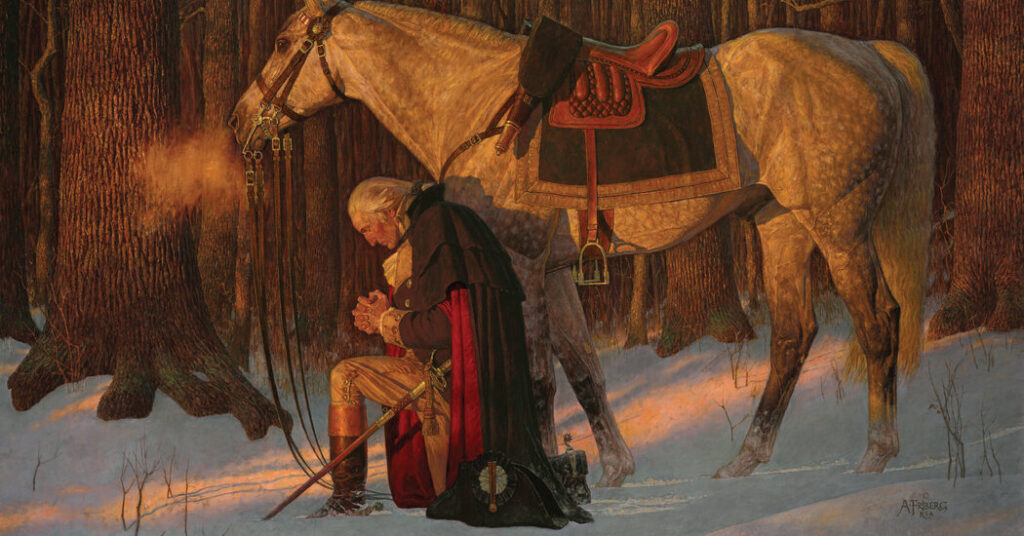
But while the trucks are on the road, a humbler image can be spotted on the back: the nation’s first commander in chief kneeling in solitary prayer next to his horse.
The iconography of Washington at prayer has long circulated in American culture on prints, postage stamps and Christmans ornaments. But in the run-up to the 250th anniversary of American independence, it’s increasingly cropping up in more prominent, quasi-official places.
The image has been posted on the social media accounts of the Department of Defense and other federal agencies. It appears on a comic book and other merchandise promoted by the nonpartisan group organizing the federal commemoration of the anniversary.
It has also been used to promote Rededicate 250, a White House-backed event on May 17 that will bring religious leaders and prominent Republican officials to the National Mall in Washington for a “national day of prayer, praise and thanksgiving.” After a video message from President Trump, the schedule lists three hours of speeches recounting “major chapters of American history where God’s providence, protection, and guidance are visible.”
Claims that America was founded as a Christian nation have long circulated on the evangelical right, along with the argument that the wall of separation between church and state is a modern liberal invention.
But as the 250th anniversary approaches, the protection of what President Trump has called “the Judeo-Christian principles of our Founding” has been woven into the administration’s anniversary plans.
And the image of Washington at prayer, some scholars say, has gone from being a patriotic commonplace to a politically charged statement.
“Fifty years ago, this image would not raise eyebrows,” said John Fea, a historian at Messiah University in Pennsylvania who has written about Christian accounts of the founding. “It would have just seemed like a form of civil religion — ‘God Bless America,’ ‘Faith of Our Founders,’ and so on.”
“But Christian nationalists are now in power,” Fea said. “And that is why you are seeing it in different kinds of spaces.”
Disputed History
Washington really did cross the Delaware. But the story of his dropping to his knees in solitary prayer at Valley Forge in the winter of 1777-8, at one of the bleakest moments of the American Revolution, is more legend than history.
Scholars trace its first appearance to the decade after Washington’s death, in the 18th edition of a biography by Mason Locke Weems (which also included the invented tale of young George chopping down the cherry tree).
Weems, an evangelical pastor and bookseller, claimed that he heard the story from a local Quaker who had come upon the general in prayer, and was so inspired that he abandoned his pacifism and embraced the cause of the Revolution.
The story continued circulating in the 19th century, inspiring paintings and engravings that increasingly left out the Quaker observer, shifting the focus entirely to Washington’s piety.
But perhaps the most familiar version today — the one used on the back of the Freedom Trucks — is “Prayer at Valley Forge,” a painting created for the 1976 Bicentennial by Arnold Friberg.
Friberg, an illustrator and painter based in Utah, first came to prominence in the 1950s with a cycle of monumental paintings based on the Book of Mormon. They caught the attention of Cecil B. DeMille, who hired him to produce paintings and designs for “The Ten Commandments.” (He was nominated for an Academy Award for costume design.)
Friberg, who died in 2010 at 96, spent two years on the Washington painting, which he intended as an antidote to what he saw as the “rebellious cynicism” of Vietnam-era student protesters. He studied Washington’s uniform, which is preserved at the Smithsonian. And he visited Valley Forge in winter, an experience he later described in near-mystical terms.
“It was deserted, the wind moaning through the great trees, silent, lonely, cold,” he recalled.
For much of his life, the original painting hung over Friberg’s fireplace in Utah, while his studio did a brisk business in reproductions. Since 2017, the original has been on loan to the Museum of the Bible in Washington.
The museum referred questions about the work to First Freedom Art, a Texas-based investment company that bought more than 200 of Friberg’s paintings from his estate in 2022, with the goal of raising his artistic profile and market value.
The company has made a documentary about Friberg, which includes animated versions of works like his series on the history of college football. And it recently organized a display in London of his 1994 portrait of Queen Elizabeth II on horseback, flanked by some of his many paintings of the Royal Canadian Mounted Police.
But Elizabeth Carlyle, the company’s chief executive, said the jewel in the crown is “Prayer at Valley Forge,” which it hopes to make as recognizable as Emanuel Leutze’s 1851 painting “Washington Crossing the Delaware.”
“This painting bridges faith and freedom,” she said of Friberg’s image. “We know that prayer preceded American freedom, and it will be the way to preserve it.”
Julia Friedland, a spokesman for Freedom 250, the Trump-backed group that organized the Freedom Trucks and the prayer event, said the painting “captures a defining part of the American story: faith in moments of uncertainty.”
Some displays of the painting have raised hackles. In 2018, the Freedom From Religion Foundation sent a letter to the Museum of the Bible objecting to its display, calling it “disinformation.” (The current wall label, while noting the image’s 19th-century origins, states that “many believe Washington knelt in solitary prayer” at Valley Forge.)
But Doug Bradburn, the president of Mount Vernon, where the painting was on loan from 2008 to 2012, said he saw no issues with a museum’s displaying it, if it is properly contextualized.
The kneeling episode itself may be fictionalized. “But it’s interesting to me that some people are so adamant that Washington would never have done that,” Bradburn said.
A carefully factual entry on Washington and religion on Mount Vernon’s website calls the subject “complex,” and warns against relying on “trite labels and descriptions.”
Washington, an Anglican who served as a church vestryman, was “not an evangelical,” Bradburn said. Nor, he said, was Washington a deist who believed that God created the world but did not intervene in human affairs, as has often been claimed.
Washington, the entry notes, rarely referred to Jesus in his writings or speeches As with many things, he was private about his faith, leaving some contemporaries wondering what he believed.
But as commander in chief, he required military chaplains for each unit, and he spoke often of “Providence,” which he saw as guiding the nation in some sense.
In his famous 1796 farewell address, he declared that “religion and morality are indispensable supports” of “political prosperity.”
Bradburn said that the most significant thing was Washington’s strong belief in religious freedom, including for non-Christians.
“He was definitely religious himself, but he didn’t want to enforce it as a state project,” he said.
‘A Godly Heritage’
Still, the image of Washington kneeling in prayer has been a touchstone for some Christians who reject the idea that the founders wanted a separation between church and state.
A version appeared on the cover of the 1993 book “America’s Godly Heritage” by the evangelical writer David Barton, the founder of the group WallBuilders, which promotes what it calls “the true story of America and our biblical foundation.” The First Amendment, Barton and his followers argue, was meant to protect religion from government interference, not to keep religion out of government.
The prayer image has also seeped into pop culture. An image inspired by Friberg’s version, appears on the cover of “The President,” a biographical comic book from the Christian publisher Kingstone that has been promoted by America 250, a nonprofit group charged with organizing the federal commemoration.
It has also been invoked by some top Trump administration figures. At a prayer service last year at the Pentagon, Defense Secretary Pete Hegseth referred to Washington praying “on bended knee” with his troops.
Hegseth is scheduled to speak at the prayer event, as part of a segment called “God’s Hand in the Founding of a Nation.” That section also includes Eric Metaxas, an evangelical radio host and author who has called the idea that the founders were quiet about their faith a “secularist lie.”
In his forthcoming book “Revolution: The Birth of the Greatest Nation in the History of the World,” Metaxas writes that the United States was born when “the idea of liberty went forth from the eternal mind of God, entering history and time.”
Few professional historians endorse that kind of theologically infused perspective. But a growing number of scholars argue that the Founders were more influenced by religion than secular colleagues have recognized.
In his book “Reading the Bible With the Founding Fathers,” Daniel L. Dreisbach, a legal scholar at American University, argues that the writings and rhetoric of Washington and others are shot through with allusions to the Bible, which they looked to for insights into human nature, morality and politics.
Many scholars today “either miss or dismiss the vital role religion played in the founding generation’s political thought and practices,” Dreisbach said in an email. “The result has been a somewhat distorted account of the founding.”
Fea, of Messiah University, also questions the idea of a purely secular founding. But the public debate about religion and the nation’s origins, he said, is ultimately less about 18th-century facts than 21st-century politics.
“Right now, everyone is looking for a usable past,” he said. “And having Washington on his knees sends a powerful signal.”