


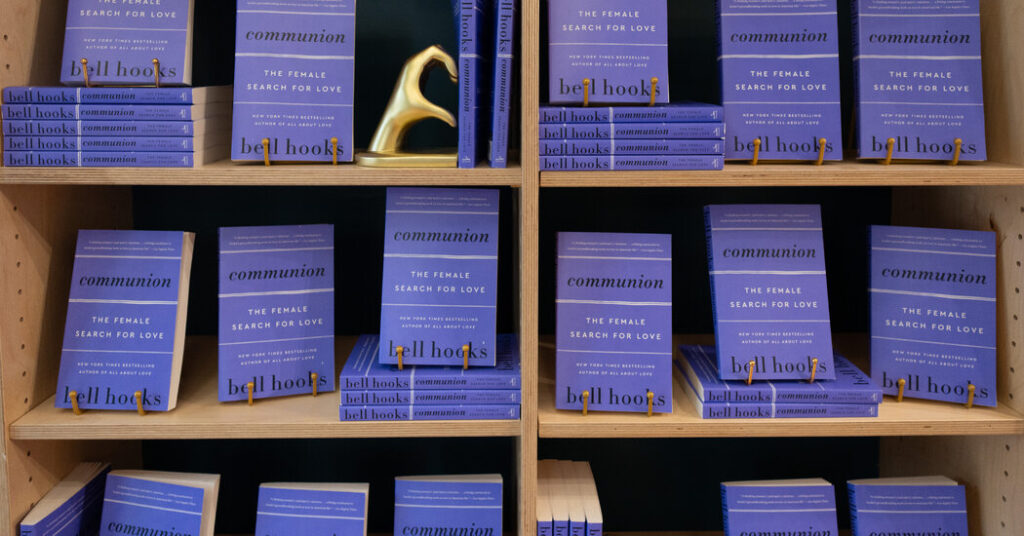
This spring, when Vice President JD Vance announced his new memoir, “Communion,” a backlash erupted on social media. The critiques weren’t about the contents of the book, which chronicles Vance’s conversion to Catholicism and how his faith has informed his politics. Instead, people seized on the title — specifically, its similarity to a work by another famous writer.
In 2002, the Black feminist writer and scholar bell hooks published a book titled “Communion,” which argues that women have been conditioned to search for love outside of themselves, and should focus on cultivating self-love in all stages of their lives. hooks’s fans saw a pattern: The title of Vance’s 2016 memoir, “Hillbilly Elegy” — which became a huge best seller and put him on the map as a public figure — also bore a similarity to another hooks book, “Appalachian Elegy.”
Whitney Alese, a content creator in Philadelphia who has been reading hooks since college, said she saw an opportunity to use the attention surrounding Vance’s memoir as a way to get more people reading and talking about bell hooks.
“I did what I always do — I started yapping about it,” Alese said. Starting in early April, she posted about hooks on Instagram, where she has close to 150,000 followers. Her videos urging people to read hooks went viral, a few racking up more than 800,000 views. They kicked up so much discussion that Alese launched a free online book club about hooks’s “Communion,” which meets every two weeks on the crowdfunding site Patreon. More than 5,000 people have signed up so far.
“My goal was to say, hey, instead of putting all our energy into opposing JD’s work, why don’t we lift up bell hooks’s work?” she said. “Her work was so focused on love, and this particular book was all about loving yourself.”
A grass-roots effort to push hooks onto the best-seller list spread across social media. Booksellers took up the challenge, including Possible Futures in New Haven, Foxing Books in Louisville, Ky., All She Wrote Books in Somerville, Mass., Fiction in Wiscasset, Maine, and Loyalty Bookstore in Washington, D.C. Just Book-ish in Boston ran through 50 copies and ordered 100 more, said Porsha Olayiwola, the store’s co-founder, who has shelved them at the front of the store.
The Word Is Change, a bookstore in Brooklyn, delivered a subtle dig at Vance in an Instagram post without naming him: “This week we want to make sure if any book called Communion makes the best-seller list it’s by bell hooks.” Dozens of people replied in the comments, many saying they had picked up copies from their local bookstore.
In June, hooks’s “Communion” landed on The New York Times paperback best-seller list at No. 12. It hit the No. 1 spot on the Indie best-seller list, which tracks sales at independent bookstores, and also reached No. 1 on Bookshop.org during the week ending in June 17.
A representative of HarperCollins, which publishes both hooks and Vance, said that sales of hooks’s “Communion” are up 1,000 percent since the end of March compared to the same period last year. Vance’s book is currently No. 1 on the New York Times best-seller list and has sold some 70,000 copies since its release on June 16.
“I get giddy when I think about all the communities, indie bookstores and readers that are rallying around this book,” said E. Gale Greenlee, a literary scholar and co-editor, with the Appalachian artist and curator shauna caldwell, of a forthcoming book about hooks, “Belonging to Place.”
“bell was afraid when she passed that she would be forgotten,” Greenlee continued. “This just proves she will not be forgotten, we will not let it happen, and that her work is still so meaningful and necessary for us all.”
Writers have also joined the effort, including Caro Claire Burke, whose best-selling novel, “Yesteryear,” skewers tradwife culture. “If you buy one book this week it should not be mine,” Burke said in a video posted on Instagram. “It should be bell hooks’s ‘Communion.’”
When Vance was asked about whether he was aware of the similarity of his titles to bell hooks’s, he declined to comment through his publisher. A representative for Vance did not respond to a request for comment. A HarperCollins spokesperson who has worked with Vance said the similarity between the titles was coincidental, and noted that the content of Vance’s most recent book, describing his turn to Catholicism and the role his faith plays in his work as a politician, bears no resemblance to hooks’s work.
“HarperCollins has always published books across a broad range of subjects, genres and viewpoints, and we are committed to giving readers access to a wide variety of ideas and perspectives,” said Liate Stehlik, chief executive and publisher of the U.S. trade books division at HarperCollins.
hooks, who was born Gloria Jean Watkins in 1952, was a prominent and influential Black feminist intellectual. She chose the pen name bell hooks in honor of her maternal great-grandmother, Bell Blair Hooks, and used lowercase letters to emphasize, she often said, the “substance of books, not who I am.” Before her death in 2021, she published more than 40 books, and laid the groundwork for future scholars and activists with works like “Ain’t I a Woman: Black Women and Feminism.”
Linda Strong-Leek, the executive director of the bell hooks Institute at Berea College in Kentucky, said she believed hooks would be alarmed by the political animosity dividing the country but thrilled that her work is still resonating.
“She was a pretty profane person, so she’d be cursing,” Strong-Leek said, “but she would be proud that people understand the significance of her work right now.”