


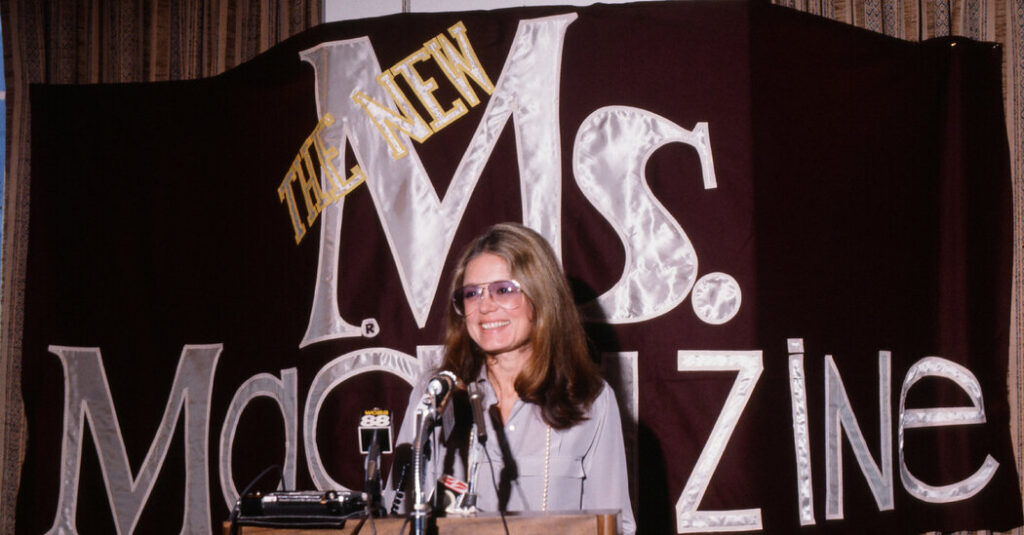
One of the lasting accomplishments of Gloria Steinem, the feminist leader who died this week, was her role in replacing the honorifics Miss and Mrs. with Ms. She encountered much resistance. But her most formidable opponent may well have been The New York Times, which had long been seen as an arbiter of standards and language usage, and its executive editor, A.M. Rosenthal.
The disagreements between Ms. Steinem and Mr. Rosenthal are hashed out in letters going back half a century, stored today at the New York Public Library.
“It isn’t possible to continue forcing women to disclose marital status when men are not forced to do the same,” Ms. Steinem said in a letter dated Nov. 23, 1973 and addressed “Dear Abe,” as Mr. Rosenthal was known. Her message was backed up by protesters who showed up in front of the newspaper’s headquarters on West 43rd Street with placards demanding that the paper drop its prohibition.
But Mr. Rosenthal held firm.
“If I didn’t know you well enough to call you Gloria I certainly would address this letter as Ms. Steinem, because I know you prefer to be addressed that way,” he wrote in a “Dear Gloria” letter dated Dec. 3, 1973. “Then the question arises as to why we don’t do the same thing in the paper,” he added.
“We could call everyone Ms.,” he wrote. “We don’t want to do that because it really is not part of the language yet and because an awful lot of people would object.”
He also spoke of what he saw as The Times’s authority on these kinds of matters.
“An inordinate amount of thought goes into any stylistic change,” he said. “Sometimes the amount of discussion annoys me and yet I realize this passion about the Times style, among staffers and readers, is part of the paper and in the end more constructive than negative.”
As was suggested by this exchange, this is not the only time they crossed pens over the years. The letters — handwritten (Ms. Steinem) and typed (Mr. Rosenthal), sometimes going on for pages — are stored at The Times Archives at the New York Public Library. To my delight, I stumbled across them while plowing through files while researching for a book I wrote on the history of the newspaper.
Ms. Steinem valued Mr. Rosenthal’s opinions; he was one of the dominant figures in journalism at the time. And Mr. Rosenthal was only too glad to share them with her. She sent him a preview copy of the first issue of “Ms.,” her new magazine, at the end of 1971.
“If you have advice for us, please say so,” she wrote him. “It would be gratefully received.”
Mr. Rosenthal waited nearly a month before responding with a three-page, single-spaced letter.
The positive? “The idea of the magazine itself,” he wrote. “I can’t quite figure out why some publications are in business or what they are trying to say, but nobody should have any that problem with Ms.”
He went on: “I didn’t much care for your cover and the general typographical feel of the magazine. I think you have some work to do here.” It seemed, he said, a knockoff of New York magazine. There was more: “I do think that as time goes on, you will have to broaden your range of articles considerably in order to avoid saying the same thing over and over.”
Mr. Rosenthal, with the backing of the publisher at the time, Arthur Ochs Sulzberger, held firm to the Ms. policy for nearly 13 years until June 1986, when he finally reversed course.
“Until now, ‘Ms.’ has not been used because of the belief that it had not passed sufficiently into the language to be accepted as common usage,” he wrote in a note to the newsroom. “The Times believes now that ‘Ms.’ has become a part of the language, and is changing its policy.”
Ms. Steinem and a contingent of women showed up at The Times with a bouquet of flowers to thank him. It was Mr. Rosenthal’s last major decision as executive editor; Mr. Sulzberger would ask him to retire two weeks later.