


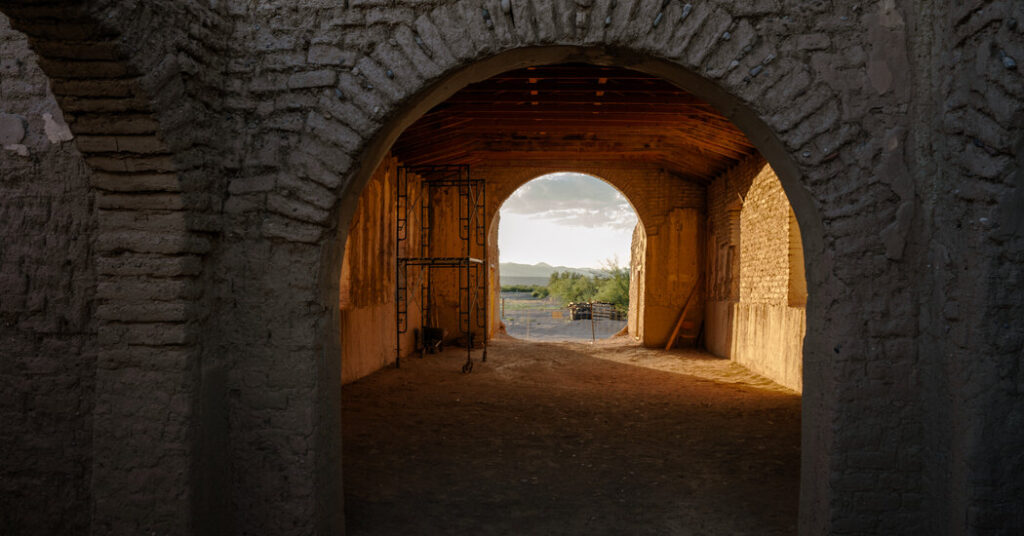
Out in Far West Texas, a heavy bronze bell once tolled, calling congregants from both sides of the U.S.-Mexico border to worship at a small adobe church.
The bell and the Catholic church in Ruidosa are hallmarks of an era when Mexican and American border communities lived as one. But nearly three generations ago, parishioners moved away from the tiny town. One of the church’s twin towers toppled. The bell disappeared.
Local volunteers have begun restoring the church, El Corazón Sagrado de la Iglesia de Jesús. They view it as one of the last vestiges of a shared history along a southwestern landscape that is as Indigenous, Spanish and Mexican as it is American. Fortifying its walls and twin towers means that perhaps the bell could ring again.
Now their work faces a new danger: President Trump’s border wall. The church is one of dozens of historical sites across the Southwest threatened by the construction. In Arizona, portions of a 1,000-year-old etching in the earth have been bulldozed. In Texas, work is endangering ancient cave murals and landmarks on the Underground Railroad.
“If you value a people’s worth and contributions, then you preserve their history in textbooks and curriculums,” the historian Trinidad Gonzales said. “You would preserve these physical markers.”
Trump administration officials say the wall will go up yards away from the church and help deter violent drug traffickers in one of the most remote parts of the Chihuahuan desert. Preservationists, though, warn that the relentless vibrations of the construction threaten the church’s fragile structural integrity.
To historians and border residents, the administration’s construction plans, alongside a campaign to deport thousands of immigrants, amount to uprooting centuries of Mexican and Latino American history and presence.
The 110-year journey of the church and its bell is a story of displacement and migration, of being lost and improbably found, and of artists, historians and community residents who have gone to great lengths to bake and haul adobe bricks, bail the bell out of a Marfa jail and reclaim a piece of lost past.
El Corazón Sagrado arose during the Mexican Revolution. Hundreds of thousands of Mexicans were migrating north. They opened schools, theaters and newspapers and, in the borderland, they organized against U.S. segregation and anti-Mexican discrimination.
In Ruidosa, a tiny settlement southwest of Marfa, the community built a church. Mexican and Mexican American families from both sides of the river molded clay bricks to raise its mission-style walls and twin towers. From a central wooden gable, they hung its bronze bell.
For nearly 40 years, the bell tolled. It brought people together for weddings, funerals and Sunday masses.
”The church was a center of life,” said Zenaida Maria Nazeri, 77, who was born in Ruidosa and attended its services.
But by the 1950s, a New Mexico dam and a drought had choked the river that sustained Ruidosa’s farmland. Many in the region began to move again. The post office closed. El Sagrado Corazón fell into disrepair, and the Catholic Church officially retired the mission in 1956.
Sometime in the 1960s, the bell finally migrated, too. The front entryway fell after years of winds and rains had eroded its foundation. The great bell crashed to the earth. A family retrieved it and gave it to Johnnie Tucker Chambers, a teacher living in a nearby schoolhouse. She mounted the bell on a wooden stand and used it to call children from both sides of the border to class.
When she left, she took it to her property in nearby Candelaria, where she used it to call her ranch hands to dinner.
Without its bell, the Ruidosa church, named for the Sacred Heart, seemed to lose its own pulse. The building was locked up, its doors and windows boarded up to prevent vandals from scavenging its wooden floor and pews.
By the early 1990s, the left tower had collapsed, and the El Paso Diocese officially ordered the mission demolished.
That stirred something in people.
Historians, church patrons and community residents expressed their outrage in letters to local newspapers and the diocese. County commissioners paused the Catholic Church’s demolition request.
Restoration efforts regained momentum in 2019, not long after Mr. Trump was elected on rallying cries to “build the wall.”
In his second term, the Trump administration has pushed those plans forward, placing El Sagrado Corazón in jeopardy. U.S. Customs and Border Protection did not respond to questions regarding the community concerns about preserving the church and other sacred sites. In federal lawsuits, administration officials argue they have the authority to waive environmental regulations and other legal claims in the interest of tackling drug smuggling and illegal immigration.
Across the Southwest, similar projects have already begun. In California, explosives have blasted Tecate Peak, also known as Kuuchamaa, a mountain sacred to the Kumeyaay people that is on the National Register of Historic Places. In Arizona’s Sonoran Desert, construction crews bulldozed parts of the 1,000-year-old Las Playas Intaglio, a giant fish-shaped image etched into the earth, disturbed sacred burial grounds at Monument Hill and threatened Quitobaquito Springs, a 10,000-year-old desert oasis revered by the Tohono O’odham and Hia-Ced O’odham nations.
Further east in New Mexico, land seizure efforts are targeting church-owned land around Mount Cristo Rey, a 720-foot Catholic pilgrimage site. In Texas, proposed barriers endanger the 6,000-year-old cave murals of the Lower Pecos Canyonlands, Underground Railroad sanctuaries such as the Eli Jackson Cemetery and Jackson Ranch Church, and the 19th-century La Lomita Chapel in Mission.
In West Texas, protests erupted this month as bulldozers cleared terrain in Big Bend National Park and near the site of the Porvenir Massacre, where a force of Texas Rangers, U.S. Cavalry soldiers, and local ranchers rounded up and shot dead 15 unarmed Mexican men and boys in 1918.
Last week, Rodney Scott, the U.S. Customs and Border Protection commissioner, paused the construction in Big Bend as he visited the region. He said only patrol roads and vehicle barriers were planned to go through the national park and that his agency was “firmly committed to protecting America, and that includes our national treasures.”
The preservationists of Ruidosa church say that Mr. Scott’s pause is not cause for celebration. Construction of a steel wall is still expected to continue miles up the road, bringing heavy machinery and excavations within yards of the sanctuary. They and local leaders have filed federal lawsuits and have been pushing back with the help of landowners, including some Trump supporters.
For Mike Green, a retired architect who has long lived in West Texas and helps lead the latest restoration campaign, the construction has been especially troubling.
He felt a kinship with the church when he first saw its ruins in 1984. Scavengers had stripped most of its timber, but he was captivated by its adobe arches — among the tallest still standing in Texas — and by the history of the 160 farmworkers buried on a hill just above it.
“Presidio and Ojinaga have had this rich history, and it’s a history of longstanding community cooperation,” he said of the Mexican and American border cities.
In 2020, after years of negotiation, the diocese deeded the property to Friends of the Ruidosa Church, a nonprofit founded by Mr. Green and the archaeologist David Keller. The group resumed the process of making thousands of sun-dried adobe blocks by hand and has worked with restoration and engineering experts to build and install a modular steel tower structure to buttress the church’s right tower.
The group has even found its key missing piece: the bell.
In 2023, Mr. Green happened to lament the lost artifact to his friend, Betty Gaddis, over lunch. Unbeknown to him, Ms. Gaddis, then 90, had been a longtime friend of Ms. Chambers and had once seen the old bell sitting in her Alpine apartment. Within two days, she tracked the bell down — it was sitting in storage in the Presidio County jail in Marfa.
On Oct. 28, 2023, members of the nonprofit gathered to “bail out” the bell. A month later, they trucked it back to Ruidosa for an annual celebration, displaying it on an altar against an art installation and before dozens of glowing candles.
Now it sits in Mr. Green’s Marfa home, waiting to chime across the valley again.