


Nearly a billion people in the world’s biggest democracy are being asked to show documents to prove that they should keep the right to vote.
The exercise is billed by an election commission appointed by Prime Minister Narendra Modi as cleaning India’s voter roll of duplicates and discrepancies. So far, it has expunged over 130 million names — more than the population of Mexico.
Tens of millions of voters have been flagged by algorithms for deletion over anomalies in their information. Millions who have appealed their deletions remain stuck in adjudication, deprived of their right to vote during close-fought elections earlier this year. Some removed for being dead are challenging the decision based on the fact they are very much alive.
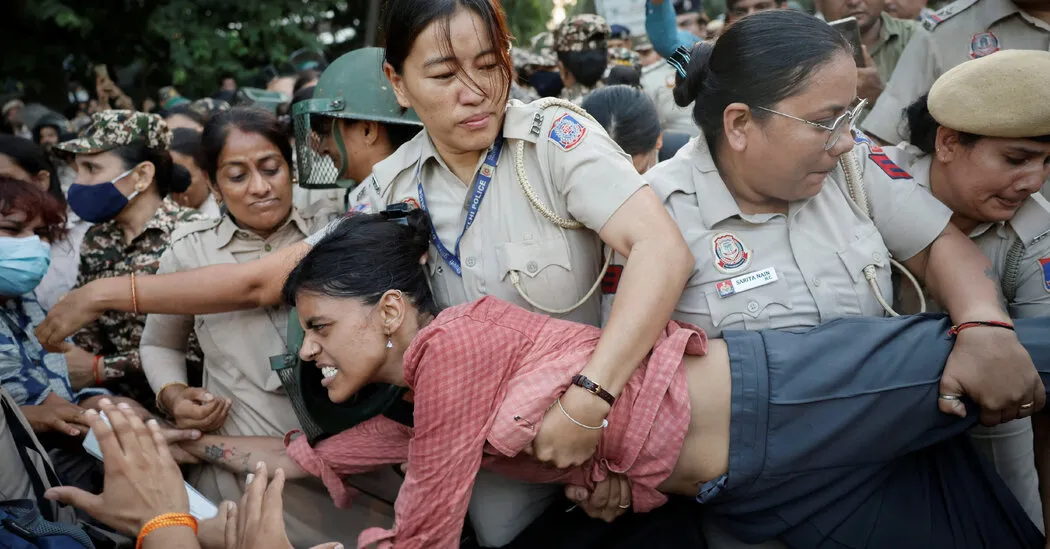
Public anger is turning into widespread protests, as evidence piles up that the exercise is disenfranchising parts of society seen as less likely to support Mr. Modi’s ruling Hindu nationalist party. India’s 200 million Muslims appear to have been disproportionately targeted.
Protesters are calling for the resignation of Gyanesh Kumar, the chief of the election commission, a body that was long held in high regard for running relatively fair polls in a region with a history of coups and autocratic governance.
“The heart of our democracy, which is the right to vote, is at great peril,” Rohinton Nariman, a former solicitor general of India and a supreme court judge, said in a lecture last week.
The exercise, which began last summer in one state before being expanded to every voter in the country, has struck the biggest blow to election integrity in India’s more than seven decades as a republic, former Indian polling officials and analysts say. The anger is intensifying on the back of recent revelations that officials within the election commission and the Supreme Court have expressed reservations about the revision.
“The entire approach has changed from making the rolls inclusive,” Ashok Lavasa, a former election commissioner, said. “The effort, and the priority, seems to be getting rid of people on the slightest pretext.”
While previous revisions of the voter roll focused on “physical verification, door to door” to make sure that every citizen was included, he said the current process puts the onus of proof entirely on citizens and otherwise excludes them. That leaves a large section of the electorate at the mercy of algorithms and mistakes in old records that could largely be clerical errors, he said.
To be sure, inaccuracies in the voter roll, which included about 970 million names before the recent revisions, have long been a fixture in a country where tens of millions of people are on the move for work, enabling abuses by some. But the list is routinely updated before every local and national election, and public faith in the electoral system was strong enough that the impact of the remaining discrepancies was believed to be marginal. Mr. Modi won three terms in office through elections based on the voter roll before the nationwide revision, and his Bharatiya Janata Party flourished.
The sudden discovery and deletion of over 20 million dead people and 90 million others categorized as “absent, shifted, and others,” has cast doubt about the integrity of previous elections or raised suspicion about the ruling party’s intentions for upcoming ones, analysts and opposition leaders say.
Since a weaker showing in 2024 national elections, Mr. Modi’s party has strung together a series of wins at the state level, including flipping one large state that it had never won based on a revised voter list. The next national election is in 2029.
Election commission officials did not respond to multiple requests for comment. Leaders of Mr. Modi’s party have rejected the uproar as fomented by a struggling opposition, which had earlier asked for similar revisions.
“If political parties themselves have repeatedly demanded the removal of duplicate, bogus and ineligible entries in the past, why should the election commission’s effort to clean and update electoral rolls now be portrayed as inherently suspect?” said Pratyush Kanth, a spokesman for the party.
A Burdensome Process
Two senior officials who would talk about the governing party’s strategy only anonymously said the process was aimed at entrenching its electoral advantage. The officials asked not be named for fear of retribution.
One of them said the intention was purely political: to use the party’s vast local machinery to flag people to local authorities for deletion. But the effect, he said, had been limited in India’s federal system because not all local officials were beholden to the B.J.P.
The other official said making gains in recent elections was secondary to a larger ideological objective: implementing an effort by the Hindu right to weed out large numbers of Muslim illegal immigrants, something it had failed to achieve through an earlier attempt at citizenship tests.
A pilot citizenship registration project in 2019 flagged an even larger number of Hindus as lacking documents, halting the exercise. Using the election commission to carry out a similar effort allows the ruling party deniability while achieving the same goal of blocking political participation by Muslims, the official said.
The argument is supported by public rhetoric from leaders of Mr. Modi’s party who have defended the revision exercise as weeding out “infiltrators” — a term that ostensibly means migrants from Bangladesh but has increasingly been deployed to refer to all of India’s Muslims.
Analysts and former election officials say the authorities are asking people to verify their voting rights with documents that prove citizenship. Many people in India — Hindus and Muslims alike — struggle to produce such documents because record keeping is poor, and many people lack even birth certificates.
There has been no strong evidence that the revision exercise has found a substantial number of foreigners. Leaders of Mr. Modi’s party have nonetheless declared that those deleted from the voter roll will be denied welfare benefits meant for citizens.
India’s poorest citizens are forced to chose between multiple visits to polling officers and earning a daily wage.
“I am standing in front of them. I will bring my entire family also to stand in front of them. They can see for themselves that we exist,” said Nanhe Lal, 43, a toy store worker in Delhi who was on his third visit to a voter center with documents to prevent the deletion of their names.
His employer kept calling to ask how much longer he would be away from his duties, he said.
Opposition parties say Mr. Modi is using independent institutions like the election commission to lock in his party’s advantage for years to come.
They say the groundwork had started years earlier. In 2023, Mr. Modi changed the composition of the committee through which election commissioners are appointed to tilt it in favor of the government. He also passed a law to give commissioners legal immunity.
Since then, the opposition parties have raised complaints over irregular additions and deletions of voters ahead of several state elections. But the election commission ignored their pleas to investigate even cases of “statistical abnormalities,” said Praveen Chakravarty, a lawmaker from the opposition Congress Party. Instead, the commission restricted the opposition’s access to things like machine-readable voter rolls and existing CCTV footage from polling centers, which would allow them to verify voting data, he said.
In the revisions, millions of people have been flagged by algorithms for “logical discrepancies” — a term that could include inconsistencies from the spelling of a name to the number of siblings listed or the gap between the siblings’ ages.
Other people have been deleted from the voting roll based on forms submitted by third parties who dispute their existence.
In one constituency in the southern state of Karnataka, nearly 2,000 such forms were filed on a single day late last month, a review by The New York Times showed. Nearly half of those were filed by five individuals, and the voters they were disputing were overwhelmingly Muslim. Many of the forms were typed up with the target’s name, leaving only a blank space for the name of the person objecting to fill in by hand, which analysts said suggested an orchestrated campaign.
The Test Case
The election commission’s conduct in one state in particular has drawn particular scrutiny.
Mr. Modi’s B.J.P. had for decades fallen short of a majority in elections for the state legislature in West Bengal. It finally came to power in May, right after a voter roll revision that removed about nine million names.
India’s top court allowed the election to proceed, even though millions of people who had challenged their removals were still waiting for their cases to be heard. In about 100,000 appeals to have been adjudicated so far, a majority were found to be legitimate and ordered restored to the roll.
Leaders of opposition parties in West Bengal have argued in petitions to the Supreme Court that the number of deleted voters exceeded the margin of victory in 82 of the 207 seats won by Mr. Modi’s party, a number that tips the balance of power.
Officials appointed by the court cleared 1.6 million West Bengal voters to be restored to the roll, but the election commission has blocked their return by appealing against their inclusion, according to the commission’s own court filing. A recent investigation by an Indian newspaper found that two of the country’s three election commissioners had expressed outrage internally at the effort, which they said was done without their knowledge.
Mr. Lavasa, the former election commissioner, questioned why the body responsible for protecting voter’s rights “would implement a procedure which will deprive” them of it.