


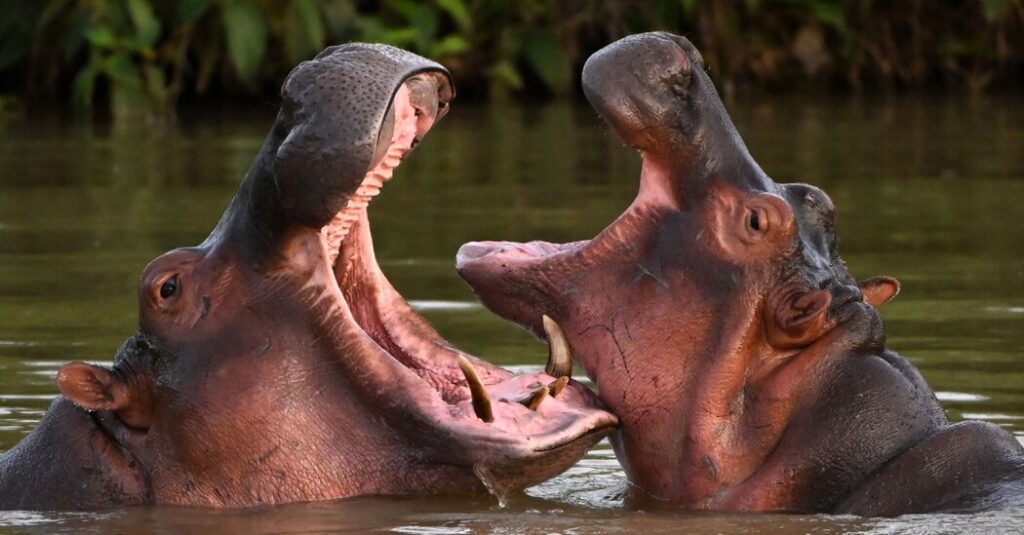
They are not known to have any taste for raw coca leaf. But the hungry hippos of Colombia’s Antioquia department have been rampaging through too much of the marshy flora that lines the waterways of the Magdalena River basin.
Colombia’s environment minister, Irene Vélez Torres, said that, left unchecked, they will keep procreating and destroy the local ecosystem: They are an invasive species from Africa, imported by Pablo Escobar, the world’s most notorious drug kingpin.
She released a proposal earlier this month to kill at least 80 of the animals later this year, after an effort to sterilize the herd, now about 200-head strong, proved disappointing.
Enter Anant Ambani, a scion of Asia’s richest family with a net worth greater than $100 billion. Alarmed by the proposed slaughter, he had his own private wildlife park in western India offer the hippos a new home, reflecting the “belief that every life matters and that we share a responsibility to protect life wherever possible.” It proposed a “scientifically led translocation” of the animals to Vantara, in Jamnagar, part of Gujarat state.
Vantara is a 3,500-acre wildlife sanctuary on the scrubby shoreline where the Ambanis have made a fortune operating the world’s largest oil refinery. Its critics in India call it a zoo. Mr. Ambani’s organization prefers the term “animal rescue, rehabilitation and conservation center.”
The project is so dear to him that his pre-wedding festivities in 2024, among the most eye-catching on earth, culminated in the boondocks of Jamnagar so that guests could be shown the grounds. Rihanna sang, while Mark Zuckerberg and other global CEOs and celebrities joined the party. Prime Minister Narendra Modi of India formally inaugurated Vantara a year later and Lionel Messi was brought in to participate in a Hindu ritual in December.
So Vantara — the name means “star of the forest” — should be a suitably star-studded home for globe-trotting hippos reared in a relatively flashy milieu.
The hippos were bought in the 1980s by Mr. Escobar. Riding high on the profits of the cocaine trade, Mr. Escobar stocked a zoo of his own on a secluded hacienda. The hippos found company among other African transplants like zebras and an ostrich.
Hippos are native to the wetlands of Africa and nowhere else. After Mr. Escobar’s death in 1993, their offspring were left to run riot.
Ms. Vélez, the Colombian minister and formerly an environmental activist, had emphasized that killing the hippos would be a last resort. Soon after the order was proposed, she took to social media to explain that six other countries had been approached as possible destinations for the feral hippos.
Mexico had seemed like a maybe, but could not import wild-born creatures because of its observance of the Convention on International Trade in Endangered Species (CITES). Ms. Vélez also mentioned an intriguing meeting at India’s embassy in Bogotá.
India’s government would have to be involved in Mr. Ambani’s mission of mercy, if it is to go through. Under the leadership of Mr. Modi, India has shown a daring for such ventures, not just to save lives but also with the idea of importing new species from faraway habitats.
Cheetahs, once endemic to India, were hunted to extinction in the early 20th century. With some fanfare, Mr. Modi oversaw an experiment to bring African cheetahs from Namibia to breeding centers in India in 2022, though many of them have died.
M.K. Ranjitsinh Jhala, a former chairman of the Wildlife Trust of India, said that, so long as the CITES rules are observed, if Mr. Ambani “wants to have a private zoo, then there should be no objection.”
But he took issue with the notion that Vantara, with its thousands of exotic animals, counts as a legitimate conservation project. “If it is a question of him being given a special status under India’s Wildlife Protection Act as a rescue center,” Mr. Jhala said, “then the country would like to know: How many animals which he has ‘rescued’ in India have been put back into the wild, in India?”
A spokesman for Vantara said that at least some of the Indian animals under its care have been returned to the wild, through its rehabilitation program. But most creatures raised by human hands or transported from their native habitats, can never be released, he said. They simply need a peaceful home.
Suhasini Raj contributed reporting.