


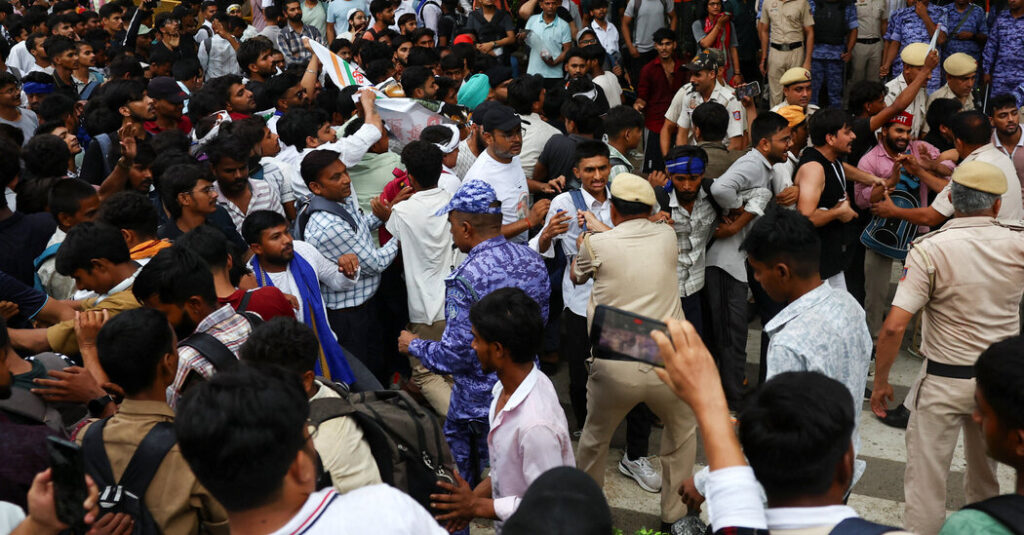
Thousands of protesters gathered in New Delhi to march to Parliament on Monday, demanding the resignation of India’s education minister after botched college entrance exams disrupted the lives of millions of students.
The protest, one of the capital’s largest in years, was met with road barricades and massed ranks of police officers after the authorities warned that the gathering was unauthorized. Officers at times fired tear gas and used batons to break up the crowds.
Public anger over the scandal has been simmering since May, when more than two million students who took India’s biggest entrance exam for medical school found out that the results would be scrapped because the questions had been leaked and that they would have to retake the test. Such leaks have become a frequent problem in recent years, and news reports in India that some students have died by suicide because of the stress have intensified the outrage. The movement has since grown into broader discontent over the failings of the Indian education system.
The march was an escalation of protests that began more than a month ago, gaining momentum over the weekend after the police forcibly removed Sonam Wangchuk, a prominent activist who had been on hunger strike for more than 20 days. The police said that they had moved him to a hospital for court-ordered essential medical care, despite opposition from his family and fellow protesters.
On Monday morning, crowds chanting slogans against the government of Prime Minister Narendra Modi poured into the Jantar Mantar area, the protest site not far from the Parliament. The streets around the area were jammed with mostly young people, many saying that they had come from other parts of India. They tried to push their way to the site through heavy barricades. In some areas, the police welded tall barricades together to stop the protesters from moving toward the Parliament.
“The apathy the government is showing us is shameful,” said Anshul Yadav, 20, who attended the protests on Monday with two friends. Mr. Yadav, who is studying for entrance exams along with his friends, added that they had the right to ask the government questions.
“The government should come talk,” he said. “Education is important.”
On Monday afternoon, J.P. Nadda, a senior member of Mr. Modi’s cabinet, met with leaders of the movement behind the protests. The movement’s leaders have issued three specific demands: the immediate resignation of the education minister, Dharmendra Pradhan; the discharge from the hospital of Mr. Wangchuk; and compensation for those students who died by suicide. Mr. Nadda promised to discuss the demands with the government, the protest leaders said in a statement.
Mr. Modi did not directly address the protests when he attended the opening session of Parliament on Monday.
Mr. Pradhan is seen as close to Mr. Modi, having played an important role in recent victories by his Bharatiya Janata Party, or B.J.P., in key state elections. The education minister has previously brushed the protesters aside, calling them “the B-team of terrorists.”
Angry Students
The protesters are demanding the resignation of Mr. Pradhan, whom they blame for doing little to fix an education system that can be corrupt, lax and inefficient. The latest instance — the cancellation of the entrance exams to medical school because the question papers were leaked and sold — was a prompt for Monday’s march, which drew thousands to New Delhi on a gray and muggy day.
Such tests can be a ticket to a better life, whether for a higher education or for a coveted government job. Many families sell land or borrow money to pay for private tutoring to give students a chance of success.
Priyam Dubey, 26, a doctoral student, said that he had been a student in 2024 when exam questions were leaked. After taking an entrance exam for a fellowship that could fund his graduate degree, he was told that it had been scrapped and that he had to sit for it again.
“I gave in the paper, it went really well and next morning when I woke up, the paper got leaked and they canceled the examination,” he said. “I didn’t want to prepare again.”
He said no one was being held accountable for what young people like him often go through.
Most of India’s mainstream TV news channels largely ignored the protests in the prelude to Monday, in the latest sign of Mr. Modi’s hold over the country’s broadcast media. But the students and activists flooded social media with Gen Z memes and livestreams.
As the crowds built up, the internet became inaccessible in the protest area. Some protesters received notifications from their telephone companies saying “as per government instructions, internet services have been stopped in your area till further notice.”
Sreelakshmi Sreevalsam, 37, traveled to Delhi from Bengaluru to “make things audible to the government.” Ms. Sreevalsam, a project manager at a fintech company, met up with two friends on Monday morning for the protests. “I want to be on the right side of history,” she said.
Bharati Ghosh, a B.J.P. spokeswoman, said on Sunday night that the police had arrested those responsible for the leaks and that the law would take its course.
“The B.J.P. government senses, understands and responds to its people. We are not sensing that the entire country is angry or frustrated,” she said.
Rare Dissent
The space for protest and dissent in India’s traditionally raucous democracy has shrunk significantly during Mr. Modi’s 12 years in office. His government has cracked down on dissent and put activists behind bars, creating a chilling effect on public opposition.
The protest was started by the Cockroach Janta Party, a grass-roots movement founded just two months ago that has come to symbolize the anger among India’s youth. It started in response to a rant by India’s chief justice that compared the country’s unemployed youth with cockroaches and parasites. In June, the party launched a protest demanding accountability over the series of exam leaks.
When the crowds filled the area around the protest site on Monday morning, the movement’s social media handles posted: “A flood of hundreds of thousands of cockroaches.”
Mr. Wangchuk, a prominent education and climate activist from the Himalayan region of Ladakh, joined the protest movement later and announced that he would go on a hunger strike until the education minister resigned. His wife, Gitanjali J Angmo, has appealed to the courts over what she has described as an illegal abduction of her husband.
On Monday, Mr. Wangchuk shared online a photograph of a letter that he had written by hand to the medical superintendent of the hospital. He said he was “feeling very fine today” and sought temporary discharge from the hospital so he could join the march to Parliament. He was denied permission
Anupreeta Das contributed reporting.