


Pakistan’s business owners are desperate for peace.
Ghulam Mustafa, a mango exporter, rushed containers of the plump fruit to the Pakistan-Iran border as soon as the United States and Iran signed a cease-fire agreement, brokered by Pakistan, last month.
But the truce has collapsed, the trucks have turned back, and Mr. Mustafa’s mangoes are rotting.
“We’re sending our products, and we don’t know whether they’ll cross or get stopped,” Mr. Mustafa said.
I spoke to him on a recent morning in his office as he watched videos from his driver showing boxes full of spoiled fruit that never reached their Iranian buyers.
For him and other business owners in Karachi — Pakistan’s largest city and its commercial hub — the economic stakes of an end to the war in Iran are high. Peace would mean not just lower fuel prices but also a chance to finally take advantage of the huge trading partner right across the 565-mile border.
The Pakistani economy is struggling and heavily reliant on foreign lenders like China and Saudi Arabia. A nation of 250 million people, Pakistan has four neighbors but doesn’t formally trade with two of them, India and Afghanistan, because of ongoing tensions. Investments from the third one, China, are down nearly 30 percent this year.
Traders and entrepreneurs had pinned their hopes on better relations with the fourth, Iran.
“The situation is very urgent for Pakistan,” said Kaiser Bengali, an economist based in Karachi. “We subscribe to loans to pay back old loans. Any relief from any side will be welcome.”
Both governments have pledged to boost trade. This week, Iran’s interior minister, Eskandar Momeni, led a delegation to Islamabad, Pakistan’s capital, that included the governor of Iran’s border province, the head of the national oil company and top Iranian officials in transportation, agriculture and urban development.
But many among Karachi’s powerful and influential industrialists are feeling disillusionment and alarm.
Yasmin Dadabhoy, whose business specializes in construction materials and energy, briefly considered a trip to Iran for construction deals during the cease-fire.
Ms. Dadabhoy said the mood at the time was, “Business will be back, sunshine and rainbows, reconstruction and everything.”
“It ended in a blink of an eye,” she added. “Now there’s bombing everywhere.”
Like many Pakistanis, Ms. Dadabhoy praised the country’s government and military leadership for their efforts, but she said the United States and Iran should sit down for talks again.
“The big boys need to settle things down fast,” she said.
Spoiled Fruit, Soured Hopes
It’s not only Mr. Mustafa’s mangoes that are stuck at the border. Rice and textiles from Pakistan, and oil and steel from Iran, are moving in a trickle. Traders and business owners say smuggling of oil and essential food products is still going on, but that, too, has become more difficult and expensive because of the war in Iran and attacks by armed groups in Pakistan’s border province of Balochistan.
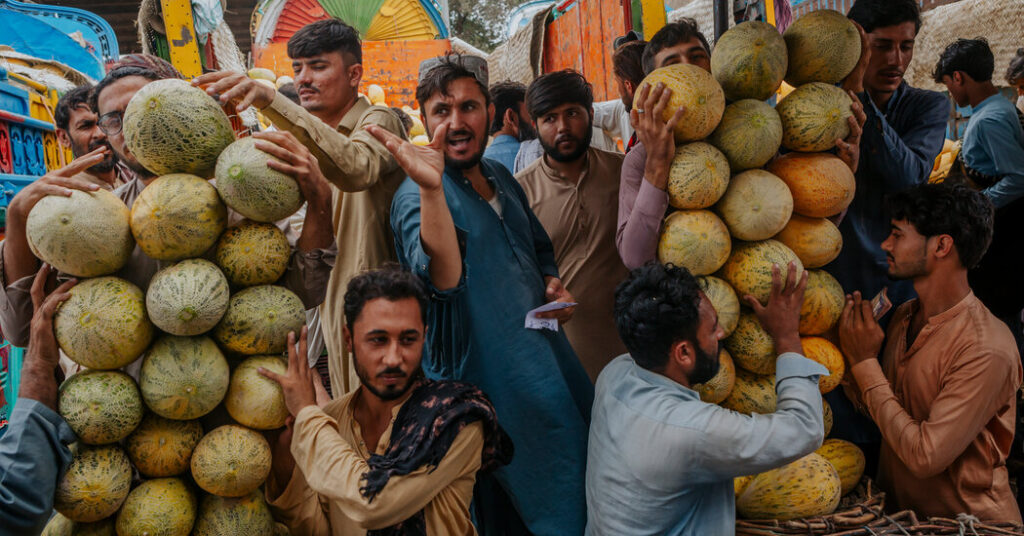
Pakistan’s mangoes, a source of national pride, brought in $110 million in export revenue last year. But the country’s main trade association for fruits and vegetables has slashed this year’s export target by nearly 30 percent because of declining yields and rising freight costs, which have doubled by air and increased almost sixfold by sea.
With fruits rotting at the border with Iran, traders have cut prices by half and sold them at auctions.
They are getting impatient, too. Pakistan’s top leaders, Prime Minister Shehbaz Sharif and the army chief, Field Marshal Asim Syed Munir, earned some praise domestically for hosting the first meeting in decades between top U.S. and Iranian officials in Islamabad in April, and later for helping broker a cease-fire between the two countries.
But that good will may have already been spent.
“The leaders are showing off,” said Afzal Khan, a wholesale trader selling mangoes in Karachi. He added that the moniker “Showbaz” was circulating widely — a play on Mr. Sharif’s first name, reflecting the view that his role was more performative than substantive.
“The solution is in the hands of Mr. Trump,” said Aitbaar Ali Syed, a fruit and vegetable exporter based in Karachi. “If he wants, he can solve all these problems.”
Spooked by Sanctions
Pakistani business owners dealing with Iran say U.S. sanctions have hampered their quest to expand trade.
Decades ago, Shahid Hamid Jafri’s father traded textiles for rugs from Iran. These days, Mr. Jafri deals mainly in Pakistan’s critical minerals and exports only a trickle of Pakistani rice to Iran. (Essential items like food are not subject to sanctions.) With full access, he said the Iranian market would have “huge, huge potential.”
Officially, Pakistan and Iran trade is about $3 billion — much less than the $5.4 billion in goods that Pakistan exported to the United States last year.
But Muhammad Rehan Hanif, the president of Karachi’s Chamber of Commerce and Industry, said that when Iranian business owners visit the chamber, the two sides struggle to discuss anything concrete because of sanctions.
“When banks read the word ‘Iran,’ they get spooked,” said Asfandyar Khan Mandokhail, who’s with a major Pakistani trade organization.
If not for sanctions, traders say, Pakistan could increase its supply of maize, rice, textiles, pharmaceutical products and surgical equipment to Iran. Iran could supply fuel and gas much more cheaply to Pakistan than Saudi Arabia and other countries in the Gulf.
Instead, for most trade, Pakistan and Iran must rely on barter, third-party routes, like ports in the United Arab Emirates, and smuggling over land or by sea, which is widespread. There is no official data on the volume of informal trade, but it is estimated to represent billions of dollars.
“When you blend Iranian oil with a cargo coming from elsewhere, you cannot prove it’s Iranian,” said Mahmood Moulvi, the chairman of a major shipping company that trades rice and cooking oil with Iran, among other products. Describing how Iranian products reach Pakistan, Mr. Moulvi said it is nearly impossible for business owners to do so legally, so they use smugglers or route products through a third country.
Watching and Waiting
Formalizing trade by lifting sanctions, business owners say, would eliminate the expense and risk involved in paying smugglers, and they would be able to sell a wider variety of Iranian consumer products, from watermelon to whipped cream or sweets.
Today, even the trade in smuggled goods appears to be drying up.
One morning last week, I wandered the alleys of a market in Karachi that once sold a wide variety of Iranian sweets. Only a handful were available: Iranian-made copies of Snickers bars, called Stunner, and Oreo cookies, called Bisoreno.
Imports of smuggled oil have been cut by half as well, said Tariq Hasan, the vice chairman of Pakistan’s main petroleum lobbying group.
A gas pipeline project to link the two countries has also stalled because of U.S. sanctions; Iran has completed construction, but Pakistan hasn’t started its portion.
Along with the chance to legalize and increase imports of Iranian oil, analysts and business owners say the big prize for Pakistan would be a chance to be involved in the postwar reconstruction of Iran.
Ms. Dadabhoy, the construction executive, noted that Pakistan had the workers and the construction materials Iran would need.
“We are playing watch and wait, because with uncertainty entrepreneurs don’t venture out,” she said.