


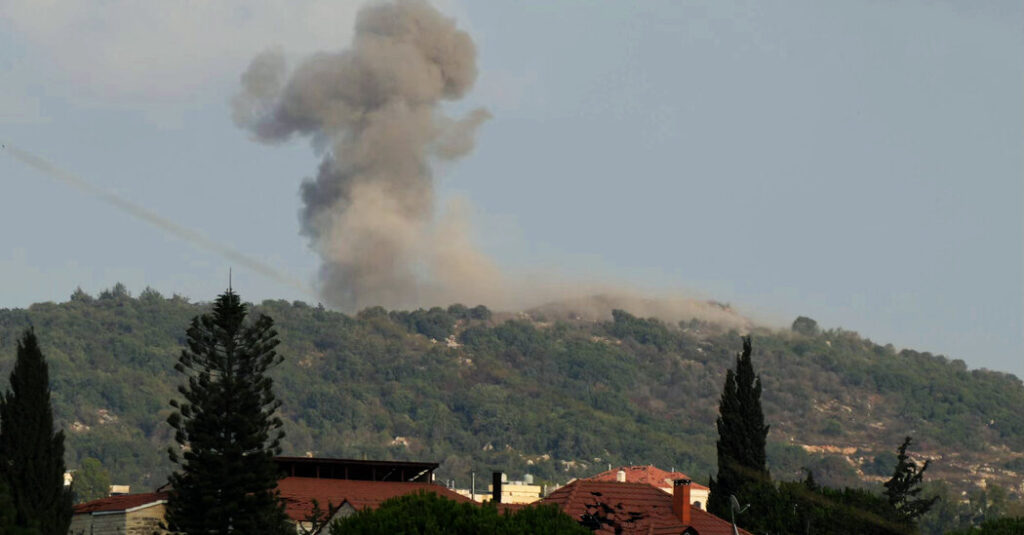
The Israeli military said on Thursday that it had cleared Hezbollah militants from two tunnels leading to a fortress strategically located beneath the hills of southern Lebanon and would “neutralize” the underground complex that it said had long been used by the Iran-backed group to launch attacks against Israel.
The ridge, called Ali al-Taher, is about six miles from the Lebanese border with Israel. The Israeli military said that its soldiers had worked to clear two underground routes in the ridge area and that some militants inside the complex had been killed or had fled.
There was no immediate comment from Hezbollah, the militant and political group, or Lebanese officials.
The Israeli operation threatens to exacerbate tensions with the Lebanese government and military, which have struggled to minimize Hezbollah’s sway, and could test a cease-fire agreement between Israel and Lebanon that Hezbollah was not a party to. Israel’s announcement on Thursday could also stress its relationship with its closest ally, the United States, which brokered the truce with Lebanon, and heighten tensions with Iran.
The operation began in June, with thousands of Israeli troops surrounding the Hezbollah fortress and trapping dozens of militants inside, according to the Israeli military. The operation, which the military said was still ongoing, comes as fighting between the United States and Iran has flared anew in recent days and as hopes for a negotiated peace between those two countries has receded.
On Thursday, Iran warned the United States in a message via Oman, which has mediated between the two countries, that Israel’s capturing the strategic ridge would cross a red line. Iran also said that, if the offensive continued, it would retaliate forcefully, according to an Iranian official and a member of the country’s Islamic Revolutionary Guards Corps.
The officials, who asked not to be named because they were discussing sensitive issues, said that the area had tunnels where Hezbollah stored critical weapons like rockets and drones, and that its main command center was underneath the ridge.
The official from the Revolutionary Guards, who said he had been in regular contact with Hezbollah members, said that about 70 to 100 Hezbollah members, along with Iranian advisers from the Quds Forces, were trapped in a tunnel in the Ali al-Taher area as Israeli forces encircled the tunnels.
The official added that Hezbollah had been trying for days to send food and water to its trapped soldiers using drones, but that when they emerged to retrieve supplies, Israel targeted and killed them.
The same official said that the complex had three exit routes and that two of them were under Israeli military control, while the collapse of the third was imminent. For Iran and Hezbollah, the priority had been to retrieve and save the weapons there, he said, but it seemed increasingly unlikely that would happen.
Some Israeli leaders have suggested any Iranian retaliation to the current operation would be an opportunity for Israel.
“An Iranian attack on Israel will free us from all constraints,” Israel Katz, the Israeli defense minister, said on Thursday in a speech. “We will strike all infrastructure, including energy infrastructure, and return Iran to the Stone Age and darkness.”
Benjamin Netanyahu, the Israeli prime minister, said on Thursday that he was convinced Israel could “remove the Iranian threat once and for all and bring down the Iranian regime, which is now fighting for its life.”
Clashes between the Israeli military and Hezbollah have continued all summer despite the cease-fire agreement with Lebanon. The Israeli military said in its statement on Thursday that it “remains committed” to the cease-fire agreement but that its soldiers “will continue to operate” in an area of southern Lebanon that borders Israel and that it deems a “security zone.”
Hezbollah began firing on Israel in solidarity with Iran in March — soon after the U.S.-Israeli attacks on Iran in late February that began the war — reigniting the intense fighting between them that had abated after a cease-fire deal in 2024.
In its negotiations with the United States, Iran made ending Israel’s offensive in Lebanon a crucial condition. The first provision in the Islamabad Memorandum of Understanding, signed by President Trump and President Masoud Pezeshkian of Iran, called for an end to “military operations on all fronts, including in Lebanon.” Israel, however, was not a party to those talks. And that deal fell apart.