


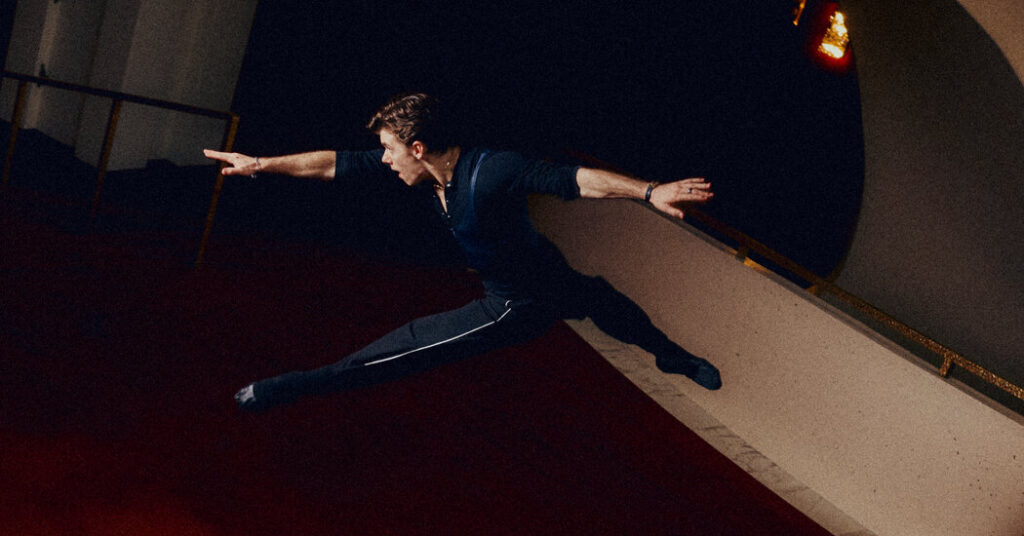
Jake Roxander was promoted to principal dancer with American Ballet Theater on Friday after his sparkling debut as Basilio in “Don Quixote.” He spun with sharp brilliance, and he leaped into the air like a beam of light. The audience lost its mind.
But Roxander, 24, didn’t start out this way. As a child, he spent hours at the barre of his parents’ ballet studio in Medford, Ore. Many of his ballet lessons, though, took place during long car rides home.
His father would ask how class went that day, and if it didn’t go well, Roxander would acknowledge what his parent already knew. “‘Yeah, you were talking a lot in the back,’” Roxander said in a video interview, recounting his father’s words. “‘You weren’t being very focused. You know who’s very focused, Jake? Captain America.’”
Roxander was, and remains, an ardent comic book fan — a Batman figure sits on a bookshelf in his apartment today — but he was not a disciplined student. “We talked about courage and bravery,” he said of conversations with his father. “We talked about Bruce Lee and how focused and quiet and accurate he could be. And we talked about always telling the truth.”
He and his older brother, Ashton (a principal with Philadelphia Ballet), grew up with the belief that if you’re not happy with where you are or how you’re dancing, you can change. “So many of my heroes are fictitious,” Roxander said. “Superhero culture is modern mythology. Those myths and those legends are to remind us of who we can be and who you are at your heart.”
His promotion, effective Sept. 1, was announced onstage at the Metropolitan Opera by Susan Jaffe, Ballet Theater’s artistic director. “He has distinguished himself with remarkable artistry and incredible charisma, fearless virtuosity and really an unmistakable, unique presence,” she said in an interview. “Everything that has been given to him, he aces it.”
That includes the role of Basilio, Roxander’s first lead in a three-act, full-length ballet. Effervescent, with powerful and refined dancing as well acting full of deft and subtle comedic timing, he was riveting.
His rise has been meteoric. After dancing with what was then Pennsylvania Ballet II in 2019, he joined Ballet Theater’s Studio Company. Sascha Radetsky, the artistic director of the Studio Company, spotted Roxander at a Ballet Theater summer program, which Roxander was able to attend because he was hosted in New York by the principal Thomas Forster and his wife, the former company member Leann Underwood. Then, in 2022, Roxander joined Ballet Theater’s main company. Two years later, he was named soloist.
“Without Tom and Leann,” Roxander said, “I don’t think any of this would have happened.”
So far, Roxander hasn’t really been able to process his promotion. “I’m in an ocean of hope, and I’ve been dragged to the bottom and scraped up my head pretty good a few times,” he said. “Then sometimes you end up on an island somewhere, and you’re like, how did I get here? What is life doing right now? But it’s like Dory says: ‘Just keep swimming.’”
In the interview, Roxander spoke more about his current state of disbelief and what brought him to this point. Here are edited excerpts from the conversation.
How surprised were you about your promotion?
I did not see it from a mile away. Then, yeah, lo and behold, I’m just trying to suck in the moment of taking a bow for my first full-length, three-act ballet, and Susan comes out, and I go, Oh my God. I’m trying to push her forward, and she’s holding me and dragging me with her. And then I see the microphone, and then my face just goes full, like, panic.
It really did. Susan Jaffe told me that before the show you thanked her for giving you this chance to dance Basilio. Why?
I’m a dancer not a lot of people would see wearing white tights and doing a classical ballet or playing a prince. I’m maybe 5 foot 9 inches. They could say, “You’re going to be Mercutio or Benno for the rest of your life.” Having Susan give me these opportunities to grow and learn and become more is all I’ve ever wanted. It’s such a short career, and it’s so amazing to be given the repertoire to really grow. There is such a friendly competitive energy, but it is just that — so friendly.
What’s an example?
The other day I told Takumi Miyake, “You and I could have so easily butted heads and been against each other.” I was not going to let that happen. We have just pushed each other further and further into our careers, and it’s nothing but fun and support. There’s nothing about it that feels negative. Niki Lauda needs his James Hunt. I’m a Formula 1 fan.
Why is that so important?
We really help each other, and that just makes a debut like this so much easier. I dance my best when I’m joyous. I can dance well when I am angry and when I have something to prove, but there is no comparison to when I’m dancing out of just joy for the game.
Did you grow up in an artistic environment?
It was celebrated to be creative. I’m an artist, my brother’s an artist, my dad’s an artist. My brother and I are publishing a graphic novel. That’s kind of what we want to move on to after this ballet career of ours. But I did taekwondo. I did swimming. I did gymnastics. I did all of those things. I was an extremely undisciplined, emotional little kid.
How so?
I would throw tantrums when something didn’t work. As I’ve gotten older and worked on that, I feel a little bit more like the dancer where you could hit me in the head with the baseball bat, and I would say: “Hi, good morning. How are you?”
When did you fall in love with ballet?
I realized how magical it could be. I remember being in third or fourth grade, and on “What is your dream?” I wrote, “I want to be a principal dancer with American Ballet Theater just like Baryshnikov.”
How did you end up in New York?
One week in Pennsylvania Ballet II, everything changed for me as a person and as a dancer. My girlfriend broke up with me. That was a first. That was a little confusing. And then my best friend at the time, Lochlan Brooks, who was in [the Jacqueline Kennedy Onassis School at Ballet Theater] killed himself. And then there were some talks with artistic in Pennsylvania that made my job feel a little in jeopardy. My world flipped upside down.
How did you get through it?
I interpreted that as life, God, the universe — whatever you want to call it — challenging me and testing me. And I was going to pass the test. Because of those car rides home, it was instilled in me that it’s not the event that matters. It’s what you interpret the event to mean that matters.
How did it change you?
That dramatic kind of tantrum-throwing, emotional little boy that I once was left me. By the time that Sascha got me into Studio Company, I had a no nonsense, no complaining, “don’t stop when you’re tired, stop when you’re done” mind-set. It was a life-altering experience, but I had the tools instilled in me to fight through it. And that’s something I just try to keep and stay true to.