


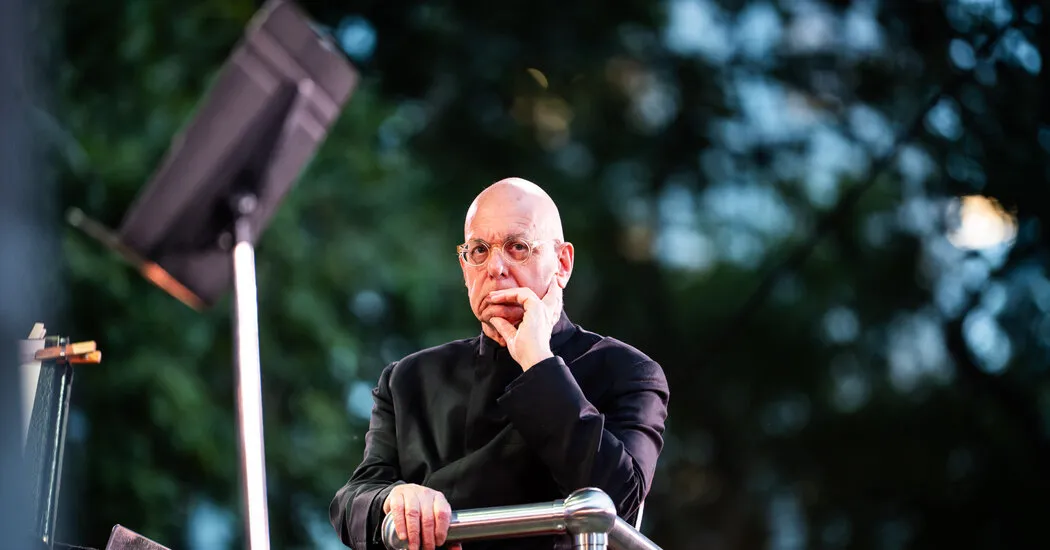
As dusk settled over Bryant Park, the conductor Leon Botstein walked slowly across the stage, settling into a stool in front of the American Symphony Orchestra. The crowd sprawled across the lawn on this late-summer evening did not seem to notice that he had taken his position. Mr. Botstein raised his baton and started a performance of Copland’s “Fanfare for the Common Man,” competing with police sirens and the whine of passing buses.
Nearly 80 minutes later, Mr. Botstein, with a wave and a suggestion of a smile, walked off the stage to respectful applause.
For Mr. Botstein, this warm reception may prove little more than a brief moment of respite. After a half-century as a prominent figure in academia and music, Mr. Botstein, 79, was forced to retire in June as the president of Bard College, a post he had held since 1975. That came in the face of detailed revelations in Justice Department documents about his longstanding friendship with the convicted sex offender Jeffrey Epstein, including a visit by Mr. Botstein to Mr. Epstein’s island retreat and exchanges of friendly notes, even after Mr. Epstein’s conviction on solicitation of a minor for prostitution. Mr. Botstein has said his dealings with Mr. Epstein came as part of his efforts to raise money for Bard.
The college’s independent review of the case, conducted by the law firm WilmerHale, found that Mr. Botstein had done nothing illegal but said that his relationship with Mr. Epstein raised concerns about his leadership. “In his public statements and his statements to the Bard community, President Botstein minimized and was not fully accurate in describing his relationship with Epstein,” the report found.
But Mr. Botstein, embattled and polarizing, has held on. He has continued to teach at Bard, the liberal arts college 100 miles north of New York City. (He is on sabbatical now to complete a book on Mahler.) He remains the artistic co-director of the Bard Music Festival and runs The Orchestra Now, the graduate-level program for musicians at Bard. He leads the American Symphony Orchestra, the resident orchestra for the Bard festival. And he continues to live at the official college home for the president, while the college finishes renovating an off-campus home for its former president. College officials said he was being provided housing in part as recognition of his long service to Bard.
Mr. Botstein’s decision to hang on in such prominent positions, with the support of the college, has caused distress in many quarters of the campus community.
Current and former staff members of the Fisher Center for the Performing Arts, founded by Mr. Botstein in 1990, signed an open letter to the Bard board of trustees saying that Mr. Epstein had “instilled a broad sense of distrust in Botstein’s ability to be an effective, transparent leader in any capacity at the College.”
The letter noted that Mr. Botstein had agreed to step down, but — in a plea that was by all appearances not heeded — asked that the board “not further engage Leon Botstein in any contract related to music and performing arts activity at Bard College.”
Moira Donegan, a columnist for The Guardian who was an undergraduate at Bard, said in an interview that “Botstein’s ongoing connection to Bard reflects the institutional values of the college, which has shown throughout this saga that it prizes Botstein’s cult of personality over the safety and dignity of women students.” (Ms. Donegan was the creator of an online spreadsheet from October 2017 that allowed women to list men in the media industry who they accused of sexual misconduct.)
Mr. Botstein declined a request for an interview on the advice of lawyers, who are representing him in a House Judiciary Committee inquiry, led by its ranking Democratic member, Jamie Raskin of Maryland, into Mr. Epstein’s dealings with Bard and Mr. Botstein. But in a lengthy written statement to The New York Times, Mr. Botstein made clear he has no intention of moving to the sidelines, asserting he had much to offer the college and the world of classical music.
“Bard has been my professional and intellectual home for six decades, and its success will never stop mattering to me,” Mr. Botstein said. “My continuing involvement is about completing and keeping alive musical and artistic projects that are unique and contribute to Bard, and to the economy and life of the Hudson Valley as well as to the broader world of the arts.”
“I wish I’d never met Epstein,” the statement continued. “I did not know then what a monster he was.” He said he was driven to befriend Mr. Epstein by “my urgent responsibilities to raise resources for an institution committed to the arts that was struggling to find donors who claimed to be interested in supporting the arts.”
Asher Edelman, an American financier who is a member of the school’s board of trustees and a longtime friend of Mr. Botstein, said the criticism minimized what he described as Mr. Botstein’s career of building Bard as a cultural force in central New York.
“They are lucky he’s around,” Mr. Edelman said of Mr. Botstein’s critics. “They wouldn’t have that school around if he hadn’t been around. They should kiss his feet. They are in a place that is extraordinary and it’s only because of him.”
Bard is now in a difficult position as it searches for a new president and close what has been a divisive and embarrassing chapter for a distinguished college, even as Mr. Botstein remains active on campus. For now, the school is in limbo; Bard officials said a new president was not expected to be in place until the beginning of 2028.
“The last six months of the academic year were a challenging time on campus,” said Jonathan Becker, the acting president. “Many people have different views on what happened and might have happened. I think what’s most important right now is everyone is forward looking. We are just moving on. I am trying to restore normalcy.”
“He has a very minor footprint on campus,” Mr. Becker said of Mr. Botstein. “I’ve seen him once since I became acting president. He’s not been a visible presence on campus.”
Before the revelations about his entanglement with Mr. Epstein, Mr. Botstein was renowned for how he had elevated Bard College and for being a promoter of off-the-beaten-track classical music, with the summer music festival and the American Symphony Orchestra. At the Bryant Park concert, a performance honoring the anniversary of Sept. 11, he conducted George Walker’s “Lyric for Strings” and Charles Ives’s “The Gong on the Hook Ladder.”
His inventive programming of the summer festival is one reason it gained so much attention; in much of the classical music world, Mr. Botstein is better regarded as a curator than as a conductor.
“The Bard Music Festival is our football team,” said Christopher Gibbs, who is the festival’s artistic co-director with Botstein. “That is something that has brought a great deal of attention to the college.”
“A lot of people are sophisticated enough to know that fund-raising can be a nasty business, and you take risks,” he said. “But when it comes down to what we are doing with music here, people understand that it was through Leon’s fund-raising that they are sitting where they are sitting and seeing what they are seeing.”
Mr. Botstein, in his statement, said that at this stage of his life, and with the arts “under assault both politically and financially,” his work was as important as ever.
“I am particularly conscious that I do not have an unlimited amount of time in which to do this work,” he said. “I am not oblivious to the actuarial tables or to the real-life reminders, including the recent death of my older brother, that time is not on anyone’s side. There is a humility that comes with recognizing that the runway is getting shorter.”
Yet his view of his future at the college is not shared with many of his colleagues these days.
Karen Painter, a professor of musicology at the University of Minnesota who has worked at the Bard festival, said the school needed to sever all its ties with Botstein, given his history of dealings with Epstein. “It’s time to move on,” she said.