


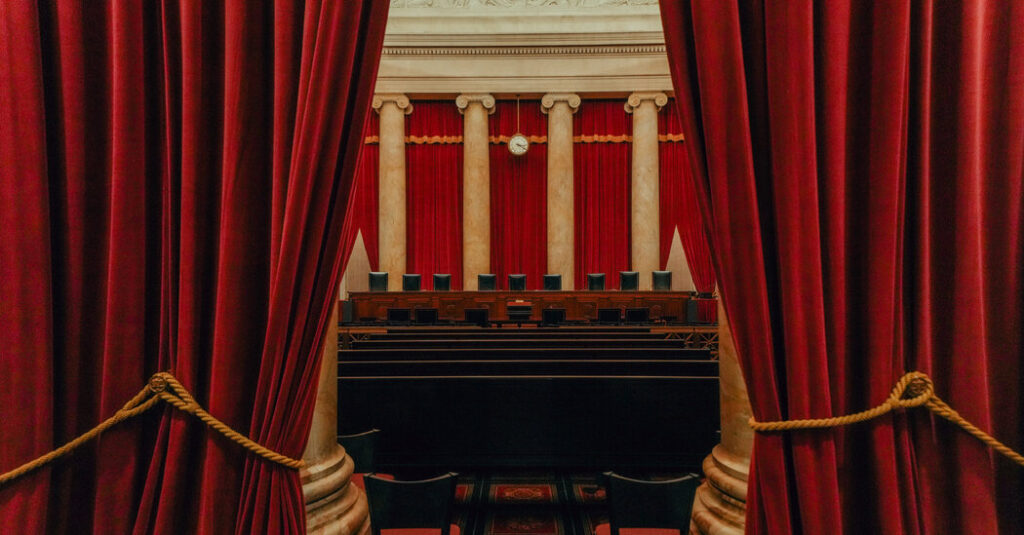
The Supreme Court is mulling whether to create a screening facility outside its courthouse as a security measure. Money to begin planning for such a facility is included a budget proposal that Justices Amy Coney Barrett and Elena Kagan will testify about on Tuesday before two congressional subcommittees.
Off-site screening would be a modest step compared with the court’s 2010 decision to close its front doors to visitors, also on security grounds.
That move, ripe with symbolism, divided the justices and prompted an unusual dissenting statement from Justice Stephen G. Breyer. “To many members of the public,” he wrote, “this court’s main entrance and front steps are not only a means to, but also a metaphor for, access to the court itself.”
Until 2010, people with cases before the court, their lawyers and those who just came to see the arguments could climb the grand steps arrayed in front of the courthouse’s marble columns, pass under the inscribed words “Equal Justice Under Law” and walk through a passage flanked by two six-ton bronze doors that depict historic scenes in the development of the law.
Chief Justice John G. Roberts Jr., who was once an accomplished Supreme Court lawyer, recalled that journey when he was nominated.
“I always got a lump in my throat whenever I walked up those marble steps to argue a case before the court,” he said. “And I don’t think it was just from the nerves.”
These days, visitors enter on the ground level, under the stairs, in what the court said in a 2010 announcement was “a secure, reinforced area to screen for weapons, explosives and chemical and biological hazards.”
In his statement, Justice Breyer, who supervised the design and construction of a new federal courthouse on the Boston harbor as an appeals court judge and has served since 2011 on the jury that selects winners of the Pritzker Prize, architecture’s highest award, said that security concerns did not warrant the closing the front entrance.
“To my knowledge, and I have spoken to numerous jurists and architects worldwide,” he said, “no other Supreme Court in the world — including those, such as Israel’s, that face security concerns equal to or greater than ours — has closed its main entrance to the public.”
Justice Ruth Bader Ginsburg, who died in 2020, joined the statement from Justice Breyer, who retired in 2022.
Justice Breyer noted that visitors would still be allowed to exit through the front door. He added that “the main entrances to numerous other prominent public buildings in America remain open.”
“I thus remain hopeful,” he said, “that, sometime in the future, technological advances, a congressional appropriation or the dissipation of the current security risks will enable us to restore the Supreme Court’s main entrance as a symbol of dignified openness and meaningful access to equal justice under the law.”
Things seem to be moving in the opposite direction. In its budget request to Congress, the court cited a security assessment recommending that the “screening of visitors should occur exterior to the Supreme Court before entering the building’s main vestibules.”
Ann E. Marimow contributed reporting.