


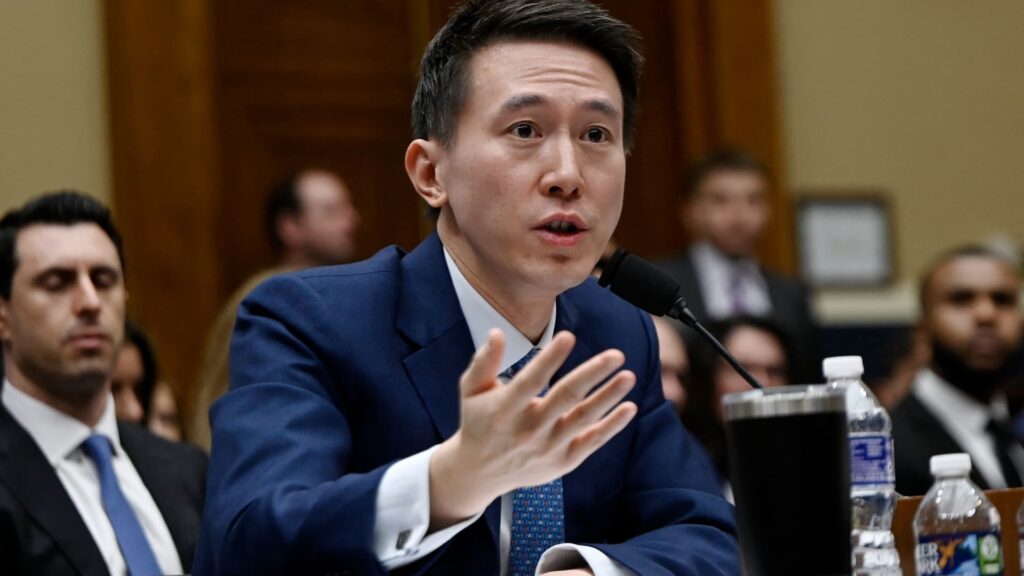
SINGAPORE — TikTok CEO Shou Zi Chew expects artificial intelligence to drive major scientific breakthroughs within the next three years, transforming a broad range of sectors.
„In the next two to three years, we’re going to have a real scientific breakthrough: physics, biotech, chemistry, material science, because of AI. It’s very, very, very possible,“ Chew said at the DBS Asia Future Forward Conference in Singapore on Monday.
Chew’s remarks come as ByteDance, TikTok’s Chinese parent, expands its artificial intelligence research beyond consumer applications. In April, the company’s Seed research team unveiled Protenix-v2, an AI model focused on biomolecular structure prediction and design, with potential applications in drug discovery.
Chew said rapid advances in AI were opening up possibilities far beyond the technology’s current applications, even as questions remain over how to ensure increasingly powerful systems operate within human ethical boundaries.
„If that happens, then you know the question would be: how do you align the models? How do you align the machines to be doing things that are obvious to us as human beings?“ he said.
Chew highlighted the accelerating pace of technological development, particularly in scientific research, arguing that the longer-term implications of AI could be far greater than currently anticipated.
„The trend is very very clear. It’s that we are only at the beginning of what artificial intelligence can probably do,“ he said. „And if you look at where the trend is, [where] the progress is, particularly in areas of science, it’s really trending on a very steep curve at this moment in time.“
Chew explained that while the technology’s immediate impact could be overstated, its longer-term potential remained underappreciated. „I think in the short term we are probably overestimating it, but in the long term we are probably underestimating it,“ he said.
His optimism comes at a time when technology giants have been pouring billions of dollars into AI-powered scientific research. Last week, the U.S. government, Meta and Google announced their participation in a $1.8 billion initiative to develop AI models capable of predicting how cells behave, in an effort to accelerate biological research and drug discovery.
TikTok’s parent company, ByteDance, is also developing its own AI models and exploring opportunities to collaborate with scientists on research.
„There’s an effort to see how we can collaborate with a lot of scientists to make some progress in science as well,“ Chew added. „There’s been some work that we’ve done in this area, and it is very exciting.“
He described scientific discovery as one of the most promising applications of AI, even as the technology increasingly reshapes TikTok’s operations, from content creation and recommendations to search and moderation.
Chew cautioned that AI’s growing capabilities would require stronger safeguards, particularly as autonomous systems become more widely adopted.
„I think the cybersecurity risks are quite big,“ he said, warning that users may grant AI agents extensive permissions without fully understanding the potential consequences.
He pointed to the risks of allowing AI agents to make purchases autonomously, saying the systems could end up buying more than users intended in their eagerness to complete a task.
Chew also highlighted the growing cybersecurity challenges facing companies, as increasingly sophisticated AI models make it significantly cheaper for malicious actors to carry out fraudulent activities.
„So you need the right tools to now you know defend against the fast falling cost of creating problems for platforms like us, security problems for us,“ he emphasized.