


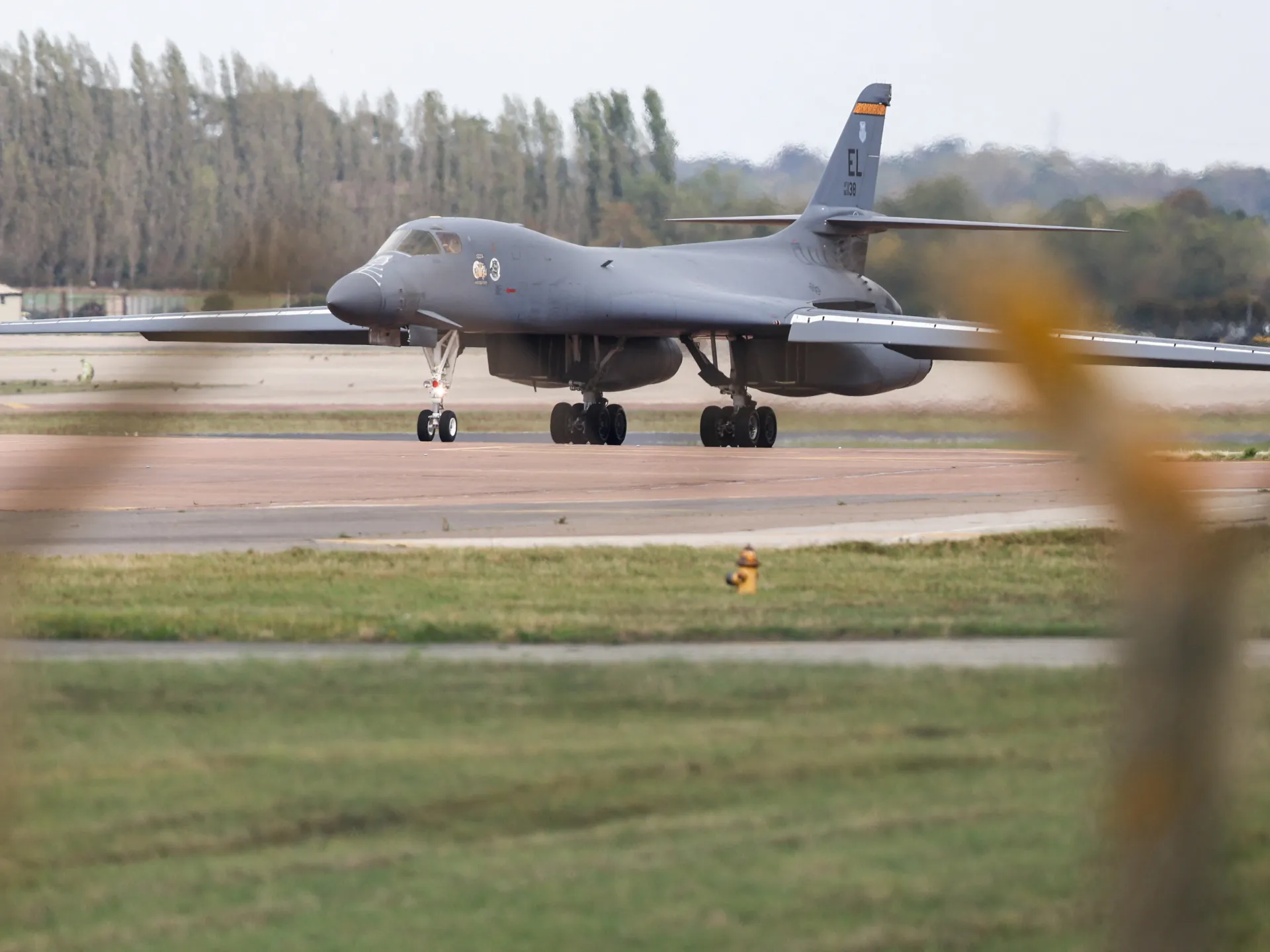
Over the course of Sunday, a dozen B-1B bombers took off from Royal Air Force (RAF) Fairford in western England and flew home to the United States. Their departure abruptly ended the base’s role as a launchpad for US strikes on Iran, which began on February 28.
The base, roughly 160km (100 miles) west of London, is the US Air Force’s only European airfield for heavy bombers and a key forward operating location for deployed bombers.
Over the past two weeks, six people were arrested on suspicion of “terrorism”. They were all released on bail.
US President Donald Trump said on Monday the bombers were moved because “there were some threats”, which he believed were linked to Iran. “So we moved them around a little bit, not very far,” he told reporters at the White House.
Hours earlier, US Secretary of State Marco Rubio played down any link to the alleged plot, saying it was “not unusual to see rotations happen” and that he had confidence in the security of US bases.
What happened at RAF Fairford?
On September 27, police arrested five men on suspicion of plotting to plant explosives near Fairford in the United Kingdom. They were released on bail a day later.
Investigators found petrol but no explosive devices in their vans, though UK officials say the men remain under investigation. On Thursday, police arrested a 25-year-old UK-Iranian dual national in London on suspicion of plotting an attack on the airbase. He was also released on bail on October 3.
UK Prime Minister Andy Burnham suggested that “Iran played a part” in the alleged plot but declined to give details. Iran has denied any such scheme and summoned the UK ambassador in Tehran in protest at the arrests.
What bombers does the US have?
The US Air Force flies three types of bombers, with a fourth on the way.


The B-52 Stratofortress is the oldest. The B-52H model currently in service was built in the early 1960s. With a wingspan of 56 metres (185 feet), it is the largest US bomber and can carry about 31 tonnes of weapons, including nuclear bombs and cruise missiles.


The B-1B Lancer, which entered service in the mid-1980s, is the fastest of the three. It can reach 1.2 times the speed of sound and has a swing-wing that sweeps back for high-speed flight. It carries the largest conventional payload, about 34 tonnes, but no longer carries nuclear weapons. These were the aircraft that left Fairford.
The B-2 Spirit is a flying-wing stealth bomber designed to slip past air defences. Only 20 were built, of which 19 remain in service. It can carry both nuclear and conventional weapons, including the 13,600kg (30,000lb) “bunker buster” bomb used in US strikes on Iran’s nuclear sites in June 2025.


The B-21 Raider, a smaller stealth bomber, is still in flight testing, and it remains on track for delivery in 2027. Over the next decade and a half, the air force plans to replace the B-1B and B-2, leaving a future fleet of B-21s and upgraded B-52s.

Where do these bombers fly from?
All US bombers are permanently based in the US, at five main airbases:
- B-52H: Barksdale Air Force Base in Louisiana and Minot Air Force Base in North Dakota
- B-1B: Dyess Air Force Base in Texas and Ellsworth Air Force Base in South Dakota
- B-2: Whiteman Air Force Base in Missouri
- B-21: Due to arrive at Ellsworth in South Dakota in 2027
All of these bases have long, wide runways, typically exceeding 10,000 feet (3,048 metres).
That makes bomber runways about as long as those at a big international airport. What limits where bombers can operate is not tarmac but security, weapons storage and support.
For missions abroad, the US rotates bombers through a handful of forward bases. Other important overseas operating locations include Andersen Air Force Base in Guam and Diego Garcia in the Indian Ocean.
Beyond these, the air force sends small groups of bombers to allied airbases for a few weeks at a time, in what it calls Bomber Task Force deployments. Recent rotations have included B-52s at Moron in Spain, B-1Bs at Orland in Norway and Misawa in Japan, and B-52s at Tindal in northern Australia, which arrived in September.
The bombers can also go on a strike mission from the US with the help of aerial refuelling. Bomber missions during the US-Israel war on Iran lasted more than 30 hours there and back. Each group of three bombers needed six to nine tanker aircraft to refuel them along the way.

