


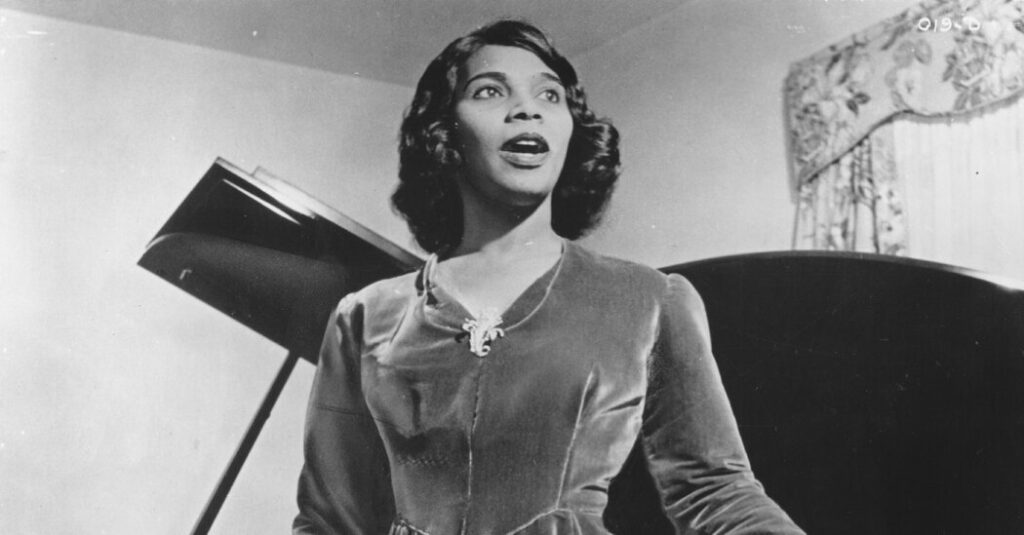
And, of course, her overwhelming accounts of spirituals, which W.E.B. DuBois called sorrow songs. Anderson ended every recital with a group of them, to demonstrate that they merited a place on any program of European art songs.
Today Anderson is surely best known for one short concert on Easter Sunday, 1939. After Anderson was barred from appearing at Constitution Hall in Washington by its owners, the Daughters of the American Revolution, because of her race, activists pushed to have her sing instead on the steps of the Lincoln Memorial, a concert broadcast live on national radio. Anderson, who had long been reluctant to speak out forcefully about segregation, was wary. As the date approached, she feared that this “affair,” as she called it, had morphed into a civil rights demonstration and would come to define her. To a large extent it has.
More than 75,000 people, Black and white, gathered before the memorial and around the Reflecting Pool. The cultural historian Scott A. Sandage has written that the modern civil rights movement “came of age” that day, noting that Anderson’s concert was “the first black mass action to evoke laudatory national publicity and earn a positive place in American public memory.”
It’s telling that the longest work she performed on this 30-minute program was “O mio Fernando,” a challenging, still little-known aria from Donizetti’s opera “La Favorita.” After opening the concert with “America,” she went right into the Donizetti, which had become Anderson’s unlikely go-to piece to demonstrate her vocal technique and dramatic flair.
This Italian aria must have mystified most of those in the crowd, and many radio listeners too. Anderson had sung to acclaim in the major halls and capitals of Europe. That day, with this seven-minute aria, she was going to show why she had become famous and wealthy. Newspaper reporters observed that many in the crowd, however uncomprehending, seemed mesmerized by Anderson’s brilliant singing of Donizetti’s music, replete with arching melodic lines, daring leaps, fleet runs, even a final trill.
In her letters and memoir (1956), Anderson reiterated that it was artistry that drove her as she pursued what, for a Black woman of that era, was an improbable career as a concert singer. In her early teens she had an epiphany about the nature of true artistry when the noted Black tenor Roland Hayes, 10 years her senior, sang a recital at her church. Hayes, who had studied and performed in Europe, included lieder, especially Schubert, on his program.