


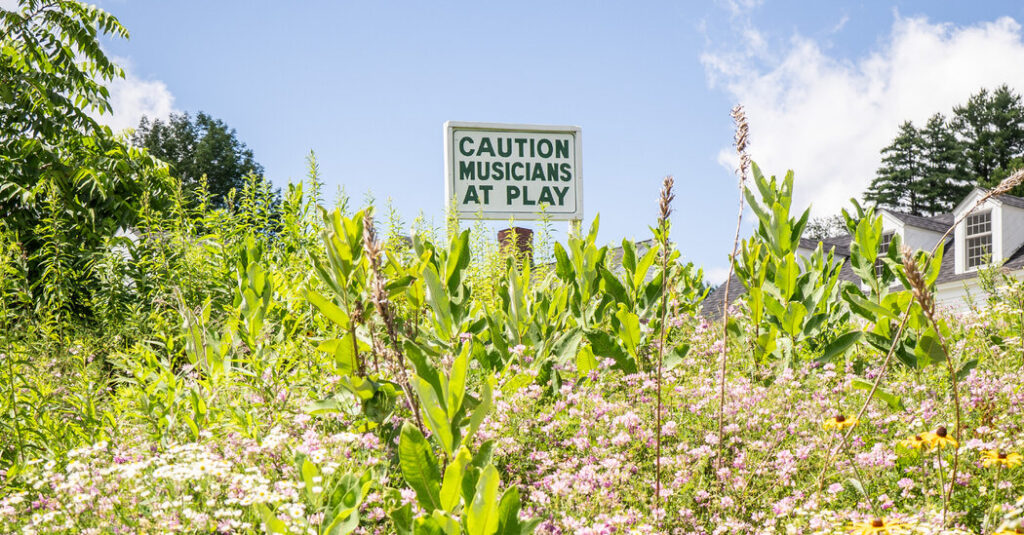
As you wind your way down South Road in the small Vermont town of Marlboro, past the community meeting house and the volunteer fire company, you pass two unassuming wooden signs signaling that the Marlboro Music Festival lies just ahead.
Those signs, elegant yet understated, seem to hint at something important about Marlboro: One of the world’s elite chamber music gatherings, it cuts a distinctly modest profile. And that’s the point. Marlboro, now in its 75th summer, has a venerable history that reaches back to its founding by some of the 20th century’s eminent musicians — chief among them the pianist Rudolf Serkin, who would remain its guiding spirit until his death in 1991.
The campus, on the site of the former Marlboro College in the foothills of the Green Mountains, is serene and unassuming. Plain white buildings, some bearing obvious signs of age, dot the bucolic grounds, and it was not unusual, in earlier years, to see sheep grazing as you wandered. Younger musicians, revered elders, families and festival staff all eat together in the dining hall, where napkin fights are common. During Sunday afternoon concerts, cups of lemonade and packets of gingersnaps are sold for $1 outside Persons Auditorium, with proceeds benefiting the Marlboro Historical Society.
That dichotomy, high-powered musical artistry and low-key surroundings, is central to Marlboro’s identity and to what has sustained it over the years. Participants think of it less as a festival and more as an idyllic retreat away from life as a professional musician.
“The core mission of the place, at least as I see it, has not changed,” said the pianist Jonathan Biss, who since 2019 has shared artistic director duties with the pianist Mitsuko Uchida. “Which is that Marlboro is, has always been and continues to be for people who feel that there is an infinite amount to be found in great music, and the job of a musician is to spend every day investigating, and hopefully ending the day just a little closer to the essence of that piece than you were the day before.”
Many of the festival’s traditions go back to its earliest years. Ensembles mix relative newcomers (“juniors”) with at least one musician who has deeper Marlboro experience (“seniors”). Everyone gets the opportunity to suggest pieces they’d be interested in rehearsing. When the musicians (78 this year) arrive in late June, they have no idea what they’ll work on for the festival’s seven weeks.
“In the real world, two and a half years from now, I know exactly what I’m playing where,” said Uchida, who has served in leadership roles at Marlboro since 1993. “And I hate that. Here, having the opportunity to explore with young people, you don’t know what will happen.”
The most important thing about Marlboro, musicians say, is that it removes the pressure of performance. Ensembles are free to rehearse and study as long as they wish. Pieces are considered for inclusion in Marlboro’s public concerts (a dozen this year, spread over five weekends) only if the players deem them ready. (The concert programming decisions are made by a committee that includes Uchida, Biss and other longtime seniors.) This means that of the works rehearsed each summer — between 200 and 250 — only about a quarter are ever heard by an audience here. It’s a deeply idealistic, almost romantic, notion of musical life.
“You don’t come here for performing,” said Arthur Stockel, the principal clarinet of the Luxembourg Philharmonic, who’s in his second summer at Marlboro. “You come here for rehearsing.”
I got a few glimpses of this intense orientation by sitting in on rehearsals last weekend. A quartet that included Stockel, the bassoonist Duncan Henry, the flutist Hannah Tassler and the violist Beth Guterman Chu was working on “Codex Seraphinianus,” by Marcos Balter, this year’s composer in residence. The piece, inspired by Luigi Serafini’s 1981 surrealist encyclopedia of the same name, is scheduled for performance this Saturday.
Before Balter arrived at a rehearsal, the quartet, which had already spent about 18 hours together on the piece, focused on tricky passages — getting one up to tempo, subtly shifting the tone color in another, trying to achieve a particular wavelike effect. Numerous solutions were proposed and tried for each issue, and someone asked whether they had time to try them all.
“Sure,” Chu said. “We have all the time we need.”
When Balter arrived and listened, he was delighted by the progress the ensemble had made. Apart from a few fine points and notes on movement transitions, “I have nothing to coach you on,” he said. “And we still have a week before the concert!”
“You should write us another piece!” Chu replied, to widespread laughter.
The outsize focus on study and exploration raises the question of whether Marlboro is, at heart, a festival or a school. Biss recalled a quip of Serkin’s that when the concerts were good, it was a festival and when they weren’t, it was a school. Biss comes down squarely on the educational side. “I love our audience,” he said, “but the reason we have concerts is because playing is part of the learning process for all of us.”
Not that the lavish preparation time doesn’t pay dividends in concert. In 2012, I went to a performance of Beethoven’s late Op. 130 String Quartet, with its original Grosse Fuge finale, that fused polish, insight and let’s-go-for-it audacity. It was perhaps the best Beethoven chamber music I have ever heard. A Marlboro representative told me that it had been rehearsed for 47 hours.
More broadly, the best Marlboro performances tend to have a searching, exploratory quality, as if the musicians were sharing a fresh discovery, even if it meant de-emphasizing more familiar aspects of the music. At the season-opening concert last Saturday, a performance of Mozart’s G-minor Piano Quartet that included Uchida exemplified this approach. I have heard this piece played with greater raw power and drama, but I’ve never heard its logical flow of ideas come off as so unerringly natural.
Marlboro’s inhabitants tend to talk about the place in unabashedly idealistic terms. But there are challenges. At times, there has been a tendency for the most senior musicians to impose their views even on experienced artists, despite the core tenet that artists “collaborate as equals.” The violinist Ida Levin, an outstanding musician, was once asked about her experience preparing the Brahms Piano Quintet with Serkin. “Terrifying,” she replied.
Given the often vast differences in experience, “the thing of us all being equal strikes me as slightly dishonest,” Biss said candidly, adding that the aim, rather, should be that everyone feel respected and encouraged to find their voice.
Still, he is intent on keeping Marlboro’s idealism intact, on detaching music from its practical constraints as much as possible while acknowledging that perfection will always be elusive. Last year, Biss said, a string quartet worked on Bach’s monumental “The Art of Fugue” all summer. It was never scheduled for performance, so, one night during the last week of the festival, the group decided to play it in the dining hall for whoever happened to be around.
“I thought it was fantastic, and I also felt like they barely scratched the surface,” Biss said. “I think that often, in real life, we turn off that feeling in self-defense because it’s too frustrating otherwise. You rehearse a concerto one and a half times, and then you play it. You just accept that if there’s the broadest agreement on the contours of the piece, that will have to do because there is no other way. But it’s nice to be able to acknowledge that there is so much more to be done.”